Up go the barricades as universities voice anger at Sarkozy
Lecturers and students accuse French President of ‘ultra-capitalist’ attempt to privatise education system
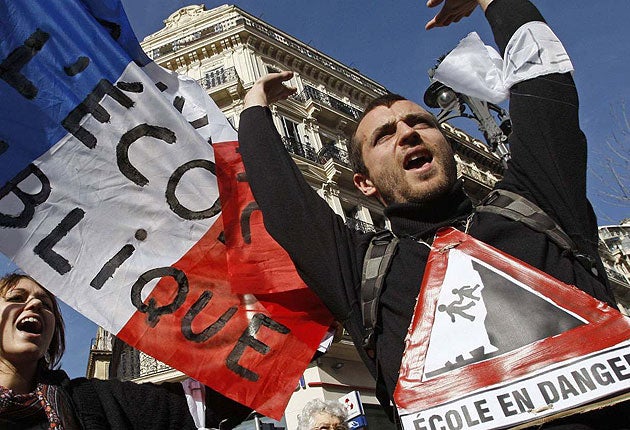
Strikes and protests by lecturers and students which have disrupted French universities for six weeks are threatening to turn violent and merge with broader anger against President Nicolas Sarkozy's reforms and the economic crisis.
Student barricades closed two universities in Montpellier in the south of France today and sit-ins last week exploded into scuffles, vandalism and even death threats.
Despite concessions by the Education Ministry, an arcane dispute over the status of lecturers and other university reforms shows no sign of easing. The government also faces a one-day general strike and street marches against the recession on Thursday and there are fears the education dispute could become the focal point for prolonged and wider social unrest.
In the past, university battles have lit the touchpaper for broader grievances in France. Because of this, M. Sarkozy – who had pledged not to flinch from his programme of economic and social reform – has ordered his higher education minister, Valérie Pécresse, to make a series of strategic retreats over the past three weeks.
But they have been to no avail. The row over changes in lecturers' contracts and plans to give more autonomy to university administrators has taken on a life of its own. To left-wing teachers and students, the protests have become a crusade against M. Sarkozy's "ultra-capitalist" plans to "privatise education" and subject universities to the "laws of the market".
Supporters of the reforms say they are a modest and overdue attempt to rescue the university system from mediocrity and neglect. Rather than defend lecturer privileges, they say, teaching unions and students should be protesting against the chronic underfunding and overcrowding of universities, which remain overshadowed by the elite "Grandes Ecoles".
In many French universities, there have been scarcely any lectures or classes since strikes and blockades began on 2 February. The dispute has frustrated the 18,000 students from other European countries – including 2,000 from Britain – who are attached to French universities as part of the EU Erasmus exchange programme.
The Erasmus co-ordinator at the Sorbonne university in Paris last week warned his students that they might have to cut their losses and go home to secure the course credits they need.
In an email to students, Alfonso Mostacero said: "Some of you will have to consider going home if there is a possibility that you can complete the second semester in your home university. I am not telling anyone to return, but I think that I should give you all the available information so that you can decide what to do for yourselves."
Hannah Burrows, 20, from Edinburgh, is studying at the Sorbonne on a year out from St Andrews University. She said British students were looking for jobs to fill their time. |"I guess I have sort of given up on the Sorbonne," she said. "The thing that exasperates me most about this dispute is how much students' time it wastes. Sometimes I will turn up to a class hoping to be taught, and the teacher doesn't bother to show up."
"I find myself feeling very disillusioned and exasperated by the whole situation, financially and otherwise."
At the heart of the standoff is the government's attempt to shake up the terms of employment for university teachers. Under their existing contracts, French academics, like academics elsewhere, are meant to divide their time between teaching and undertaking original research. In practice, the government says, some researchers rarely teach and some teachers rarely do any research.
Under the proposed reform, academics who failed to complete their research hours would be obliged to teach for longer.
Some teaching unions have portrayed the reform as a right-wing plot against academic freedom and independence, a view which left-wing students have accepted.
Ten days ago, Mme Pécresse agreed to a revised version of her plan which would allow individual university teachers to refuse any enforced change in their timetables.
The talks failed, however, to solve another grievance over proposed changes in the training of primary and secondary school teachers.
The strikes and blockages have continued and now threaten – as in Montpellier yesterday – to be hijacked by student groups protesting against all attempts by M. Sarkozy to reform the education system.
Gendarmes were called in on Friday to expel students and alleged outsiders who had occupied an amphitheatre at a Montpellier university.
After scuffling and severe damage to university buildings, administrators insisted that people without student cards would be banned from the campus in future.
Students barricaded themselves into two Montpellier universities today in protest.
Join our commenting forum
Join thought-provoking conversations, follow other Independent readers and see their replies
Comments