US commits $1bn in aid to Georgia
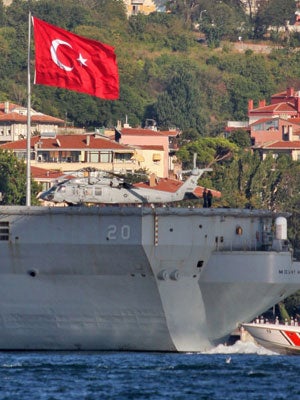
The US government committed $1bn (£562m) to help Georgia ally recover from war with Russia.
US Vice President Dick Cheney, visiting Azerbaijan, said the United States has a "deep and abiding interest" in the region's stability. Cheney is due in Georgia today on a swing through potentially vulnerable former Soviet republics close by Russia's underbelly.
Meanwhile a US Navy flagship sailed toward Georgia with a cargo of humanitarian aid, ignoring Moscow's complaints. The USS Mount Whitney, the flagship of the Navy's 6th Fleet in the Mediterranean, crossed through the Dardanelles and Bosporus into the Black Sea, which Russia shares with three Nato nations and two others seeking to join the alliance: Georgia and Ukraine.
Russian leaders have lashed out at the US for sending humanitarian aid to Georgia aboard military ships, part of their campaign portraying the United States as a belligerent troublemaker that pushed Georgia into war and continues to compromise security in a volatile region.
The appearance of the Mount Whitney was likely to stoke Russia's ire further. As the command ship of the fleet based in Naples, Italy, it has special electronic and communications equipment it uses to transmit orders and information.
Two other US military ships — a missile destroyer and Coast Guard cutter — have delivered aid to Georgia since the five-day war in early August, which prompted the worst crisis in Russia's relations with the West since the Cold War.
"We don't understand what American ships are doing on Georgian shores," Russian Prime Minister Vladimir Putin said on Tuesday. "The second question is why the humanitarian aid is being delivered on naval vessels armed with the newest rocket systems."
Putin warned of an unspecified Russian response.
US President George Bush is sending US$1 billion in new economic aid to Georgia to help the pro-Western former Soviet republic rebuild after Russia's invasion. Bush made the announcement yesterday in a statement obtained by The Associated Press.
He said the money will meet humanitarian needs in the wake of last month's war, such as resettling families that were displaced. The money also will help the tiny nation rebuild infrastructure and boost its economy.
Georgian Foreign Minister Eka Tkeshelashvili said Western aid would be used to rebuild the economy and regain the confidence of foreign investors. She said Georgia had suffered "huge environmental damage" along with losses to its infrastructure.
"It will be a recovery, a rebuilding of the Georgian state, making it as attractive as we used to be for the last several years for foreign investors and foreign businesses. That's the primary aim," Tkelashvili told a news conference with Italian Foreign Minister Franco Frattini.
Frattini, in Tbilisi ahead of a Moscow visit today, urged Russia to take "urgent action" to comply with troops withdrawal commitments under an EU-brokered cease-fire. He said Russia should complete the withdrawal before Monday, when an EU delegation led by French President Nicolas Sarkozy is due in Moscow.
EU officials said Monday that unless Russian troops pull back, talks on the wide-ranging political and economic agreement with Moscow will be delayed.
Frattini also demanded Russia remove checkpoints it has established in parts of Georgia where he said the EU-brokered cease-fire allows only patrols.
Russia insists it is in compliance with the cease-fire and has shown no sign of backing down on the size and location of its positions in Georgia.
Russian forces repelled a Georgian offensive against the Russian-backed separatist province of South Ossetia in early August and then drove deep into Georgia. They have set up checkpoints around South Ossetia and another breakaway region, Abkhazia, and have maintained other positions further into undisputed Georgian territory.
Russia deepened the crisis last week by recognizing South Ossetia and Abkhazia as independent countries. The US and EU say Georgia's borders must remain intact.
War-ruined relations between Russia and Georgia worsened still further yesterday. The Russian consul in Georgia said Russia closed its embassy and suspended consular operations after Georgia severed diplomatic ties yesterday.
"A break-off of diplomatic ties is an action that has a price," Russian Foreign Ministry spokesman Andrei Nesterenko said in Moscow. He said the ministry is considering additional measures in response.
Georgia straddles a major westward route for oil and gas from Central Asia and the Caspian Sea and has become the focus of a struggle for regional clout between Russia and the West.
In neighboring Azerbaijan yesterday, Cheney said he was meeting with the oil-rich nation's president "in the shadow of the Russian invasion of Georgia."
Cheney said the principle of territorial integrity was in danger, a reference to Russia's recognition of the two separatist Georgian regions and the Russian troops now ringing their de-facto borders.
Join our commenting forum
Join thought-provoking conversations, follow other Independent readers and see their replies
Comments
Bookmark popover
Removed from bookmarks