While technocrats haggle, ordinary people feel the pain
Greece: The debt crisis is getting worse, not better, and Greeks are wondering how much more they can take
A new Greek tragedy is being written.
Five years of economic chaos have torn great holes in the social fabric of the country. There has been a surge in the number of children abandoned by their parents. A kindergarten teacher in Athens found a heartbreaking note about one of her four-year-old pupils in the weeks before Christmas. "I will not be coming to pick up Anna today because I cannot afford to look after her," it read. "Please take care of her. Sorry. Her mother."
It is just one snapshot from a nation in pain. More than 878,000 people are unemployed – 18 per cent of the workforce. Athens officials say that the numbers using the city's homeless shelters and soup kitchens is up by 25 per cent since the economic crisis began. Hospitals are reported to be understaffed and starved of supplies. And, as became all too clear when talks with bond-holders stalled yesterday, there is no end in sight to the agony. The International Monetary Fund expects the economy to shrink by a further three per cent in 2012. Others are still more pessimistic. One forecaster has predicted a whopping 7 per cent contraction.
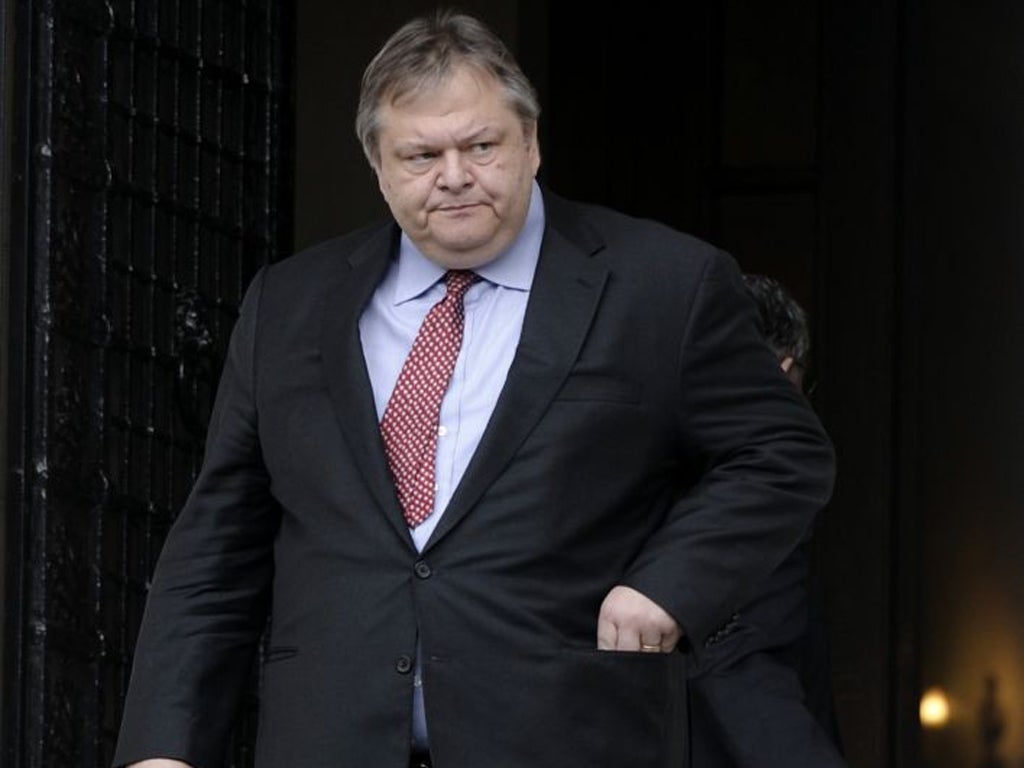
A "Troika" of inspectors – made up of officials from the European Central Bank, the European Commission and the International Monetary Fund – will return next week to check that the government is delivering on its reform commitments, slashing public spending. They will receive updates from the prime minister, Lucas Papademos, and the finance minister, Evangelos Venizelos, and decide whether to release the next slice of funds that Greece needs to redeem €14bn of its bonds in March.
The last visit from the Troika prompted mass demonstrations. Crowds chanted slogans such as "Don't let capitalism kill you" and "Now or never: time to revolt". Greek unions – which are preparing another strike next week – argue that the massive public austerity being demanded of the Greek government by the Troika is driving the economy into the ground, making the situation worse, not better. A growing number of economists outside Greece agree.
But the fate of ordinary Greek citizens also resides in the unsentimental clutches of private sector financiers. Germany, the biggest single contributor to the EU/IMF Greek bailout, began pushing hard last year for something called "private sector involvement" in the bailout. This meant that the holders of Greek bonds would write down the value of their investments. Germany did not like the idea of pumping ever more money into Greece merely so that the country could pay out those funds to private bondholders. In October, a 50 per cent bondholder "haircut" was announced. Eurozone leaders agreed the deal with the Institute of International Finance (IIF), the lobbying group of the global banking industry.
But the IIF only really speaks for the large banks of the continent. A number of small hedge funds have also bought up cheap Greek bonds and are refusing to take a haircut on their investment. So now there is a stand off. The German Chancellor, Angela Merkel, warned at a press conference in Berlin this week that Greece will not receive the next instalment of its bailout funding unless the deal is reached. Charles Dallara, chief executive of the IIF, flew to Athens this week for meetings with Greek ministers in the hope of brokering a deal between the country and its creditors. Yesterday those talks broke down. Some believe Germany will get its way. Others expect the hedge funds that are holding out to be paid off. No one really knows.
Yet even if the deal is ultimately done, many say that Greece needs to be let off more than 50 per cent of its debts. And the number of economists who take the view that Greece can only return to sustained growth if it leaves the eurozone, defaults on its debts and introduces its own devalued currency are growing.
Every new month of economic misery brings the prospect of Greece leaving the euro closer. The great unknown, though, is whether a eurozone exit would mark the beginning of the end of this tragedy for Greece, or a new, darker act.
The Downgrade: What it means for Europe
France
Credit downgrade is an embarrassment for President Nicolas Sarkozy. But the move was long expected by markets.
Greece
Economy still contracting. Social unrest rising. Athens needs to redeem €14bn of debt in March.
Italy
Sold €5bn of debt yesterday, but market demand was subdued. Later its credit rating was cut. Mario Monti’s government faces high costs for long term borrowing.
Germany
Issued debt this week so popular it had a negative yield – means Germany makes profit by borrowing.
Britain
UK debt regarded as a safe haven, like Germany's. British 10-year bond yields have been hitting all-time lows.
Join our commenting forum
Join thought-provoking conversations, follow other Independent readers and see their replies
Comments
Bookmark popover
Removed from bookmarks