Why the only English mayor in France is worried about losing his kingdom

For free real time breaking news alerts sent straight to your inbox sign up to our breaking news emails
Sign up to our free breaking news emails
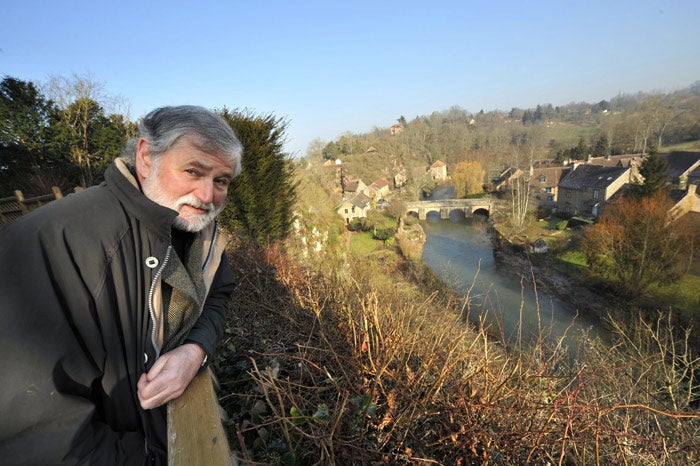
If you were to invent a perfect French village it would be Saint Céneri-le-Gérei. There is an old bridge over a babbling river. There are buildings of warm, grey stone, scattered among the wooded slopes of a narrow valley, overlooked by green hills.
There is a charming church in the Roman style with beautiful 12th-century frescoes. There are three restaurants.
Saint Céneri could hardly be more French and yet its rich history has been shaped, for good and ill, by foreign missionaries and invaders. The small settlement, just within lower Normandy, was created in the seventh century by an Italian saint and hermit – Saint Céneri himself – who conjured up springs and parted the waters of rivers by pointing his stick. During the Hundred Years' War, in 1434, the village castle was besieged for months and then demolished by 15,000 obstinate Englishmen.
After 561 uneventful years, the village fell, willingly this time, into the clutches of another foreigner – a Yorkshireman. For the past 13 years, Ken Tatham has been the mayor of Saint Céneri-le-Gérei, the only British mayor in France.
On Sunday week, 9 March, he is up for election for the third time. There are no opinion polls in Saint Céneri but Mr Tatham, 62, is likely to win by a miniature landslide.
How many voters would that mean exactly? Mr Tatham considers for a moment. "We have a population of 140, of whom 160 can vote," he said. "This is just like Corsica, although you'd better not quote me saying that."
Mr Tatham has lived in Saint Céneri for 38 years. He is married to a Frenchwoman, Christiane, and has, in his own words, "two French sons". Without having a miracle-working stick to point, Mr Tatham is regarded as having done an excellent job in Saint-Céneri. He was even awarded a Marianne d'Or, a kind of French municipal Oscar.
His position as village mayor is secure, as long as he wants the job – and as long as the job survives. But how long will that be?
France has 36,782 mayors, enough to fill a decent-sized football ground. More than two-fifths of all the 88,000 mayors in the 27 nations of the European Union are French. There are mayors of cities as large as Paris (population: two million). There are mayors of villages in the Massif Central which have just a dozen people. There are even elected mayors of five villages which ceased to exist 92 years ago, during the terrible battles north of the town of Verdun.
All of these mayors have budgets and legal powers and duties and municipal councils of at least 11 people (sometimes almost as large as the village itself). In France, democracy starts at the grass roots. But how long can such a lavish system of local government survive?
A report presented to President Nicolas Sarkozy this month suggests that France is absurdly "over-administered". The 96 départements, or counties, should be abolished, the report says. The 36,000 "communes", and their mayors, should be reduced to only 6,000 "super-communes".
Both suggestions have raised a storm of protest. President Sarkozy has promised not to scrap the "départements". He has given no such commitment to the survival of village mayors like Ken Tatham.
"The system may seem absurd but it works and it is not expensive," Mr Tatham said. "We are actually very cheap. And we are almost all that's left to give a sense of community and local contact. There are no more village priests. There are no more village school teachers. There are often no more village shopkeepers.
"All that is left is the mayor, who is social worker, chief mourner, the odd-job man, the first line of the law, chief form-filler, the man, or woman, who marries people, a bit of everything... France, rural France, would be a much poorer place without its mayors." What exactly does a mayor DO in a commune of only 140 people (and 160 voters)?
Lots of things. Mr Tatham gives a few examples. There was the Christmas Eve when his family had just sat down to dinner. The telephone rang. Lumps of rock had fallen on to a road. Mr Tatham and family spent the next few hours moving the rocks.
On another occasion, the telephone rang at 5.20am. There was a stone on a road. Monsieur le Maire got out of bed. There was indeed a stone on the road, about a foot long. Why didn't the motorist move it? No, that was the mayor's responsibility.
On another occasion, Mr Tatham was called by an old woman of 85. She wanted to be buried in the village cemetery, which is administered by the commune. No problem. Her family had a plot in the cemetery. She could be buried there.
"No, monsieur le maire, my brother will not allow it... I haven't spoken to my brother for 65 years." Mr Tatham spoke to the brother and he finally agreed. When she died – still without speaking to her brother – she was buried in the family plot.
Ken Tatham, born in Roundhay, near Leeds, left England in his late teens to hitch-hike, and seek adventure, in Europe. He found his wife, Christiane, in Spain. They lived briefly in South Africa and Paris before moving to Saint Céneri to open a restaurant in 1970.
Mr Tatham later worked for a fashion company exporting French clothes to the UK. He then started a call-centre in the village, providing services for travelling trade reps. He is now semi-retired but runs a company which advises would-be British expats.
In 1995, Mt Tatham ran for the council and was narrowly elected. When the 11 municipal councillors met, he put himself tentatively forward as mayor and was, to his surprise, elected by six votes to five. Seven years ago, he was re-elected to the council with 81 per cent of the vote and chosen as mayor by nine votes to two.
Mr Tatham's stipend as mayor of Saint Céneri is €500 (£375) a month. This has to cover everything, including telephone bills and car expenses. The commune has an annual budget of €100,000. This pays for the salaries of a part-time secretary to help to run the commune and a gardener to look after the municipal flower beds and public spaces. The local council also has to pay for the upkeep of 7.5 miles of communal or "C" roads.
In the local elections next month, Mr Tatham is also running for a seat as a county councillor in the département of the Orne. "If I am elected, I would regard that as a great honour," he said. "It would mean I have finally been accepted as French by the French."
Can France's lavish local government network survive? Quite apart from the threat of reform, some communes are finding it difficult to persuade anyone even to become a councillor. "If you worried about all the legal problems that can fall on your head, you would never become a mayor," Mr Tatham said. "But village mayors are cheap and they are close to real people and real problems."
The French countryside is changing rapidly, Saint Céneri once had 15 farms. It now has three. Many villagers work in Paris during the week and are only Norman at weekends. (This explains the Corsican conundrum of 140 residents and 160 voters.) All of which, Mr Tatham says, is an argument for preserving village mayors.
Subscribe to Independent Premium to bookmark this article
Want to bookmark your favourite articles and stories to read or reference later? Start your Independent Premium subscription today.
Join our commenting forum
Join thought-provoking conversations, follow other Independent readers and see their replies