Wilders strikes first blow for European extremists
Fears that low turnout and gains by far right will be repeated across the EU
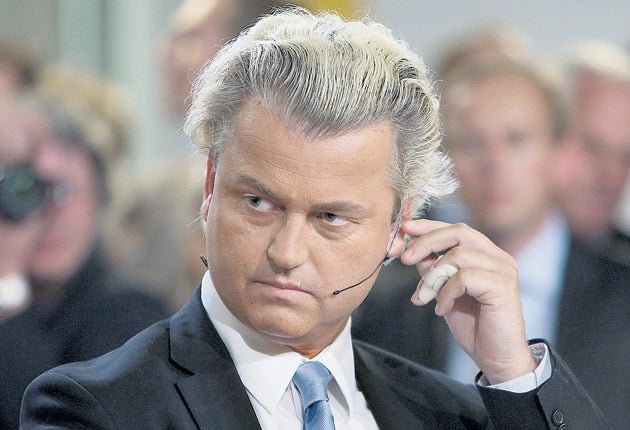
The first killer punch of the European election campaign was struck yesterday by the maverick Dutch politician, Geert Wilders, who scooped 17 per cent of the vote and almost a fifth of his country's seats in the European Parliament running on a populist, anti-immigrant, law and order agenda.
The Dutch result, released two days early – before most Europeans had even cast their votes – sent jitters around a continent fearful that a miserably low turnout will help extremists on both the left and right.
Mr Wilders, refused access to Britain as a rabble-rouser earlier this year, has perfected a form of tolerant intolerance with his Freedom Party and its smartly-suited, middle-class, anti-Islamic and "pro-liberal" values. While the Christian Democrats of Prime Minister Jan Peter Balkenende managed to keep hold of the largest share of the votes (albeit with the loss of two seats and a mere three-point lead), the Freedom Party romped home in second.
The platinum-blond maverick shot to international prominence for branding the Koran a "fascist book" and releasing a film, Fitna, which depicted Islam as inherently violent. "This is fantastic, a great day for the people who crave another Netherlands, another Europe," declared a triumphant Mr Wilders who won four of the 25 seats up fro grabs. Having beaten the Labour party, the other main bloc in the Prime Minister's coalition, into third place, he claimed the government no longer had a mandate. "The cabinet should step down, the sooner the better," he told Dutch television, although analysts said that was wishful thinking.
In another worrying sign from this founding EU member, turnout in the Netherlands was reported to be down to 36.5 per cent for Thursday's poll, three points lower than the 2004 elections. With that in mind and with the majority of the 27 member states still to vote this weekend, European leaders urged people to the polls. "Everyone must understand that Europe is very important to daily lives," the French President, Nicolas Sarkozy, pleaded.
At European Commission headquarters in Brussels there was anger that the Dutch, in clear breach of the rules, released their results before most of the continent was able to vote. It did "not comply with the spirit" of the EU vote, said spokesman Amadeo Altafaj Tardio. But the low turnout and the resurgence of extreme parties are expected to be familiar themes when the official results start coming in from the rest of the continent tomorrow night.
With the exception of Britain, Ireland and Spain – where those in power are expected to get particularly bloody noses – most ruling parties can expect to follow the Dutch pattern, seeing their support siphoned off by the extreme flanks but managing to eke out a limp endorsement from the electorate.
Chancellor Angela Merkel in Germany, President Sarkozy in France and Prime Minister Silvio Berlusconi in Italy will escape the battering which seems certain for Gordon Brown and the Irish PM, Brian Cowen.
Europe-wide trends towards the left and right, pro or anti-Europe, will be difficult to discern. Most national campaigns, in so far as they have stirred popular or media interest at all, have been fought on national themes. Even the low turnout has no Europe-wide explanation. In some countries, such as Poland, it reflects a vague contentment with the EU; in other countries, such as Greece or the Netherlands, there's growing disenchantment.
Here is the great European paradox. European voters complain that the EU is too distant and too abstract; the more power their elected representatives in Brussels and Strasbourg are given, the more the voters shun the European elections. In 1979, turnout was nearly 62 per cent. In 2004, it was 45 per cent. Yet the European Parliament has acquired considerable new powers to amend European legislation. The newly elected assembly will – unless Irish voters reject the Lisbon Treaty again – become virtual co-legislators with governments across the spectrum of EU policy and law-making.
Country by country: How battle shapes up
*Germany: Like Gordon Brown, Chancellor Angela Merkel has campaigned as a "safe pair of hands" for hard times – only she has succeeded. Interest in the election has been low, but Ms Merkel's coalition is forecast to win up to 39 per cent of the vote, despite severe recession and a German habit of turning left, or to extremes, in times of difficulty.
*France: President Nicolas Sarkozy's centre-right UMP will top the poll with about 25 per cent, after stressing law-and-order issues and opposition to Turkish membership. However, the widely forecast meltdown of the divided main opposition party, the Socialists, has failed to materialise. The great winner may be Daniel Cohn Bendit, the student leader in the May protests of 1968, whose ecological, pro-European list may sneak into third place.
*Italy: Despite revelations about his friendship with a teenage girl, and a very public "no" vote from his wife, Prime Minister Silvio Berlusconi will probably top the poll. The centre-left Democrats, founded only two years ago, have failed to impress, even with the recession.
*Poland: The centre-right party of the Prime Minister, Donald Tusk, (Civic Platform) is expected to take over 40 per cent. The Eurosceptic Law and Justice party of the President, Lech Kaczynski, and his twin-brother Jaroslaw, the ex-prime minister, is forecast to score only 30 per cent. The great paradox will be the turnout. More than 80 per cent of Poles say they are content with EU membership; less than 20 per cent may bother to vote to prove it.
John Lichfield
Join our commenting forum
Join thought-provoking conversations, follow other Independent readers and see their replies
Comments