After six years, one month and 11 days, Britain ends its military mission in Iraq
Troops mark their withdrawal from Basra with ceremony to remember fallen comrades
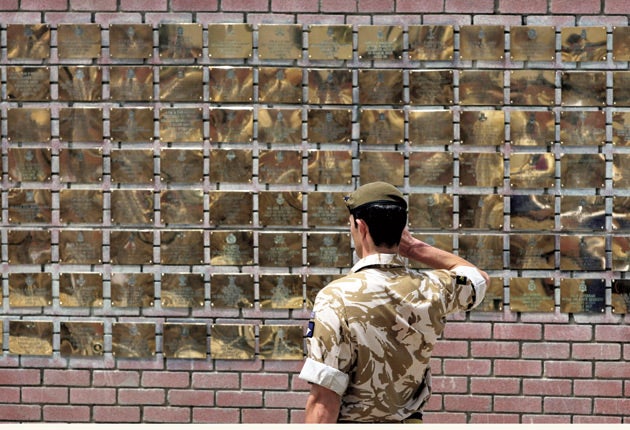
The names were read out one by one as a piper played laments. The final goodbye to Iraq was marked by remembering those who will not make it home.
In London, Gordon Brown, the Prime Minister, declared an official end to combat operations in a conflict which had lasted longer than either of the World Wars. In Basra, it was a sombre and reflective farewell to arms for British troops as they went on their last patrols along streets where they had fought battles and lost comrades.
British involvement in Iraq had started with Tony Blair joining George W Bush's invasion and yesterday it ended with the same American connection. Military authority in Basra was handed over to a US force of 5,000 which will replace the 3,800 from the UK.
There has been long been a feeling among British troops in Iraq that, after sending them off to an unpopular war, people back home failed to understand what they were up against or what they have achieved. One young officer who has done three tours here, said: "My grandmother took part in marches against the invasion. I had my own strong doubts. But we are soldiers; we follow our orders and all we can do is the best we can and not abuse our power. I think we have done some good in Basra, but I can fully understand the Iraqis not wanting foreign troops in their country."
Yesterday morning at the memorial service, in front of a wall bearing the names of the dead, there seemed to be a grim determination that here, at least, the sacrifices will not be forgotten. The names of the 234 British and allied forces and civilian fatalities were called out by their comrades with resolution and a note of defiance.
During the service, which took over an hour, Army chaplain Father Paschal Hanrahan said: "Each name is unique and each name tells a story, the story of a son or a daughter, a husband or wife, a father or a mother. Each name will invoke powerful memories, not least for the family and loved ones back home." A bugler played "The Last Post" and a RAF Tornado GR4 roared low overhead. Then, at 2.46pm, the flag of the 20th Armoured Brigade, the last British combat force in Iraq, was lowered to scattered applause from British, American and Iraqi dignitaries. The British military mission was officially over.
Gordon Brown, who had been in Afghanistan and Pakistan 24 hours previously, was conspicuous by his absence. There had been mutterings that he wanted to keep his distance from a mission which had been so entangled in controversy. John Hutton, the Secretary of State for Defence, who did turn up, said Mr Brown was not ignoring Iraq and was meeting Prime Minister Nouri al-Maliki in London.
The Defence Secretary said an inquiry would have to be held in the future to examine Britain's involvement in Iraq, but that now was the time to take "pride in our forces". "They are the best in the world and can be immensely proud of what they have done in enabling the Iraqis to establish democracy," he said.
More than 150,000 British troops have passed through Iraq. Now the base at Basra airport will be turned into a hotel and the new US headquarters will only have a handful of UK military personnel. In the future the UK footprint in Iraqi sands will be commercial and political, one of the reasons for the hosting of Mr Maliki and most of the Iraqi cabinet at a trade conference in London.
Nigel Haywood, the British consul-general, said: "Our role here is changing and it will no longer be a military one. But we have made a lot of investment in this place and certainly intend to have an effective presence here. Iraq has a vibrant economic future and we are helping to put it together."
Basra has 70 per cent of Iraq's oil reserves, although the fall in the price of oil has meant that the province's budget has been cut in half. Nevertheless, the port of Um Qasar, where a Royal Navy team will remain to train their Iraqi counterparts, is held up as an example of Iraq's economic potential with the possibility of becoming the entrepôt for the entire region. Mr Hutton visited Um Qasar before laying a wreath at the Martyr's Memorial in the Hayaniah district of Basra City for the victims of "Chemical Ali".
Hayaniah has resonance for Britain. It was a stronghold of the radical cleric Moqtada al-Sadr's Mehdi Army, the scene of frequent ambushes of British patrols and the launch pad for mortar and rocket attacks on their headquarters at Basra airport.
Mr Hutton's gesture, however, emphasised Britain's role in liberating Iraq from Saddam Hussein's regime and it is indeed the case that the Shias of southern Iraq are, in particular, thankful for that deliverance. However, the mayhem which followed the 2003 invasion has also taken a terrible toll.
Hakim Ali Ibrahimi, a 58-year-old Hayaniah resident, lost two members of his family in the violence before and after the war and was himself imprisoned by the secret police. "The British began well in Iraq and most of us welcomed them when they came. We appreciated that they were not as aggressive as the Americans and they respected our culture" he said. "But they allowed the militias to gain too much control and we suffered."
Hania al Fadr, a teacher with six children, cannot understand why, six years after Mr Bush officially declared victory in the war, power in the city is still unreliable. "But we cannot just blame them [America and Britain], what about our own useless politicians?" he said. "Now that the British are going... we Iraqis have to examine ourselves.
Basra by numbers
3,302 Minimum estimate of number of Iraqis to die in Basra since the beginning of the war. 179 British soldiers have also died in Iraq.
51% Estimated turnout in local elections earlier this year.
2 Missile attacks on Basra airport this year compared to 400 in 2005.
Join our commenting forum
Join thought-provoking conversations, follow other Independent readers and see their replies
Comments