Ahmadinejad seizes on America's retreat at 'anti-terror' conference
Iran seeks to impress leaders of Afghanistan, Iraq and Pakistan. Robert Fisk reports
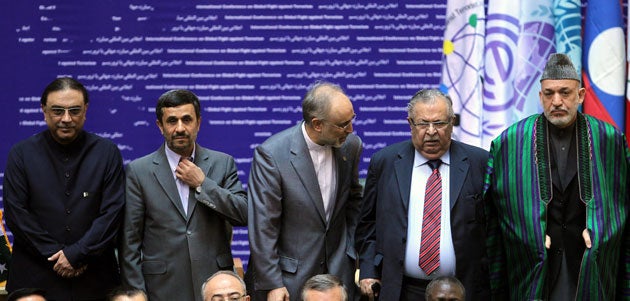
If you held a mirror up to the vast "anti-terrorism" conference in Tehran this weekend – the anti-Iranian version of terrorism, of course – you would see three men sitting down in private to discuss what happens when the US and its Nato partners stage their final retreat from Afghanistan.
Messieurs Ahmadinejad of Iran, Karzai of Afghanistan and Zardari of Pakistan – all jolly presidents sharing the stage with Talabani of Iraq, Rahmon of Tajikistan and (speak it in hushed tones), that elderly wanted man, President Omar Hassan al-Bashir of Sudan – spent time discussing how all would react when the West ends its adventure in the graveyard of Empires.
Ironies were legion. The modern-day descendant of the Persian empire, so often accused by America of helping the "terrorists" of Iraq to kill US troops, is none too keen on the "terrorists" of the Taliban – at the very moment when the Americans are keen to talk to the very same Taliban so that they can high-tail it out of Afghanistan.
The flamboyantly cowled President Hamid Karzai, whose speech to conference delegates lasted a mere four anodyne minutes – anyone can condemn "terrorism" of any variety in that amount of time – is keen to have Iran help reconstruct his country, which was supposed to be what the Americans and the Brits and everyone else who loved democracy were keen to do after the Taliban's brief defeat in 2001.
And there was President Zardari of Pakistan, whose own wife was killed in a "terrorist" attack – no one in Tehran, of course, suggested who might be to blame – anxious to talk to the Iranians and the Afghans about Pakistan's future role, despite its strong support over decades for the "black Taliban" which always featured on Iran's hit list. This wasn't smoke and mirrors. This was lots and lots of smoke amid which you had to wear dark glasses.
When I slipped through the mass of Iranian journalists surrounding the Iranian foreign minister, I found Ali Akbar Salehi a very cautious man indeed, apparently more anxious how his English would be translated into Farsi than how he would be reported in The Independent.
"In the trilateral talks between Iran, Afghanistan and Pakistan, we discussed many things and issues that may come up after the Nato military force goes out of Afghanistan," he said. "I think there was a good convergence of views among the leaders of the three countries ... In a nutshell, I'm very optimistic about the future of the region – unlike what some others would like to preach. The nations of these three are going home determined to take in hand their governance and exercise their independence to do the best in economic, political and cultural cooperation."
This is a long diplomatic way of saying "Phew! – the Americans are going at last and we're all on our own." Even Iran's Supreme Leader, whose wisdom is greeted with Vatican-like adherence here, seems to have concluded that the US plans to abandon its eastern neighbour. Ayatollah Sayed Ali Khamenei thought the Americans would be gone "within three years". But the vast US airbase in Kandahar, like those at Bagram and elsewhere, look like much longer-term projects; so do the giant US military "lily-pads" (the expression of that extraordinary military strategist D Rumsfeld, Esq) in Iraq.
President Talabani, undoubtedly the largest of the leading delegates in sheer physical size, chose not to dwell on this subject; he was much keener to promise that Iran's most hated enemies – the Mojahedin Qalq cultists still ensconced in Camp Ashraf after years of loyalty to Saddam and bomb attacks against Iran – would be kicked out of his country. The Iranians have already accepted 250 of these rogues back home after guarantees of good behaviour. A lot of them may choose to flee to third countries. The Iranian intelligence minister Heydar Moslehi has promised "to determine the fate of Camp Ashraf as soon as possible". This is what the whole panjandrum of the "anti-terrorist" conference was supposed to be about.
Confronted by the fatal word "Syria", Mr Saleh plunged into a crowd, shouting over his shoulder the words: "I think Syria will be..." And that was all we heard. Safe to say he believes that Iran's ally, President Bashar al-Assad, will soldier through his present little difficulties (1,400 dead, uprisings in almost every city, near-civil war in the north of Syria) with little to worry about.
My guess is that a shrewd country like Iran – if it is preparing for a life without the Americans in Afghanistan – must also be planning for a life without the Assads in Damascus.
Join our commenting forum
Join thought-provoking conversations, follow other Independent readers and see their replies
Comments