Al-Qa'ida 'running out of suicide bombers in Iraq'
Foreign would-be militants are heading to Afghanistan and Pakistan, Iraq's Foreign Minister tells Patrick Cockburn
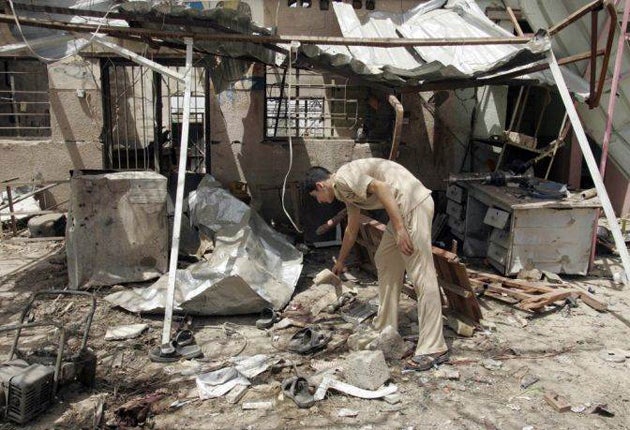
Al-Qa'ida is struggling to launch frequent suicide attacks in Iraq for the first time because of a shortage of foreign volunteers travelling to the country to carry them out.
Interrogation of prisoners and intercepted messages revealed that local al-Qa'ida commanders are complaining about the lack of foreigners to carry out suicide missions as they had done to devastating effect in the past, Iraq's Foreign Minister, Hoshyar Zebari, said in an interview with The Independent .
"The shortage of suicide bombers is because Islamic fundamentalists are more interested in Afghanistan and Pakistan these days, the Americans are withdrawing from Iraq and al-Qa'ida's networks have been disrupted by ourselves and the Americans," said Mr Zebari, whose own foreign ministry building was badly damaged by a vehicle bomb last August that killed 42 staff members and injured many more. "I expect al-Qa'ida will pool its remaining resources and make another spectacular attack in Baghdad very soon."
Mr Zebari said he believes that al-Qa'ida is finding it much more difficult to find safe havens in parts of Iraq dominated by the Sunni Arab community which turned out to vote en masse in the general election in March.
The use of suicide bombers from outside Iraq – the majority coming from Saudi Arabia, Yemen, Jordan, Syria, Libya, Algeria and Morocco – played a central role in destabilising the Iraqi governments which followed Saddam Hussein. The first suicide bombings started in August 2003 and al-Qa'ida was able to attract volunteers for suicide missions from across the Muslim world, enabling it to launch seven or eight attacks in a single day.
In 2007, 5,480 people were killed from "multiple fatality bombings" but this number more than halved the following year and dropped further to 2,058 in 2009. In the first three months of 2010, 346 people have died, according to the Brookings Institution think tank.
Shia civilians in markets or coming out of mosques were frequently targeted by the fanatically Sunni al-Qa'ida leaders. Sitting in his temporary office beside the recently reopened foreign ministry building, Mr Zebari said that the only factor now favouring al-Qa'ida is the political stalemate that has yet to produce a government, 75 days after an election on 7 March failed to produce an outright winner.
In this uncertain political atmosphere, even a reduced level of attacks increases instability. He said that earlier this week, a newly elected member of parliament was assassinated in Mosul "almost certainly by al-Qa'ida, but Sunni politicians immediately blamed the government for not giving the MP enough protection".
A leader of the Kurdish resistance to Saddam Hussein for many years, Mr Zebari has a reputation of being one of the ablest ministers in the governments which followed the overthrow in 2003.
But he sounded despairing as he detailed the difficulties in forming a new power-sharing government because of the personal animosities between leaders. He suggested that the UN play a greater role taking over from the US which "in the past played a crucial role banging heads together".
The results of the election have been in dispute since the bloc headed by Prime Minister Nouri al-Maliki came a narrow second to the Sunni-backed bloc headed by former Prime Minister Iyad Allawi. Because both blocs fell far short of an outright majority, they are competing to form a governing coalition. So far there has not even been a round-table meeting between the different parties and Mr Zebari does not believe that the US proposal for a grand coalition between Mr al-Maliki and Mr Allawi is feasible. "The difficulty is in deciding who will be in the driving seat," he said.
The result of these internal divisions in Iraq is that foreign powers are playing an ever increasing role in deciding what happens in the country. Mr Zebari pointed to the growing role of Iran, Turkey and Syria in Iraq.
Join our commenting forum
Join thought-provoking conversations, follow other Independent readers and see their replies
Comments