'America used to be our enemy No 1. But now it's al-Qa'ida,' say former insurgents
Film-makers Sam Collyns and James Jones told about the moment the tide turned for US troops
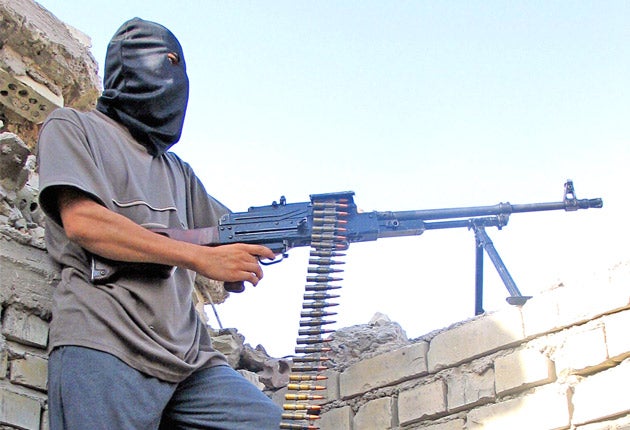
Former Iraqi insurgents have spoken for the first time about the moment that turned them away from al-Qa'ida and swung the conflict in favour of the United States.
While the US troop surge has widely been credited as the critical factor in bringing Iraq a measure of peace, senior figures in the insurgency say the most significant change came with the "Awakening", when many militants switched sides.
"At the beginning, the Americans were enemy number one," said Sheikh Abdel Jabbar, the man who triggered the shift, who has never before spoken publicly about his role. "But when al-Qa'ida started killing us, killing our people, al-Qa'ida became enemy number one.
"We started seeing bodies filling the streets," he said, reflecting on the horrors inflicted by al-Qa'ida on his family and friends for our new BBC series, Secret Iraq. "Then they managed to capture five of my people and slaughtered them. Then they killed my brother."
He was describing the period three years after the overthrow of Saddam in 2003, which represents the low point in the tempestuous history of modern Iraq. Following the invasion, a hatred of the American occupiers united the insurgents.
Sheikh Jabbar, who had built up a lucrative construction business under the old regime, had been one of their major financial backers, supporting the insurgents at Falluja.
But the arrival of foreign fighters who had pledged themselves to al-Qa'ida in 2006 changed things. With al-Qa'ida on one side and Shia death squads on the other, Iraq was sliding towards civil war in 2006. On average, 56 Iraqis were executed every day.
As General Jack Keane, the former vice chief of staff of the US Army, admitted in an interview at his office in downtown Washington DC: "[Until that point] we had made a conscious decision not to protect the [Iraqi] population. The security situation in Iraq by late 2006 was the worst it had ever been and it was getting worse by the day – that was the reality."
For Sheikh Jabbar, desperate times required desperate measures. He arranged a meeting with Colonel John Tien of the US Army in which he asked for weapons and ammunition for his men to take on al-Qa'ida. At that point, they numbered in the dozens; eventually the forces, later known as the Sons of Iraq, swelled to 100,000. The Awakening had begun.
"People ask me what was the tipping point in Anbar Province," Colonel Tien said in an interview. "I would say 22 November, the day Sheikh Jabbar entered my tactical operations centre and said 'I want you to help me take back my neighbourhood'."
Today, in his crumpled and slightly ill-fitting suit, Sheikh Jabbar looks more like a local bank manager than an insurgency leader. But with the American combat troops leaving Iraq this summer, and with uncertainty once again clouding the country's future, he felt the time was right to tell his story.
Another who joined the ranks of the Awakening was Sheikh Ali Hatem, from a wealthy landed family in Anbar Province. "We thought al-Qa'ida was an Islamic group wanting to fight Americans," he said. "What opened the eyes of the people of Anbar to the vileness and the awfulness of the regime is their attempt to take over Anbar by cutting off the heads of some of the leaders before daring their families to pick up their bloody remains."
For the followers of Sheikh Jabbar and Hatem, disgust at al-Qa'ida provided the key motivation behind their decision to take up arms alongside their old enemy, the Americans. Money played a part, too, and the salaries paid to join the Sons of Iraq were clearly attractive in a war-torn country with few legitimate means for earning a living. But in interviews carried out over nine months, members of the group say it was rarely the prime motive.
The leaders of the Awakening feel that their role in virtually destroying al-Qa'ida and restoring what passes for order in Iraq has not been properly recognised. Other factors played a part, not least the surge in US troops under the leadership of General Petraeus, who arrived in Iraq in early 2007.
But these extra American troops were far outnumbered by the newly recruited Sons of Iraq, and, as one American soldier put it, it was the Awakening, not the surge, that was "the game-changer".
Yet according to Sheikh Jabbar, the future of Iraq itself remains far from assured. The Sons of Iraq, the vast majority of whom are Sunni, are being disbanded by the Shia-dominated government. They have been promised civilian jobs to replace their military ones, but these have been slow to materialise.
The former insurgents were glad to see the back of the Americans. They hold out hope for a democratic, peaceful and united Iraq. But if they fail to achieve these goals through the political route now on offer, the danger remains that they will once again take up arms to protect their interests.
"Two kinds of people carry arms," Sheikh Hatem said. "They are either crazy or hungry. At the moment, only a fifth of my men are being paid by the government. If the rest don't get paid, they will go back to the insurgency."
The two part series 'Secret Iraq' starts on BBC Two at 9pm tonight and concludes next Wednesday
Join our commenting forum
Join thought-provoking conversations, follow other Independent readers and see their replies
Comments