At night and in secret, the last US combat troops depart
Some head home, others to Afghanistan. But for all, the war in Iraq is over
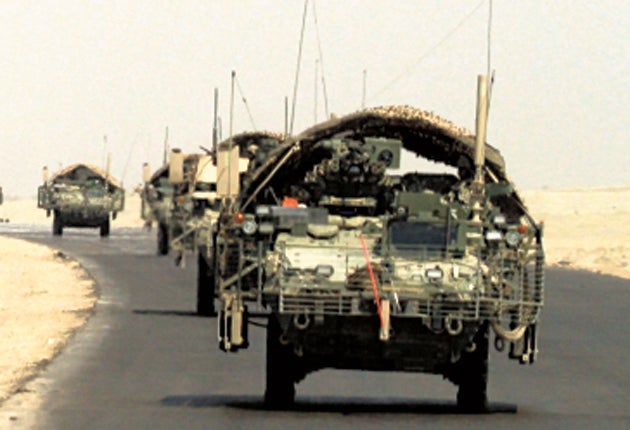
There was no grand farewell. Seven years and five months after the start of one of the most bitterly divisive wars of modern times, the remaining American combat forces left Iraq under the cover of darkness to head home.
The "last patrol" of 362 military vehicles and 1,820 soldiers began pulling out from Baghdad just after midnight, retracing the route they had taken at the time of the invasion. The troops of the 4th Stryker Brigade, 2nd Infantry Division, many of them veterans of the country's ferocious insurgency, were on their way out through the Euphrates valley to Kuwait.
The move took place two weeks ahead of schedule, the timing kept confidential in an attempt to avoid insurgent attacks on the vulnerable departing column. A force of around 56,000 will be left behind for training purposes, but these too will leave by the end of next year.
The Obama administration has followed its Republican predecessors by insisting the "surge" carried out under General David Petraeus had succeeded in significantly reducing violence, enabling the withdrawal to take place.
The drawdown, however, began two days after a suicide bomber blew himself up in Baghdad, killing 61 people and injuring 123 others who had queued for hours to join the Iraqi armed forces. July has been the bloodiest month since May 2008, with more than 500 killed. Iraqi figures from the head of the army, General Babaker Shawkat Zebari, to Tariq Aziz, the deputy prime minister under Saddam Hussein, have warned that the Americans are pulling out too soon.
Some of the departing force had been airlifted out. But it was decided that there should also be a road move, partly as a symbolic gesture. As the vehicles began rolling, Colonel John Norris, the head of the brigade, shouted out: "Operation Iraqi Freedom ends on your watch. This is a historic mission!"
The soldiers roared back their battle cry of "Hooah!" as the colonel nodded his approval. "They are leaving as heroes," he said. "I want them to walk home with pride in their hearts."
But for most of the American soldiers yesterday, there was mainly relief at leaving a war in which 4,415 of their comrades had fallen. As they made their way slowly in their Stryker vehicles through dark streets, they reminisced about their experiences: the siege of Fallujah, gun battles in Sadr City, fighting in the streets of Karbala, of those who did not make it back home.
Specialist Clinton J Clemens was 18 when he entered Iraq in 2003. "I was scared to death. I remember crossing the border and [after] about 15 minutes we got our first contact. It was the first time I'd ever been shot at," he said.
Two months later, on board an aircraft carrier, President George W Bush declared victory with a banner saying "Mission Accomplished" fluttering behind him. But Spc Clemens, now 26 and with multiple tours of Iraq under his belt, recalled how a year later, he was only too aware that the war was far from over as Sunnis began forming armed groups to attack US forces.
Three years later, the war was still raging and Sergeant Luke Hitchcock was taking part in the fight of his life at Arab Jabour in south-east Baghdad. "That was a horrible area, my platoon took six casualties," he stated quietly. "I received a Purple Heart during the deployment. I was blown up."
There were also glimpses of bleak humour from the soldiers. "That Saddam really hid those WMDs well," said a voice in one of the Strykers, to widespread laughter. The excuse given for the invasion, Iraq's supposed chemical, biological and nuclear arsenal, has long been a matter of mirth for the American forces and their British allies. Sergeant Shawn Sedillo was adamant: "You cannot put me in a bad mood right now, I am going home." Sergeant Dennis Hill was laconic: "I am going to Afghanistan," he said.
The threat of roadside bombs and ambushes remained. The more risky parts of the route had been cleared; Apache helicopter-gunships flew overhead. Phalanxes of Humvees sat at overpasses and soldiers patrolled strategic points.
As they rolled past Baghdad's District 9, the soldiers in one Stryker repeatedly played Queen's "Bohemian Rhapsody", joining in to the lines: "Mama, just killed a man; put a gun against his head; pulled my trigger, now he's dead; Mama, life had just begun; But now I've gone and thrown it all away."
Approaching the Kuwaiti border, the men in the Stryker demanded a reprise. "Just gotta get out, just gotta get right outta here," they sang before ending on: "Nothing really matters. Nothing really matters to me."
Stretching out after he finally got out of his armoured vehicle in Kuwait, Specialist Thomas Smith mused: "More sand, more heat. But at least no one's shooting at us here. I wonder what the weather is like in Kandahar?"
Iraq today: What kind of country are they leaving behind?
Security
Iraq in 2010 may not be experiencing the same level of bombings, kidnappings and murders which reached its height between 2006 and 2007, provoked by the orgy of sectarian bloodletting which the invasion unleashed.
But it remains one of the most dangerous countries in the world. Buoyed by the departure of US combat troops, insurgents have stepped up their attacks, killing at least 250 people through suicide bombs in the past four months alone. Sixty people were killed this week. Overall estimates of the number of Iraqi civilians killed since March 2003 range from 97,196 to 106,071 according to Iraq Body Count.
Politics
The ousting of Saddam Hussein toppled the Ba'ath Party dictatorship and cleared the way for the first democratic elections in the country's history.
Elections were held in 2005 and were trumpeted as a major turning point in Iraq's history by the US-led invasion. Power was swiftly seized by Shia and Kurdish parties, leaving the Sunni minority increasingly isolated and supportive of the insurgency.
The country has been without a government for the past five months following elections in March which produced no clear winner. Attempts to cobble together a coalition have floundered, leaving a dangerous vacuum.
Society
Whether Iraq is a freer and happier place since the invasion in 2003 is difficult to measure.
The country is supposedly ruled by a democratically elected government operating under a constitution that guarantees freedom.
But human rights groups say extra-judicial killings, kidnappings, torture, bribery and corruption are still endemic with little accountability for perpetrators.
More than 5 million Iraqis have been turned into refugees since the invasion, with 2.7 million of those displaced internally. Some live with relatives, others in public buildings.
Economy
The slightly improved security situation is allowing Iraq's economy to improve, particularly in the retail and manufacturing sector. Growth is currently around 5 per cent.
But the country is still overwhelmingly dependent on its vast wealth of natural resources, with the oil and gas industry accounting for 90 per cent of the government's revenues.
With Iraq's oil output expected to quadruple over the next 10 years, foreign companies are flocking to the region. But that is little comfort for ordinary Iraqis. Unemployment runs at close to 40 per cent and GDP per capita remains a paltry $3,200.
Regional stability
The presence of an occupying non-Muslim force in the heart of the Middle East sent Islamist militants flocking to Iraq with devastating consequences for both Iraq and its neighbours.
Jordan, Syria, Turkey, Saudi Arabia and Lebanon have all seen al-Qa'ida-inspired militant activity increase with varying levels of success.
Iran, meanwhile, has come out of the invasion as the clear regional winner, with the ability to influence events in the region as never before, thanks to Iraq's Shia population taking the lion's share of political power. Islamist and Sunni militants still remain the major threat to the Iraqi government.
Join our commenting forum
Join thought-provoking conversations, follow other Independent readers and see their replies
Comments