Cease-fire revives business in Egypt-Gaza tunnels

For free real time breaking news alerts sent straight to your inbox sign up to our breaking news emails
Sign up to our free breaking news emails
For eight days, the sounds of illegal commerce here at the ragged southern edge of the Gaza Strip were silenced by the pounding thrum of battle.
Israeli military jets bombed the sandy stretch of land just a center fielder's throw from Egypt each day, hoping to collapse the underground avenues for food, cars, medicines and weapons that support Hamas' rule in Gaza.
Ahmad al-Arja, a 22-year-old engineering student, was among the army of diggers forced to take the conflict off. But minutes after Israel and Hamas reached a cease-fire on the evening of Nov. 21, his boss was on the phone.
"He said, 'Come on, count on God, and tomorrow morning, start digging,' " Arja recalled, as he began with his cousins the tedious, treacherous work of tunnel repair.
The business of Rafah is the tunnel network that circumvents the Israeli blockade of Gaza, and business once again is booming.
For Israeli leaders, who are seeking assurances since the recent cease-fire that Hamas be prevented from restocking its potent weapons arsenal, the thriving return of tunnel commerce poses a daunting strategic challenge.
Since leaving Gaza seven years ago, Israel's military has lost its on-the-ground ability to stop tunnel smuggling. Since the cease-fire, Israeli Prime Minister Benjamin Netanyahu has sought guarantees from Egyptian President Mohammed Morsi that he will do more to prevent the illegal trade into Gaza — a diplomatic negotiation between uneasy neighbors that in the past has proved fruitless.
Without such help, the trade will almost certainly continue. As Israel has found in trying to suppress rocket fire from Gaza, an airstrike campaign against the tunnels provides a respite, not a solution.
"Our expectation of Egypt, and the rest of the international community, is to stop Hamas from rearming," said Mark Regev, a spokesman for Netanyahu. "We believe they came out of this latest round significantly depleted in terms of rockets and missiles. The way to prevent a future round is to prevent their ability to rearm."
Maj. Avital Leibovitz, an Israel Defense Forces spokesman, said there is so far no evidence any new arms shipments have gone through the tunnels since the cease-fire.
Leibovitz said an Israeli ground presence is not necessary to stop smuggling under the border. Like the intelligence assets that the military drew on to target underground rocket launchers, she said, "we know what we need to know" about the tunnels.
Whether that will always be enough is unclear.
Israel targeted 140 tunnels during the recent operation, severely damaging dozens of passages beneath Gaza's nearly seven-mile border with the Egyptian Sinai. The bombs buried entrances, destroyed cement-reinforced walls and cratered the muddy access roads used by flatbed trucks that deliver goods across the strip.
Hamas security officials who monitor the tunnels — and collect "taxes" from the merchants who buy the imports — say at least 50 were collapsed along one busy mile-long stretch alone. Diggers think that hundreds of tunnels span the border.
But as the Arja family and others toiling under a warm winter sun less than a week after the cease-fire made clear, none of the tunnels will remain dormant for long.
"Some wanted to get to work during the bombings," said Mohammed Bahrawi, 23, a Hamas guard who monitors a particularly busy patch of tunnels. "But, look, they were crazy. We wouldn't let them."
Dressed in an all-black military uniform, Bahrawi walked among the churned, pitted landscape that hummed with generators, bulldozers and trucks. The trucks hauled smuggled propane gas canisters, crates of fish and gravel into the strip for sale.
Only three months ago, Bahrawi was a digger himself. A business administration graduate of Khan Younis College of Science and Technology, Bahrawi, like many young Gazans, could not find work in his field. So he turned to the tunnels.
Hamas officials chose him three months ago to help guard the site, which they monitor constantly.
Bahrawi said it is his job to make sure only permitted goods come through the tunnels, and to prevent people from using them to leave for Egypt.
"But I am not going to lie to you," Bahrawi said. "Many other things enter, too."
Of primary concern to Israel are the weapons — missiles, small arms and explosives — that military officials say have arrived in Gaza from Iran, Sudan and Libya through the tunnels.
Bahrawi points toward clusters of apartment buildings, their walls pocked long ago by Israeli shrapnel. Many of the tunnels, he said, have secret extensions that end out of sight. Those are the ones used to smuggle materials that Israel is not meant to see.
The tunnels vary in size and depth. Two that are big enough for cars to enter stand on either end of a roughly mile-long stretch — one damaged by the bombing is closed, the other is open for business.
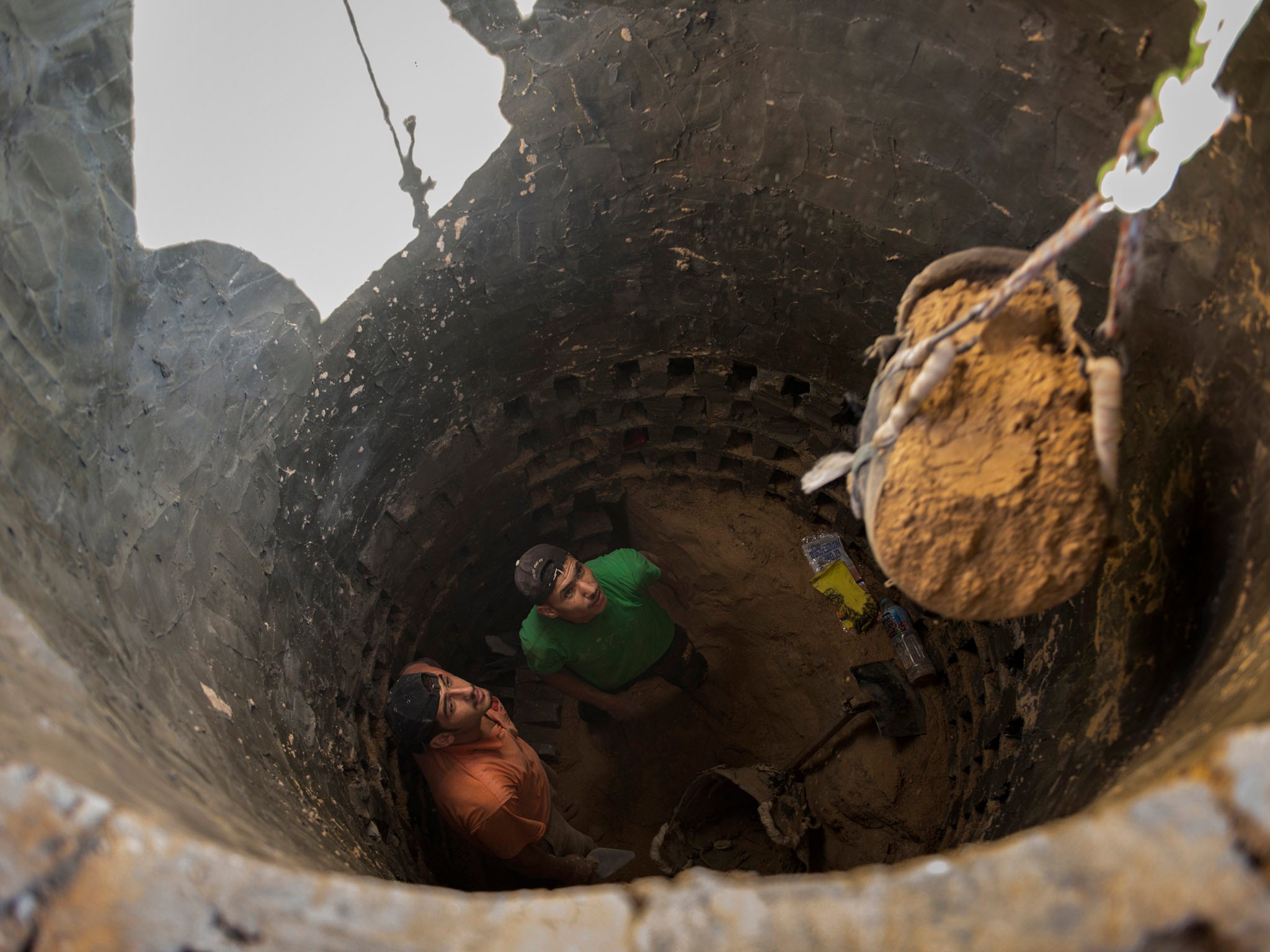
The most common are spacious enough for men to stand in with room to spare, and wide enough for large crates to pass through. In one dusty shaft, a makeshift elevator carried men up and down.
But the sandy soil above the diggers has shifted during the recent bombardment, and Bahrawi thinks collapses are inevitable as they attempt to reopen the passages.
"Some have been working in these tunnels for seven years, and I think once you see some of these men hit the right depth and start to head toward Egypt, there will be deaths," he said.
The men, who earn about $15 a day, sweat in the sun. Small fires smoke from several of the pits, used to heat kettles of water for morning tea.
Down in the vertical entry shafts, diggers pause for a cigarette, buckets of wet cement at their feet. Over the din of generators and excavation equipment, a man's yell from time to time signals dray horses to haul large bags of damp soil up from the pits.
"They will bomb again," Arja said. "And then we will dig again — and there will be more money."
To Abu Ahmed, a tunnel owner who gave only his nickname, the frantic restoration underway brings a smile.
A former digger who saved enough to make his own tunnel, Abu Ahmed said he lost about $8,000 during the tunnel closures caused by Israel's airstrikes.
On a recent morning, his workers dragged stacks of Styrofoam crates filled with Egyptian sardines through his undamaged tunnel. He sells each crate for about $50, and every merchant who places an order pays 14.5 percent of the price to the Hamas officials on site. The money goes into the movement's treasury.
That is only one expense. Recently, a worker died and five others were injured in an accident inside Abu Ahmed's tunnel. A Hamas-led committee fixed the amount of restitution that he paid to the men's families, which came to a total of about $30,000.
"It's always worrying, but what else can I do? This is our business," he said. "You cannot imagine the effort we put into these tunnels."
Subscribe to Independent Premium to bookmark this article
Want to bookmark your favourite articles and stories to read or reference later? Start your Independent Premium subscription today.
Join our commenting forum
Join thought-provoking conversations, follow other Independent readers and see their replies