Civilian casualties: Human rights groups accuse Israelis of war crimes
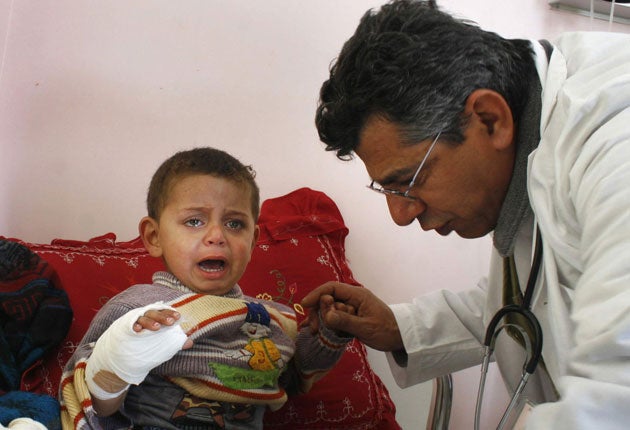
Israel is under suspicion of committing war crimes and should halt the "clear and present danger to the lives and well-being of tens of thousands of civilians" in Gaza, nine of the country's main human rights organisations have declared.
The Israeli organisations have written to the government, armed forces chiefs and the attorney general, condemning the "unprecedented" harm to a civilian population now in "extreme humanitarian distress", the "wanton use of lethal force" and a series of what it says are "blatant violations of the laws of warfare".
These include the fact that, apart from the death toll, with border crossings closed residents are unable to escape the war zone and are living in "fear and terror". The organisations also cited the dire capacity problems of Gaza's hospital system and the failure to evacuate about 600 wounded and chronically ill patients; what they say is prevention by the army of rescue teams reaching isolated areas which have come under intensive attack; and the fact that, with sewage now flowing in many streets, more than half a million people are without clean water and 250,000 residents have been without electricity for 18 days. Another million residents are without power at any one time, the organisations said.
The agencies also said 12 medical personnel had been killed, and another 17 injured, and that there had been 15 separate attacks on medical facilities. Meanwhile, Israel was hitting civilian targets which it defined as military solely because they are defined as "symbols of power" in Hamas-controlled Gaza.
Several human rights representatives went out of their way to make clear they were just as vigorous in their condemnation of the killing and injuring of Israeli civilians in militant rocket and mortar attacks. But their letter says the harm inflicted on Gaza's 1.5 million civilian population is "disproportionate" and calls on the government to open corridors to allow residents to escape the fighting and rescue teams to reach the injured.
Asked about the large majority of Israelis the polls show as supporting the warfare in Gaza, the Israeli human rights lawyer Michael Sfard said: "We are witnessing a moral corrosion." Five years ago, when 15 bystanders were killed when a bomb was used to assassinate the Hamas militant leader Saleh Shehadeh, "there had been a very serious debate. Today we're doing it daily and and no one says a word. The [Israel Defence Forces] has stopped expressing regret".
The Israeli human rights letter also says that transformers, cables and other equipment allowed by Israel into Gaza's only power station four days earlier were severely damaged in a bombing raid on Monday night.
Jakob Kellenberger, the president of the International Committee of the Red Cross (ICRC), said after a visit to Gaza that the three-hour window being offered by Israel for humanitarian operations "is simply not long enough". He added: "You must have 24-hour access to people who are wounded, people who are hungry." ICRC officials said it is often impossible to organise ambulance convoys through the battle zones in that time. Mr Kellenberger, who also visited the Israeli border town of Sderot, said he understood "the great psychological damage" caused by rocket attacks there. But he said the scenes he had seen at Gaza's Shifa hospital were "shocking, really shocking, it hurts to see it. The number of patients keeps on increasing".
Oxfam said the cost of the damage at the power plant was estimated at £280,000. Although less than a day's normal supply, 369,000 litres of industrial diesel – needed to fuel the power plant and restore electricity supplies vital to Gaza's water and sewage – is held up at the Nahal Oz terminal because it is too dangerous to transport it to the power station.
Gaza: The statistics so far
19 Number of days that the conflict has been going on.
2,360 Number of Israeli airstrikes so far.
1,013 Number of Palestinianskilled so far.
670 Number of casualties whoare civilians.
225 Number of childcasualties.
69 Number ofwomen casualties.
4,700 Number of Palestinians wounded.
10 Number of Israelisoldiers killed.
4 Number of Israelis killed by friendly fire.
3 Number of Israeli civilians hit by rockets fired from Gaza.
Join our commenting forum
Join thought-provoking conversations, follow other Independent readers and see their replies
Comments