Collapse in Iraqi oil price shatters hope of recovery
Government relents and allows foreign-owned companies a majority stake in projects to boost production
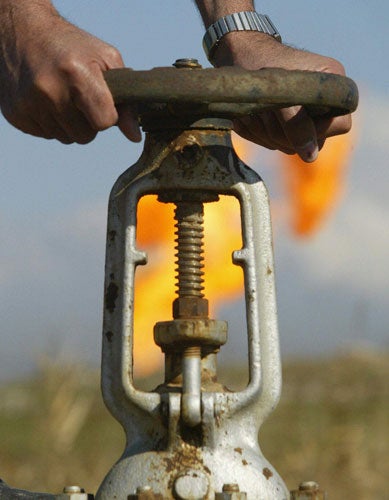
Six years after the invasion that toppled Saddam Hussein, the collapse in the price of oil is devastating Iraqi hopes of reconstructing an economy shattered by 30 years of war and sanctions. A year ago, as the price of oil approached $150 a barrel, Iraqi leaders were optimistic they would have enough money to rebuild the country.
Since then the price of a barrel of oil has slid to just $50 a barrel, leaving Iraq, on the sixth anniversary of the US-led invasion and the overthrow of Saddam, facing what one official in Baghdad called a "catastrophe".
The oil shock also presents the US President, Barack Obama, with a fresh headache, threatening to complicate his plans to restore stability to the country and withdraw US troops. Not only is there too little money for reconstruction, there is not enough to maintain and expand the oil industry, the government's only source of revenue.
With its huge oil reserves, Iraqis should enjoy the same affluence as the inhabitants of Saudi Arabia or Kuwait. Instead, since 1980, the standard of living has dropped to that of a sub-Saharan African state. And six years after the removal of Saddam, Iraq remains an economic wreck.
While the oil price slump has hit all oil states, Iraq's needs are far greater. Security has improved compared to the bloodbath of 2005-7 but reduced violence means that Iraqis have begun to expect a peace dividend and want their government to provide jobs, electricity, education and healthcare,the standards of which are all well below the level enjoyed by Iraq's neighbours.
But the Iraqi oil minister, Hussain al-Shahristani, has warned that if prices stay low, Iraq will once more have to cut its budget as it has already done three times in recent months.
In a desperate bid to raise production, Mr Shahristani gave foreign companies a major concession this week; they will now be able to take a majority stake in projects to develop oil and gas fields, from which they could be entitled to retain 75 per cent of the profits. He said an investment of $50bn (£35bn) was needed to raise daily output to six million barrels by 2014.
The low price of oil is combining with diminished US aid to make it difficult for Iraq to buy weapons for its expanded military forces. "When oil was $120 a barrel this wasn't a problem," says Lt-Gen Frank Helmick, the commander of the Multinational Security Transition Command in Baghdad. "When we could give them money it wasn't a problem. [Today] oil is not $120 a barrel and there is not an appetite in the United States to give the Iraqis large sums of money."
When Iraqi oil revenues were high the Prime Minister, Nouri al-Maliki, strengthened his political position by creating jobs and allocating them to his supporters.
"In 2005 the number of state employees was 1.2 million but by 2008 it had risen to 2.8 million," says one former senior official.
The Pentagon confirms that the numbers in the army, police and other security agencies rose from 250,000 two years ago to 609,000 today.
Not only were there more jobs but they were better paid. Teachers and other professionals employed by the government saw their salaries raised – sometimes doubled – last year.
The result of this spending splurge is that about 80 per cent of the budget is now spent on salaries, pensions, food rations and security. Monthly spending far exceeds revenues. The government is relying on cash from budgets underspent in the past to foot the bills – but this cash is running out. Important contracts are under threat. The government paid cash for the first instalment of contracts worth $7bn for turbines and electrical equipment but now wants to delay payment. Even before the money ran short, one Iraqi businessman said reconstruction was faltering because "the structure and machinery of government is so rickety and the requirements are so huge".
In the long term, Iraq is well placed to produce oil on the same scale as Saudi Arabia. It has proven oil reserves of 115 billion barrels from 80 fields, of which only 15 have been partly developed. Its potential reserves are 215 billion barrels, mostly around Basra in the south, which makes Iraq potentially one of the largest oil producers in the world.
But equipment in many oilfields is 30 years old and most top Iraqi oil technicians left the country for better paying jobs. International companies are keen to move into Iraq but wary of political instability, legal uncertainty and inadequate security. The Iraqi oil ministry needs foreign expertise but does not want to sign production-sharing agreements to obtain it.
Many Iraqis believe that the main motive for the US occupation was to gain control of their enormous oil reserves. The one act of Saddam Hussein they never criticise is the nationalisation of the oil industry in 1972 . Any attempt to reverse this would be denounced across Iraq as a betrayal of national interests.
The one place that foreign companies have been able to reach production-sharing deals is in Kurdistan. This has led to a furious and long-running row between the autonomous Kurdistan regional government and the Iraqi government in Baghdad that has been enough to frighten off the bigger foreign companies.
A year ago, all this did not matter so much to Iraq. The amount of crude produced, currently 2.4 million barrels a day of which 1.8 million is exported, was almost one million barrels a day less than under Saddam Hussein. But the price of oil had soared and Iraq was earning more money than it knew what to do with.
The Iraqi oil ministry invited in international oil companies, but to supply technology and services, not to share in the oil produced, which is what the companies were after. "They all want to book the oil reserves on to their balance sheets," one expert said.
The standoff between the international oil companies and the Iraqi Oil Ministry remains unchanged, but the balance of power between oil states and the oil companies has shifted dramatically in favour of the latter in recent months.
Join our commenting forum
Join thought-provoking conversations, follow other Independent readers and see their replies
Comments