Death toll for US troops in Iraq hits 4,000
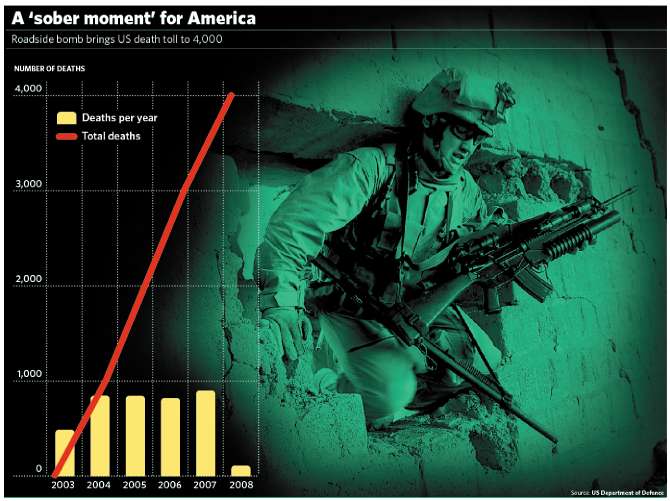
The number of US troops who have died in Iraq since the invasion five years ago has hit the 4,000 milestone following a roadside bomb in south Baghdad that killed four American soldiers.
US military fatalities are half those suffered by the Iraqi army and police, of whom 8,037 are known to have been killed. American losses are even more limited compared to Iraqi civilian casualties, which are unknown but are likely to total several hundred thousand.
But in the US it is the number of American soldiers killed which is politically important because it is used as a barometer showing how well or badly the war is going for Washington. The fall in fatalities from two or three a day to one a day in recent months has therefore had an exaggerated political impact as evidence that the US is at last on the road to success.
The latest US casualties occurred late on Sunday night at the end of a day when 61 Iraqis died, underlining the extreme violence still continuing in the country. In the northern city of Mosul a suicide bomber driving a truck packed with explosives blew himself up in an Iraqi army headquarters, killing 13 soldiers and wounding 42 other people. The Green Zone in Baghdad was hit by mortar rounds and rockets, igniting fires that sent up clouds of black smoke over the city.
The White House described the 4,000th US death as "a sober moment", while the Democratic presidential candidates Barack Obama and Hillary Clinton both pledged to honour the memory of the fallen soldiers by bringing US troops home as quickly as possible.
In reality US military losses in Iraq have never been very great compared with Vietnam, Korea or the Second World War and have averaged 800 to 900 dead a year in the four years to 2007. Most have been in the Sunni districts of Baghdad or in provinces where there is a large Sunni population such as Anbar, Nineveh, Salahudin and Diyala.
Many of the wounded – who number more than 29,000 – would have died in previous wars and have been saved because of medical advances. This means, however, that a larger proportion of the wounded have suffered incapacitating injuries.
Though the military casualty level has not been very high it has been politically unsustainable in the US because George Bush declared the war won in 2003. There is also no sign that the war is likely to come to an end in the near future.
In an election year the White House is seeking to portray the fall in violence as a turning point in the war though the US commander in Iraq, General David Petraeus, has been much more cautious. The main change contributing to the fall in violence is that Sunni insurgent groups, previously battling US troops, have in many cases switched sides and are now co-operating with and are paid by US forces.
The 90,000 members of al-Sahwa, or the Awakening Councils, are overwhelmingly Sunni and, while allied to the US, are often hostile to the Shia-dominated Iraqi government. The Shia often view al-Sahwa, particularly in Baghdad, as less of a reaction against al-Qa'ida in Iraq than al-Qa'ida taking a new form. The sectarian divisions in central Iraq remain as deep as ever and very few of the 2.2 million Iraqi refugees who fled have returned.
The fragility of the military situation in Iraq is illustrated by the White House's decision to halt reducing the number of US troops below the level they were before "the surge" at the beginning of 2007.
Iraqi officials say the US government is keen to limit bad news from Iraq in the run-up to the election in November. The Iraqi government is itself eager to play down bad news and police have started to chase away television cameramen taking pictures of the aftermath of explosions in Baghdad.
Join our commenting forum
Join thought-provoking conversations, follow other Independent readers and see their replies
Comments