Gaza leader at war with Israel – and his own rivals
Hamas PM Ismail Haniyeh is buffeted by Palestinian public as hardline militants come to the fore
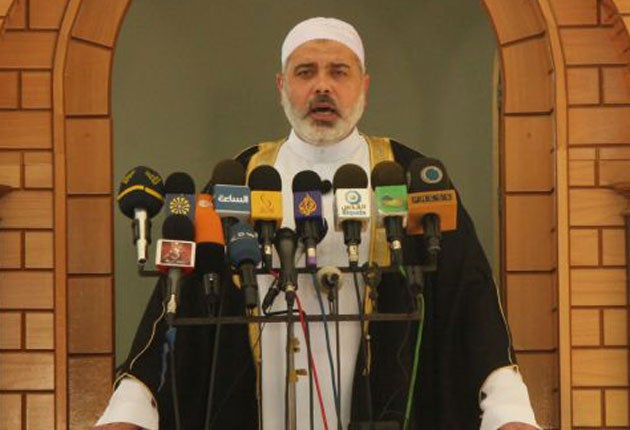
Ismail Haniyeh will hardly be encouraged to emerge from wherever he is hiding in Gaza by the bombing which killed his Hamas comrade Nizar Rayan and 19 others including 11 Rayan children on Thursday. Mr Haniyeh, who as de facto Prime Minister is arguably the Islamic faction's highest-profile political figure in Gaza, appeared on Wednesday on television addressing the people of Gaza, but it was impossible to tell from the background where he was: the wall behind was covered by a huge blown-up photograph of Jerusalem's Dome of the Rock.
The two Hamas leaders played markedly different roles in the Islamic faction. Mr Rayan was essentially a militarist, closely associated with the least compromising elements of Hamas; Mr Haniyeh, while fully sharing the collective responsibility for Hamas's conduct over the past turbulent years, including suicide bombing in the Nineties and during the second intifada, is – relatively– a more pragmatic leader. He has regularly pursued ceasefires and sought at the very least to augment the use of the bullet with that of the ballot box. Asked about the goal of eliminating Israel, he said in 2006: "Does someone believe we can use guns to destroy a state that has F-16s and 200 nuclear warheads?"
As a leader who still lives simply with his wife and 12 children in the Beach Refugee camp in Gaza City, he enjoys personal popularity in the movement and among many Gazans outside it.
But now he is a trebly beleaguered figure. He symbolises for Israel the enemy with whom it is relentlessly at war. He has to bear the brunt of complaints from the Gazan public that Hamas's term of office has delivered no benefits to its people except perhaps for internal order. And within Hamas, the more political – rather than military – tendency he represents is currently in eclipse.
Too young to have been one of Hamas's founders in 1988, and hailing from a family who like Mr Rayan's were 1948 refugees from the area of what is now Ashkelon in Israel, Mr Haniyeh, who attended UN schools, is not a multi-degree intellectual like many of his colleagues. But with a BA degree in Arabic from the Islamic University, he has, according to Wisam Afifeh, editor of the broadly pro-Hamas weekly Al Risala, "a beautiful voice in reciting Koran, with a command over the Arabic language".
Though not a star at university like Hamas's assassinated leader Abdel Aziz Rantisi, he was head of the students' council from 1985-6 representing the Muslim Brotherhood. But he was also a notable and well-built midfielder in the Islamic Association football team, according to one opponent – on the football field.
Arrested three times by Israel in the late Eighties, latterly as a Hamas activist during the first intifada, he was later one of more than 400 expelled to southern Lebanon in December 1992.
But it was under the wing of Sheikh Ahmed Yassin, the founding spiritual leader of Hamas as a movement which combined an armed wing with social welfare institutions, that Mr Haniyeh began his political ascent, rising to be his mentor's bureau chief. He would be one of the lunch guests at the house when in September 2003 an Israeli bomb landed on it in the first attempt to assassinate Yassin. (Israel succeeded in assassinating him six months later.)
Long before that, however, in the mid-Nineties, he and his long-time ally, the Hamas journalist Ghazi Hamad, were among those advocating the faction should form a political party and contest the elections that would create the Yasser Arafat Palestinian presidency.
Although it had some support among activists, Mr Haniyeh lost out to the prevailing argument that this would imply endorsement of the Oslo accords which Hamas steadfastly opposed. It would not be until the parliamentary elections of 2006 that Mr Haniyeh's view prevailed. They were elections that few in Hamas, least of all Mr Haniyeh, who was propelled into the Palestinian premiership, expected to win.
With the older Ismail Abu Shanab – assassinated by Israel in 2003 – Mr Haniyeh was a strong advocate of the shortlived ceasefire in the same year, of the one negotiated with Hamas leaders by the newly elected President Mahmoud Abbas in 2005, and, it is safe to assume, of the one which started to break down in November and which Hamas officially abandoned last month, helping to bring the crisis to its current bloody climax. On all this – and probably on the civil war against Fatah which brought the shortlived coalition to its bloody Hamas victory in June 2007 – Mr Haniyeh was on the side of (again relative) accommodation and coalition, but lost out to his harder-line colleagues like Said Siyam and Mahmoud Zahar.
It is perhaps part of Mr Haniyeh's lot to have been caught between the hardliners on his own side now – literally – calling the shots, and the consistent treatment – and consequent boycott – by Israel and the US of Hamas as a monolithic terrorist organisation.
As the titular Hamas leader in Gaza, Mr Haniyeh is constrained by two important factors highlighted by Beverly Milton Edwards, the Queen's University Belfast academic and long-time expert on Hamas. First, the structure of Hamas since 2003 does not allow for a single dominant leader on the lines of Hizbollah's Hassan Nasrallah. Secondly, as she puts it: "Those [in Hamas] pursuing the political path are as thwarted by their internal opponents as by Israel's and the US's refusal to listen to what they want to say."
Join our commenting forum
Join thought-provoking conversations, follow other Independent readers and see their replies
Comments