Gazans return to mourn their dead and salvage their lives
One family's story tells how Israeli shells killed dozens of relatives while soldiers vandalised their homes
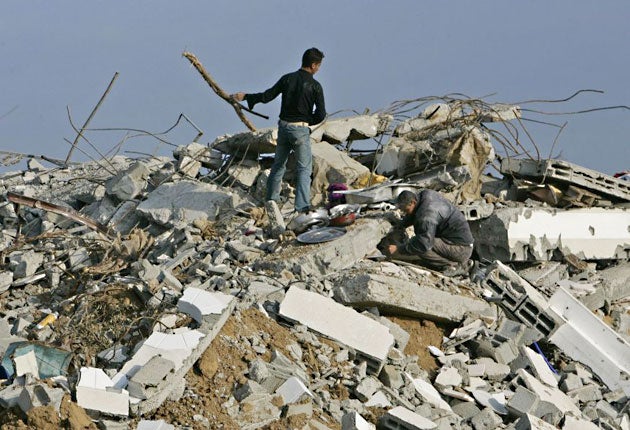
On a stretch of sand between flattened buildings, the stricken Samouni family were yesterday erecting the mourning tent for 22 of their relatives whose decomposed bodies had been dragged from the rubble a fortnight after being killed by Israeli shelling.
It was the first day that Gazans were able to return to the site of their ruined homes since the end of the Israeli military offensive. Most of the survivors of the Samouni extended family came to survey the 12 acres of razed farmland, a destroyed mosque and the pile of bulldozed concrete which had been the warehouse where 80 of them had taken shelter, only to come under lethal tank or aerial fire, or both.
For Mousa Samouni, 19, reticent and with every indication of still being in deep shock, the return was the culmination of a horrific experience that began at 7.30am on 4 January, when Israeli troops arrived at his home in the Zeitoun district of southern Gaza City under the cover of heavy fire as the offensive pushed west from the border towards the coast.
The accountancy student, in his first year at Al-Azhar University, said the troops had moved his family next door and then told both groups to join other members of the clan in a warehouse across the road, owned by the vegetable seller Wael Samouni. The troops then occupied the two houses.
He returned yesterday to find the houses ransacked and scarcely habitable, with furnishing and electrical appliances tossed out of the window, gaping holes in the wall made for firing positions, furniture smashed, clothes piled on the floor, pages of family Korans torn out and remains of soldiers' rations littered in many rooms.
Stars of David and graffiti in Hebrew and English proclaiming "Arabs need 2 die", "no Arabs in the State of Israel" and "One down and 999,999 to go" had been scrawled on walls. A drawing of a gravestone bore the inscription "Arabs 1948 to 2009".
But the two houses were at least still standing. Many smaller homes to the east had been flattened by bulldozers after being cleared of their occupants, apparently to establish a clear field of fire from which troops could target any militants to the east. One family member, Hesham Samouni, 35, said 14 of these homes had been destroyed.
As had Wael Samouni's warehouse. It had first been hit by Israeli missiles in an attack on 5 January – reported in detail in The Independent – which was launched as a few family members began taking other relatives to the building, which they thought was safe. Mousa said he fainted in the attack. By the time he came round, his mother, Rebab, 36, his father, Rashed, 42, and his two brothers, Mohammed and Walid, were dead, along with at least 21 others, including several children, among them a five-month-old baby.
After the attack, he escaped with his freshly widowed sister-in-law, Maysaa, to the nearby home of an uncle, where he found about 50 other members of the clan, including at least half a dozen men handcuffed and blindfolded. He said soldiers ordered him to stay, and confirmed his sister-in-law's testimony that the men were being kept in detention "in case Hamas comes".
The detained men included Imad Samouni, 38, who said yesterday that the others had been released but he and Mousa, again blindfolded and their hands tied with nylon handcuffs, were kept on opposite sides of a room and told to remain sitting or kneeling until the Wednesday.
At one point, he claimed the soldiers guarding them had put bags of white powder – apparently explosives – attached to wires near him. He said the soldiers had at times talked to each other in Hebrew – which he understood from 12 years working in Israel – of shooting him if he disobeyed.
Acknowledging that the soldiers had offered food and water to the men, Imad Samouni added: "Mousa did eat but I refused. They let us go to the bathroom if a soldier was with us though this depended on who was on duty. Mousa did in his pants a few times. Then on the Wednesday an Israeli who said his name was Eitan came and said: 'I can see you're not Hamas. You are not eating and you will die here if you carry on. You can go.' I said I would not leave without Mousa and they let us go."
There was little sign of support for Hamas among the family yesterday. In the house next door to Mousa's, Khamiz Samouni contemplated the damage wreaked on his home, including a one-by-six-metre hole ripped out of the floor, apparently to allow soldiers to fill bags with sand.
Khamiz, 22, a car paint-shop worker, lost his father, Talal, and his mother, Rahme, in the 5 January attack on the warehouse. He also said that they had been ordered by troops to go to the warehouse the day before the attack. "I blame both Israel and Hamas," he said. "Do you think all this would have happened if Hamas had not been in power?"
The Palestinian health ministry in Gaza claims that 48 members of the Samouni family were killed during the course of the operation.
After the Red Cross found four terrified and weak children in the area two days after the attack, Navi Pillay, the UN high commissioner for human rights, suggested the attack could qualify for a war crimes investigation. The Israeli military says it is investigating the events but regularly lays blame on Hamas for operating in civilian areas.
Clan members insist Hamas was not active in the immediate area and that bullet holes in the two houses occupied by the troops had been made by Israeli forces as they approached.
As women of the family attempted to clean up one of the houses yesterday, Wafa Samouni said: "Hamas and Israel should make peace. I want Israel or Hamas to lose. I don't want our children to be the losers."
Join our commenting forum
Join thought-provoking conversations, follow other Independent readers and see their replies
Comments