Hamas takes fight to the streets of Gaza
Plan for peace via an international force along Gaza's borders faces huge obstacles
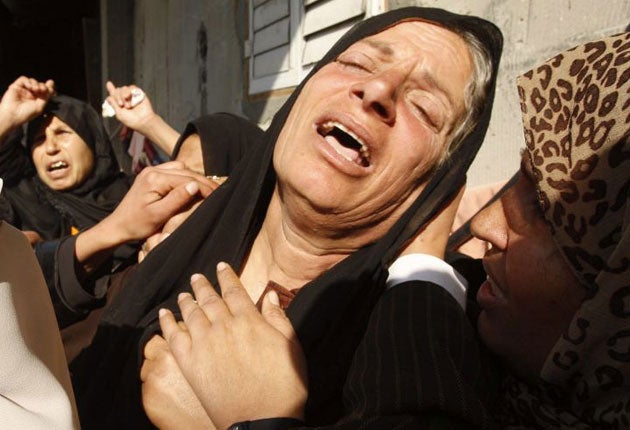
Heavy fighting was under way in the north of Gaza City last night as the Israeli Defence Minister, Ehud Barak, pledged to continue the war against Hamas – entering its 10th day – until "peace and tranquility" returned to the south of his country.
Residents in the territory's main city reported heavy ground and air bombardments that were sending plumes of smoke into the air as flares and fires lit up the night sky above the northern district of Zeitoun where some of the most intense engagements were believed to be taking place.
There were unconfirmed reports last night that up to nine Israeli soldiers had been killed or seriously injured in Gaza. The Israeli government refused to confirm the reports, saying only that eight soldiers had been injured.
In the first acknowledgement that heavy exchanges of fire had taken place on Gaza streets between troops and Hamas militants, the military said aerial and artillery forces "had assisted ground forces by attacking armed gunmen approaching them, striking launching areas from which Hamas fired rockets at the forces". It added it had "hit dozens of terror operatives". Meanwhile Hamas – which fired about two dozen rockets at Israel – vowed to wait for Israeli soldiers "in every street and every alleyway".
While citing Palestinian Ministry of Health figures saying that the total death toll so far in the offensive had risen to 534 and that at least 2,470 had now been injured, a UN report last night said that "the danger to medical staff and the difficulty of extracting the injured from collapsed buildings" made precise estimates difficult.
Saying the population of Gaza was "bearing the brunt" of the violence, the Palestinian death toll had risen by 94 since the beginning of the ground offensive on Saturday night. It said "many" recent deaths had been women and children "with entire families" among the dead. Reuters quoted local medics as saying that 13 members of a single family had been killed in the shelling of a house in eastern Gaza. By 3pm, 25 Palestinians had been killed since the early morning alone, at least 10 of them thought to be children.
Some residents were called as many as three times during the previous night with recorded messages in Arabic from the Israeli military saying it was damaging Hamas and "we will use still other means to do so".
According to the UN, Israeli ground forces, backed by aircraft, tanks, and artillery, were deployed around Gazan population centres, including Gaza City, Beit Hanoun, Beit Lahiya and the Jabalya refugee camp as well as eastern Gaza, the northern middle section of the Strip and south-eastern Rafah. With Gaza now divided in two, internal movement is now extremely dangerous.
The report from the UN Office of Co-ordination of Humanitarian Affairs added: "More than a million Gazans have no electricity or water, and thousands of people have fled their homes for shelter in addition to the destruction of essential infrastructure."
Israeli forces – who a military spokeswoman said had been training for two years in a mock Arab city to prepare for possible urban warfare in Gaza – continued to move into populated areas last night, despite a fresh flurry of diplomatic activity in the region.
As French President Nicolas Sarkozy held talks with the Palestinian President Mahmoud Abbas in Ramallah last night, calling for a ceasefire "as soon as possible", the potential deployment of a "robust" international force along Gaza borders was emerging as a key component of talks between Israel and the international community.
Some European countries – notably Britain – argue that international efforts should be mounted to reinforce Egyptian security at the southern Gaza border to halt smuggling of weapons by Hamas if the fighting ceases.
Such a plan envisages that the international force would, in effect, be a quid pro quo for opening crossings – including for commercial goods – as a means of reviving Gaza's economy since Israel imposed its embargo after Hamas's enforced takeover last June.
Tony Blair, who has held a series of meetings with Israeli leaders and Mr Abbas, is working full time on trying to devise a formula under which such a plan could bring the conflict to an end.
A deal is fraught with difficulties. Israel, beside resisting a direct linkage between the crossings issue and the anti-smuggling measures it regards as paramount, is arguing that any deal should be made with the international community, the Ramallah-based Palestinian Authority and not with Hamas.
The Foreign Secretary, David Miliband, flew to New York last night where Arab foreign ministers are preparing for a UN Security Council session today focusing on a new draft of a UN resolution calling for an end to the "Israeli aggression" and a permanent ceasefire. The Palestinian Foreign Minister, Riyad al-Malki, told reporters that Arab states hoped the draft would be adopted by the 15-member council today. The latest draft also calls for international border monitors and an international force to protect civilians in Gaza.
However UN diplomats said that after Washington blocked a Libyan draft resolution on Saturday – deemed "unbalanced" – it was hard to see a resolution being adopted today. President Abbas will be in New York for the session
Join our commenting forum
Join thought-provoking conversations, follow other Independent readers and see their replies
Comments