Iran fights back against UN sanctions
Foreign minister questions legality of Britain's Trident nuclear submarines
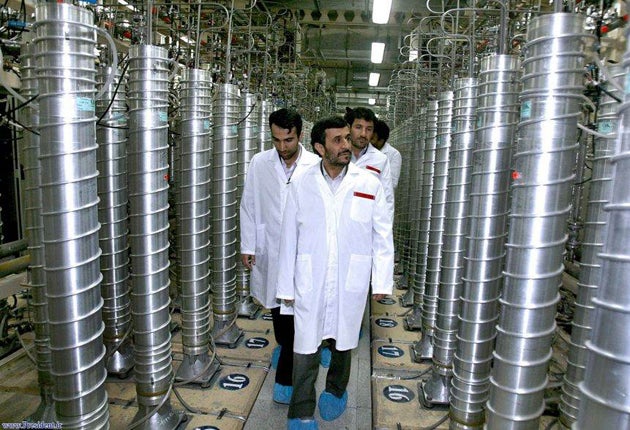
Iran is launching a concerted fightback against Barack Obama's efforts to impose UN sanctions against Tehran, by targeting Israel's nuclear weapons arsenal and the legality of Britain's Trident submarine system. Writing in The Independent today, the Iranian Foreign Minister Manouchehr Mottaki makes a strategic bid to counter pressure from the West by shifting the debate about Iran's disputed nuclear ambitions back to the failure of states such as the US and Britain, which already possess nuclear weapons, to disarm.
Washington, which claims that Iran wants to acquire the means to build a nuclear bomb, is seeking to rally support for punitive sanctions which would starve the country's energy sector of investment, deny it access to international credit and thwart the vast international business dealings of the élite Revolutionary Guard Corps. The US, which is strongly lobbying China and Russia to come on board, believes that targeting sanctions in this way will convince Tehran to resolve the stand-off.
But, in an attempt to turn the tables, Iran seems poised to focus its fire on the Nuclear Non-Proliferation Treaty (NPT) which is coming up for a five-year review in New York next month. As a signatory of the treaty, Iran will have the right to attend the meeting and will use it to seek support from developing countries for the claim that the US, Britain and other Western governments are hypocritically flouting their own obligations under the treaty while illegally trying to block Iran's right to enrich uranium.
It insists that acquiring the right to the full fuel-cycle nuclear programme for civilian purposes is a legal entitlement under the terms of the NPT. The New York gathering will be attended by 200 governments, some of whom are sympathetic to Iran's argument.
In his article, Mr Mottaki accuses "certain" nuclear-armed states which are party to the treaty (the US, the UK, France Russia and China are officially the five signatory nuclear-weapon states) of flagrantly violating their obligation to move to disarmament.
Mr Obama has made cutting arsenals and reducing stockpiles a key component of his foreign policy, including the signing of a new START treaty with Russia. He hopes to blunt the criticism that nuclear-armed states are failing to deliver their part of the NPT bargain. But Mr Mottaki makes it clear that his government will continue to target the British government's commitment to renew the Trident system as an example of the double standards he argues are more of a threat to Middle East peace than Iran's wish for a nuclear-energy programme.
The renewal of Trident, he argues, is a "total contravention" of Article VI of the NPT, which commits nuclear-weapon states to "pursue negotiations" towards disarmament. The narrowest interpretation of Article VI is that they must negotiate in good faith, but Mr Mottaki's interpretation, shared by many of the non-nuclear parties to the treaty, is that it requires them fully to disarm.
Mr Mottaki directly attacks the West's failure to tackle Israel over its undeclared nuclear programme, and its continued refusal to sign up to the NPT. Israel is thought to have up to 200 nuclear warheads. Challenged on Tuesday about the anomaly, Mr Obama would say only that the US had "urged all countries to join the NPT".
The Foreign Minister asserts that the "peaceful nature" of Iran's nuclear activity "has been confirmed by various International Atomic Energy Agency reports". This is open to challenge given the ominous tone of the last report on Iran. It spoke in terms of evidence of "past or current undisclosed activities" aimed at developing nuclear payloads.
A top US defence official told members of Congress yesterday that, as Iran continues to enrich uranium, it might be able to produce an atomic bomb in just one year. "The general consensus – not knowing again the exact number of centrifuges that we actually have visibility into – is we're talking one year," Lieutenant-General Ronald Burgess told a Senate panel.
President Obama would like sanctions to be adopted by the UN Security Council by the end of April. But while discussions have now started between "permanent five" ambassadors and Germany at the UN in New York, it is likely to take longer to arrive at a resolution on which everyone agrees. Diplomats warn that China, now that it has agreed to take part, may use its presence at the table to try to water sanctions down. Most observers in New York think it unlikely that a resolution will emerge before May or even later.
Join our commenting forum
Join thought-provoking conversations, follow other Independent readers and see their replies
Comments
Bookmark popover
Removed from bookmarks