Iran online: Around the world in 60 minutes
Neda Agha-Soltan was denied mourning rites by Iranian authorities desperate to stifle the anger at her killing. Due to the internet, they failed
The image of Neda Agha-Soltan dying on a Tehran street just a week ago spread round the world in hours. Via the internet's most powerful media – YouTube, MySpace, Facebook – a lo-fi cell phone video showed the world her dying moments, after she was shot by a sniper as she watched Iranian security forces clash with demonstrators angry at the presumed "stealing" of Iran's presidential election.
Close-ups of her face, streaked with blood, joined the landmark images of recent history: US soldiers raising the flag after capturing Iwo Jima from Japan in 1945; a naked child screaming from napalm burns as she flees in Vietnam, 1972; the lone student facing down Chinese tanks in Tiananmen Square, 1989.
Within hours, the power of Neda's final moments had inspired songs, poetry and the creation of websites such as Nedanet, where hackers offer Iranians ways to circumvent online censorship. The web has made Tehran the world capital of online dissent, and Neda is at its hub.
A Facebook page called "Angel of Iran", one of 50, was set up to mourn her and candlelit vigils sprang up across the world. "Such a beautiful young lady to have been subjected to the slings and arrows of a corrupt Islamic regime," lamented one entry.
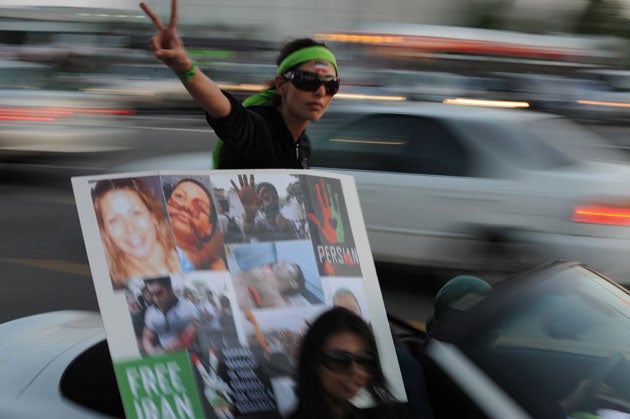
Her face adorned placards last week at unauthorised demonstrations in Tehran and elsewhere, even though security forces turned out in ever greater numbers to crush protests.
Despite the repression, Neda's slaying appears to have stiffened the resolve of those who support the opposition leader Mir Hossein Mousavi's drive to get the election results annulled. It has also drawn the scrutiny of the world.
President Barack Obama, previously reluctant to be seen to stir up already troubled relations with Iran, called the video heartbreaking. "We have seen courageous women stand up to brutality and threats, and we have experienced the searing image of a woman bleeding to death on the streets," he said. "While this loss is raw and painful, we also know this: those who stand up for justice are always on the right side of history. I think that anybody who sees it knows that there's something fundamentally unjust about it."
His sentiments were echoed countless times in tributes across the internet. One blogger wrote: "I don't quite understand what's going on in Iran right now, but I am so touched by this woman's story. I am most touched because she was just a regular person. A regular person who wanted to have regular freedoms like the kind of freedoms I would want if I were her. Sometimes it's hard for me to be sympathetic with people fighting for a cause because I have become a bit desensitised by all the images of fighting, war, burning vehicles, bombs, etc. But this woman brought it all home to me again. When I heard her story and saw her picture, I could imagine that being me."
In Iran, the fact that Neda was not a protester was academic. Her fiancé, Caspian Makan, said: "Neda's goal was not to support Mousavi or [President] Ahmadinejad, she was just in love with her country. She was a young woman, but gave a big lesson to everybody ... Neda just wanted to have freedom for everybody."
The security forces warned relatives and neighbours of the dead woman not to speak or mourn her publicly, associates said. They even banned her family from commemorating her death in the local mosque and asked them to take down the black mourning banners in front of their house. But friends and acquaintances have continued to celebrate her life and mourn her death online.
Neda Agha-Soltan was born in Tehran in 1982. Her father worked for the government. A family of modest means, they are said to be typical of Iran's middle class. Neda was loyal to the country's Islamic roots and traditional values, friends say, but also curious about the outside world, which was easily accessed through satellite TV, the internet and occasional trips abroad. The second of three children, she studied Islamic philosophy at Tehran's Islamic Azad University until deciding to pursue a career in tourism. She took private classes to become a tour guide, including Turkish-language courses, friends said, hoping to one day to lead groups of Iranians on trips abroad. Travel was her passion, and with her friends she saved up to go on package tours to Dubai, Turkey and Thailand. She also loved music, especially Persian pop, was herself an accomplished singer and was taking piano lessons. "She was a person full of joy," said her music teacher and friend, Hamid Panahi. "She was a beam of light. I'm so sorry. I was so hopeful for this woman."
The speed with which Neda became an emblem of resistance clearly took the Iranian authorities by surprise. They moved swiftly to stifle protests around her death. She was buried quickly and with no wake. Those people who tried to defy the authorities faced physical threats and intimidation.
Last Friday, small groups of people gathered at Tehran's Behest-e Zahra cemetery to mourn her. Members of the government's Basij militia had beaten passers-by, so mourners arrived in groups of two or three, muttering brief prayers before leaving.
Neda's grave, marked by a small cement block, was covered with flowers and green ribbons, the signature colour of Mousavi's campaign. "What sin did she commit?" asked a young woman who was in tears as she knelt by the grave. An elderly man who came with his family – one of the children wearing a green wrist-band – said, "Pray for our future."
The authorities' attitude has only served to feed the online rebellion. When the bullets and batons failed to stem the tide, the authorities came up with their most incredible explanation of her death, suggesting on Thursday that the BBC's expelled correspondent, Jon Leyne, arranged for Neda to be killed so he could get good propaganda pictures. They even suggested she might have been shot in the back by a protester.
Both suggestions were dismissed as "outrageous nonsense" by Arash Hejazi, the 38-year-old Iranian doctor who tried in vain to save Neda. Dr Hejazi, who studies at Oxford, was in Tehran on business when he witnessed the killing.
"As a doctor I'd seen death before, but I never thought I'd have such a feeling. It was not just her death, but the injustice of the thing and the gaze in her eyes as life was leaving her," he wrote in a blog. Fearing for his life, Dr Hejazi fled Iran and fears he may not be able to return.
President Ahmadinejad said yesterday that Mr Obama had made a mistake by criticising Iran over the violence inflicted on protesters. Amid a security clampdown, added to on Friday when a cleric demanded protesters face the death penalty, the opposition is struggling to maintain momentum in its campaign to get the election results annulled.
Join our commenting forum
Join thought-provoking conversations, follow other Independent readers and see their replies
Comments