Iraq bomb deaths blamed on 'useless' detectors
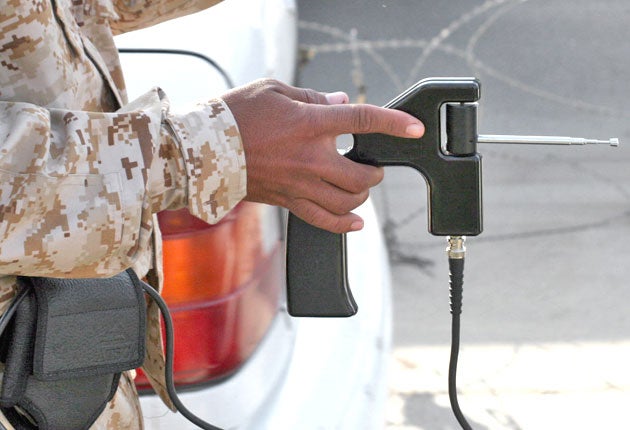
A bomb-detector long exposed as useless continues to be used by the Iraqi army and police at hundreds of checkpoints in Baghdad as their chief method of finding out if vehicles contain explosives and weapons.
The continuing reliance of the Iraqi security forces on the instrument may explain how al-Qa'ida has succeeded in sending vehicles packed with explosives undetected into Baghdad, where they have killed and wounded several thousand people over the last year.
The bomb-detectors, known as "sonars" to Iraqis, are hand-held devices with a "wand" that is supposed to twitch if there are explosives or weapons present. It is meant to work on the same principle as water-divining rods and has no power source, relying instead on the static electricity generated by the movement of the person holding it.
The British and American governments, numerous independent experts and repeated tests have shown that the ADE-651, manufactured by the ATSC company in the UK, does not work. Jim McCormick, the managing director of ATSC, was arrested on suspicion of fraud in January, and the British Government banned the export of the ADE-651.
At the same time the Iraqi Prime Minister, Nouri al-Maliki, ordered an investigation into how the bomb-detectors had been purchased at a cost of $85m (£58m) by the Iraqi security forces in 2008 and 2009. Yesterday, ATSC was not answering the phone number given on its website.
Despite the well-attested uselessness of the bomb-detector, senior Iraqi security officials have said that they are confident about its effectiveness and the Interior Ministry has never withdrawn it. A government spokesman said earlier in the year that only some of the "sonars" were fake and these had been removed from service. No spokesman was available yesterday to comment on the devices.
The normal procedure in Baghdad is for a policeman or soldier at a checkpoint to walk beside a vehicle holding the device. If it twitches, he tells the occupants of the vehicle that he suspects them of carrying explosives or weapons. When it turns out that these are not present, as is almost invariably the case, it is explained that the "sonar" has been misled by the presence of perfume or platinum fillings in teeth.
Many Iraqi policemen have ceased to believe that the ADE-651 works. Police Captain Hussein Ali says: "Time and again we have found it is useless." He explains that when he and his men first received the instrument in early 2009, they were happy because they believed they finally had the means of finding concealed explosives and weapons. He said: "We were told it was very modern and would free people from the fear of terrorism. Now we are embarrassed by it."
However, earlier this week I was prevented from entering one heavily guarded area with my car because the wand had twitched. I continued on foot but the police insisted that the car be parked a hundred yards away from them in case it really did contain a bomb. Yesterday, the same car was stopped on Jadriyah bridge over the Tigris and held for 45 minutes for the same reason, until a police lieutenant suggested we cross the river by another bridge where a similar inspection by a bomb-detector produced no results.
The use of the bomb-detectors inevitably makes it easier for al-Qa'ida to send its vehicle bombs through checkpoints. So many innocent vehicles are stopped that there is a permanent traffic jam in Baghdad during rush hour. Most people in the city are also doubtful about the effectiveness of the devices. Mustafa Emir, a student, said "The sonars are not useful and do not protect people. They should be given to the children as toys." He blamed them for making him and other students late for their lectures. "The sonar is always showing that our minibus has arms and explosives in it, though it is obvious we are just male and female students trying to study."
Join our commenting forum
Join thought-provoking conversations, follow other Independent readers and see their replies
Comments