Iraq looks to spectacular oil boom to revive its political fortunes
What is being called the great Iraqi oil rush has gained momentum in the wake of BP's Gulf of Mexico disaster
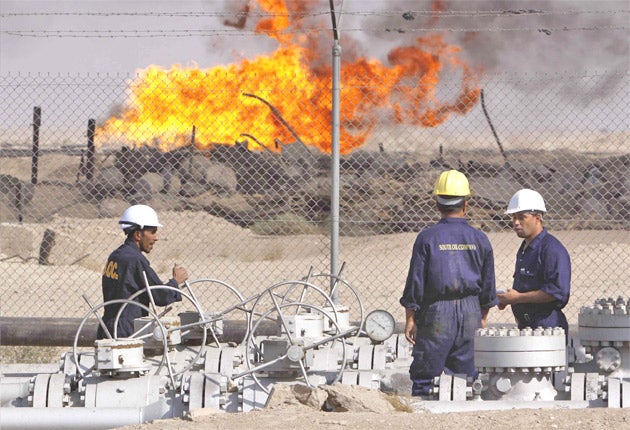
The map of the world's main energy suppliers is about to change as Iraq's oil output quadruples over the next 10 years according to new forecasts. Iraq will eventually displace Saudi Arabia as the world's biggest exporter, experts predict, giving Baghdad crucial influence over the future price of oil.
The rush to exploit Iraq's "super-giant" oilfields, of which it has the largest concentration in the world, has gathered impetus with unexpected speed in the wake of BP's disaster in the Gulf of Mexico which has raised fears over deep-sea drilling. Iraq's oil has the advantage of being both onshore and cheap to develop.
The intensifying political isolation of Iran, and the latest moves by the UN Security Council to target the Islamic regime with increasingly tough sanctions in a bid to prevent its development of nuclear weapons is a second key factor influencing Iraqi production. Iran may have unexploited reserves, but its oil output is expected to fall significantly as its old oilfields are depleted and not replaced.
Iraq, by contrast, aims to raise its crude production from 2.5 million barrels a day today to 9.5 million in 2020 under contracts signed with the world's biggest oil companies over the last 12 months. This development should be feasible, experts believe, because the rise in production will come from improved exploitation of oilfields already discovered rather than from the discovery of new ones.
The outcome of what is being called "the great Iraqi oil rush" will inevitably transform the balance of power between oil-producing states with Iraq the winner, Saudi Arabia and Iran the losers. Dr Leo Drollas, chief economist of the London-based Centre for Global Energy Studies, who has produced the first comprehensive study of the impact of the new Iraqi contracts and the consequences of an accelerated oil rush over the coming years, predicts that "the evolution of Iraq's oil capacity over the next 10 years promises to be the most important issue confronting Saudi Arabia in particular and Opec and the oil industry in general."
Saudi Arabia and Iran will both be badly hit as Iraq raises its oil production even if it does not achieve its maximum target. Dr Drollas says: "Saudi Arabia will only meet its revenue needs if Iraq wholly fails to meet its production plans." Given that Opec has more capacity than it needs to meet demand, increased Iraqi output will drive down the price of oil.
The development of Iraqi oil at breakneck pace started when the Iraqi government awarded 11 service contracts in two rounds of bidding to international oil companies such as BP, Royal Dutch Shell and Exxon last year. At the first auction last summer many companies held back or had their bids rejected as too costly, but at a second round of bidding at the end of the year there was a rush to sign up by more than 20 companies. Much of the world's oil industry felt that Iraq's oilfields represent a once-in-lifetime opportunity they could not ignore.
At stake are some of the biggest oilfields in the world. Rumaila oilfield just north of the Kuwaiti border, for example, is expected to produce 1.85 million barrels a day, West Qurna 1, north of Basra, 1.84 million and Majnoon, in the salt marshes on the Iranian border, 1.3 million. Increased Iraqi output will total 7.5 million, far in excess of the expected increased production capacity of all of the rest of Opec.
The sums of money involved are also huge. This week Shell signed a $12.5bn natural gas production venture with Iraq. The companies developing Iraq's oil, for which they are paid a fee per barrel and do not get a share in production, will spend $100bn over 10 years according to Iraqi oil minister Hussain Shahristani. He adds that Iraq itself should benefit by $200bn.
It has long been known that Iraq has vast oil reserves, mostly in the south of the country around Basra, but these have been under-exploited because international oil companies were locked out of Iraq after the nationalisation of oil by Iraq in 1972. The Iraqi government did not have the resources to develop its own oil industry at a necessary pace in the 30 years of war and sanctions following the start of the Iran-Iraq war in 1980.
But staff from the giant oil companies have been pouring into Basra recently, establishing expensive headquarters in the city. Visiting diplomats said they were impressed with the speed with which the oil giants are moving to develop the Rumaila field in particular. At the heart of the current excitement is that there may be more oil under the sands of southern Iraq than almost anywhere else on the planet. The country has 115 billion barrels of proven reserves but there may be up to another 100 billion barrels under the Western Desert where there has been little exploration.
This is on top of oil and gas reserves already discovered. These include nine "super-giant" fields (over five billion barrels) and 22 known "giant" fields (over one billion barrels). The US Department of Energy, citing independent consultants, says the cluster of super-giant fields in south-eastern Iraq forms "the largest known concentration of such fields in the world and accounts for 70 to 80 per cent of the country's proven oil reserves". A further 20 per cent of Iraq's oil is around Kirkuk where it is a source of continuing dispute between the Kurds, the local Arabs and the government in Baghdad. Iraq badly needs more oil revenues which last year were around $60bn. This was underlined in June by riots and demonstrations over the lack of electricity as summer temperatures reached 50C. The Electricity Ministry says it needs $5bn a year to build new power stations and fix old ones but it gets a maximum of $1.2bn a year.
The rest of the Iraqi infrastructure is in the same state. For 10 years after 1980 Saddam's government spent all its money on weapons and from 1990 until its overthrow it did not have much money because of sanctions. No new hospitals were built after the early 1980s. Power stations grew so old that spare parts were no longer manufactured. Much of Iraq does without clean drinking water and raw sewage often goes straight into the Tigris or Euphrates. Restoring this derelict infrastructure will be costly.
Not that money alone will solve all of Iraq's problems. Government administration is dysfunctional and corrupt. Basic needs can often only be acquired by bribery. In one recent case, a pregnant woman who taught at a Baghdad university applied for a month's paid leave as was her right. The university administrators informed her that they would reject her request unless she paid them a month's salary.
The incapacity and corruption of government helps explain why so little has been done to rebuild Iraq seven years after the fall of Saddam. A significant proportion of state revenues are spent on salaries and pensions because the state acts as a giant patronage machine in which its supporters get jobs regardless of ability. This is one way of distributing oil revenues, though an unfair one, that is unlikely to change, so money for investment requires higher oil revenues.
Whatever happens politically in Iraq the development of its oil reserves can only gather pace. It is the one trump card held by the embattled government in Baghdad and it is bound to play it. Most of the oil discovered hitherto is in the Shia heartlands around Basra where there has been little fighting so continued violence in Baghdad and Mosul will not stop the oil rush.
Political deadlock
Months after Iraqis voted in a general election, there is still no sign of a new prime minister and concerns are growing about the lack of progress in negotiations.
The power vacuum has raised fears about a resurgence of violence which may complicate US plans for military withdrawal. Bombings and shootings claimed a dozen lives on Tuesday alone, while a suicide bomber blew himself up at a hospital in Anbar province yesterday, injuring several people.
The two main rivals for power, the incumbent premier Nouri al-Maliki and his challenger, Iyad Allawi, neither of whom managed to secure an overall majority at the ballot box, met on Tuesday for only the second time since the 7 March poll. No breakthrough was announced.
There was speculation, nonetheless, that the two men may start to pursue an alliance of convenience. Mr Maliki is accused by some, including fellow Shias, of behaving like a dictator, and faces dissent from within his own Shia-led coalition at the prospect of him remaining as Prime Minister for a second term. His grouping consists of his State of Law party and the Iranian-backed Iraqi National Alliance (INA).
But he may have to turn to Mr Allawi's secular Iraqiya grouping for support instead. There is also deadlock over the issue of whether to retain the current, highly sectarian quota system for sharing out government posts between Sunni, Shia and Kurds.
The US ambassador to Iraq, Chris Hill, is pessimistic about any breakthrough before the autumn. "I think we are in the preliminary stage," he said this week. However, the longer talks continue, say analysts, the longer it will take to push through economic reforms, including ones that investors in the oil industry are anxious to see.
Join our commenting forum
Join thought-provoking conversations, follow other Independent readers and see their replies
Comments