Iraq's voters show faith in Maliki regime
Provincial election results put Prime Minister first and weaken religious opponents
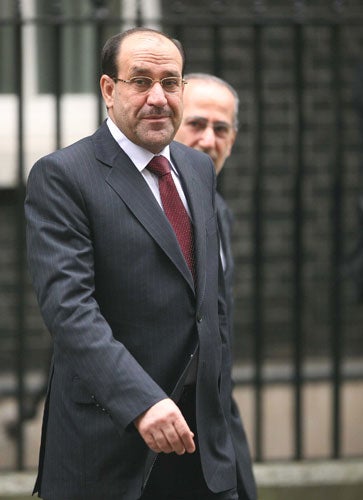
Iraq's Prime Minister Nouri al-Maliki has finished first in provincial elections, strengthening the central government and weakening the religious parties that dominated after the fall of Saddam Hussein. But Iraqis still voted along sectarian or ethnic lines with Mr Maliki's successes all coming in Shia-dominated provinces.
The election commission announced yesterday that the premier's "State of Law" coalition had won 38 per cent of the votes cast in Baghdad and 37 per cent in Basra, Iraq's two largest cities. It also finished first in seven other provinces south of Baghdad. Among the Sunni Arabs, nationalist and secular parties did well.
Mr Maliki will be able to claim that his policy of strengthening the central government, which saw him confront at different times last year the Shia militia of the anti-American cleric Muqtada al-Sadr, the US government and the Kurds, has been endorsed by voters. The elections to the powerful provincial councils in 14 out of 18 provinces are seen as a preview for the parliamentary elections in December.
The Islamic Supreme Council of Iraq (ISCI), which had been the largest Shia party, did badly, winning fewer votes than Sadr followers in Baghdad and 11.6 per cent of the vote in Basra because its rulers were seen as failing.
The Prime Minister did well in part because Iraqis see security improving compared with the Sunni-Shia civil war of 2005-7 when, at its worst, 3,000 people died every month. In January this number fell to 199, the lowest figure since the US invasion. But in a sign that Iraq remains one of the most violent countries in the world, a bomber blew himself up yesterday in the Kurdish town of Khanaqin, Diyala province, killing at least 16 people.
The election so far has had two contradictory effects: it has reinforced the popular mandate of the government; but it has also heightened the political temperature in provinces such as Diyala, where control is contested by Sunni, Shia and Kurds. "The terrorists want to destroy the happiness of the Kurds over their election victory in Khanaqin," said Salahudin Kokha, a Kurdish leader.
There are also heightened tensions in the Sunni Anbar province where US troops were asked to stand by in case of trouble. A leader of the Awakening Council, the movement of tribal leaders and former insurgents who turned against al-Qa'ida and allied themselves with the US, said the vote had been stolen by Sunni rivals.
The elections have also led to important changes in the northern province of Nineveh which is contested between Sunni Arabs and Kurds and has remained very violent. The council had a Kurdish majority because of a Sunni boycott in 2005. But in Saturday's poll the Sunni al-Hadba bloc won 48.4 percent of the votes.
The voting shows that Mr Maliki and his Dawa party are stronger but the significance can be exaggerated. Although he fought a secular campaign, on important decisions Mr Maliki does not generally act without seeking the opinion of the Shia Grand Ayatollah Ali al-Sistani.
The election has also been painted as a setback for Iranian influence but Mr Maliki is still going to keep close relations with Tehran while remaining on good terms with the US. One test of the success of the election will be how far the results are accepted by the losers.
Join our commenting forum
Join thought-provoking conversations, follow other Independent readers and see their replies
Comments