Israel calls for action as Syrian military shells Homs again
Hague says nothing has been ruled out, but Israeli leader calls for intervention now to halt the massacres
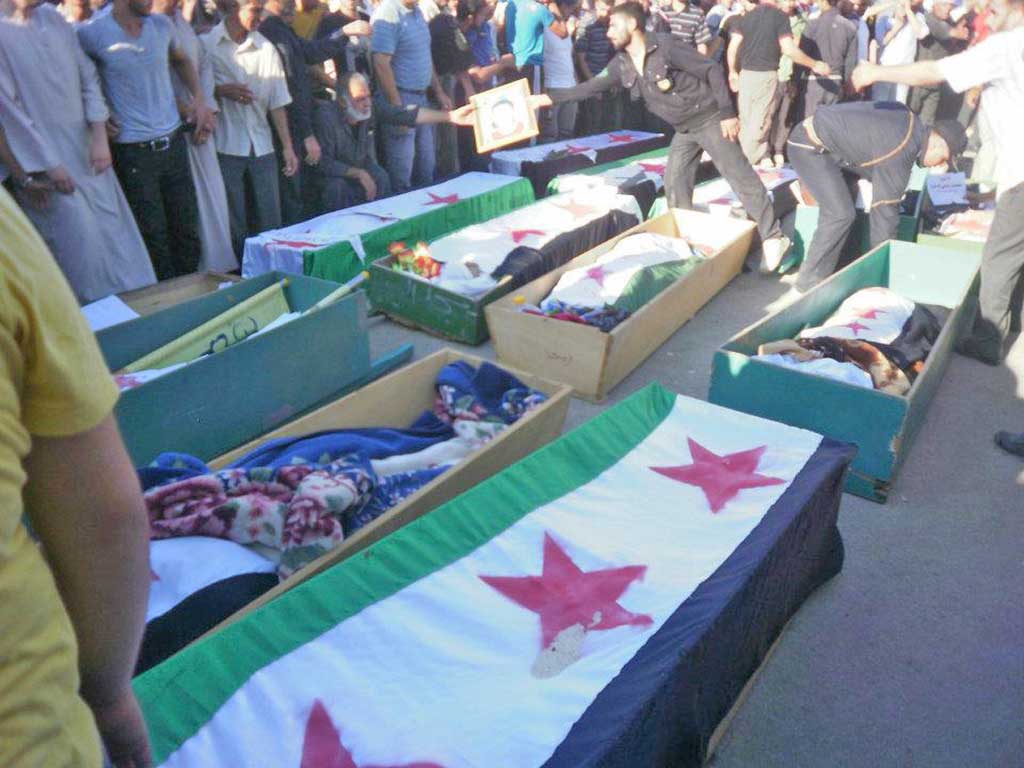
Syrian government forces resumed their lethal assault on the province of Homs yesterday, activists said, as Israel launched its strongest verbal attack yet on Bashar al-Assad's regime with an explicit call for military action against its neighbour.
Opposition activists said 38 people had died since Saturday as the regime attempted to regain control of rebel strongholds in Homs. They said Damascus had sent reinforcements to the mountainous area of Haffa, near the coastal city of Latakia, where heavy fighting has reportedly raged since Tuesday.
William Hague, the British Foreign Secretary, compared the mounting threat of an all-out sectarian civil war in Syria to Bosnia in the 1990s and warned that time was "clearly running short" for the former UN Secretary-General Kofi Annan's peace plan. Asked by Sky News if he would rule out the use of force, Mr Hague said Syria appeared "on the edge of collapse or of a sectarian civil war so I don't think we can rule anything out".
Shimon Peres, the Israeli President, said on the eve of a trip to Washington that the "efforts of the international community are insufficient". He added: "We cannot remain indifferent to the tiny coffins that contain the bodies of children. The massacres get worse each day... I have the deepest respect for the rebels who expose themselves to live fire and I hope that they will win." When the uprising in its hostile northern neighbour started last March, Israeli politicians – with a few exceptions – chose to maintain a "strategic silence", with some apparently uncertain whether it might lead to greater instability and others fearful of damaging the opposition forces by association.
But the mounting death toll over the past 15 months and a growing conviction that by detaching Syria from Iran, the fall of the Assad regime was in Israeli interests, have prompted Israeli leaders to ratchet up their expressions of outrage and offer humanitarian assistance to refugees fleeing to Jordan. "A crime against humanity – genocide – is being conducted in Syria today," the Deputy Prime Minister, Shaul Mofaz, told Israel's Army Radio. "And the silence of the world powers is contrary to all human logic. Since in the not-distant past the powers chose military intervention in Libya, here the required conclusion would be immediate military intervention to bring down the Assad regime."
Government shelling has targeted the town of Qusair, close to the Lebanon border. Abu al-Hoda, a Qusair activist, told the Associated Press: "The mortars came down on Qusair by the dozens." He said women and children had been huddled for days in the basements of buildings, too fearful to come out.
Rami Abdul-Rahman, the director of the UK-based Syrian Observatory for Human Rights, claimed that at least 58 regime soldiers had been killed and more than 200 wounded in fighting in the Haffa district between "hundreds" of rebels who had established a base there and government troops backed by helicopter gunships. It said six children were among 10 people killed by a shell that hit a house where they had taken cover on Saturday. The state-run news agency Sana said that "terrorist groups" in Haffa attacked public and private institutions on Saturday and perpetrated "heinous" crimes against civilians, setting fire to the national hospital and forcing people from their homes. It said government troops had killed a number of militants and were still seeking to secure the area.
Meanwhile, in Istanbul the opposition Syrian National Council selected an exiled secular Syrian Kurd, Abdulbaset Sieda, as its President-in-exile for the next three months.
The move was seen as an attempt to bring an element of unity to the chronically fractious council and also to widen its membership to include leaders of the Kurds and other minorities, restive about their fate in a Sunni-dominated post-Assad Syria.
Join our commenting forum
Join thought-provoking conversations, follow other Independent readers and see their replies
Comments