Israel goes cold on plan for regional peace deal
Defence minister backs Netanyahu's refusal to endorse Palestinian state
The Israeli Defence Minister yesterday issued one of the government's bluntest warnings against linkage between its stance on a two-state solution with the Palestinians and efforts to stop Iran becoming a nuclear power.
In what also appeared to be a defence of Prime Minister Benjamin Netanyahu for not committing himself to a Palestinian state, Ehud Barak declared: "These... words will not cause Iran to stop its centrifuges."
The Labour leader added: "Israel has already said in the past 'two states for two peoples' and this didn't cause the Palestinians to fall into our arms and reach all the tough decisions that are required."
Mr Netanyahu said after talks with President Obama at the White House on Monday that he was willing to open immediate talks with the moderate Palestinian leadership. But he again failed – unlike President Obama – to say that the goal would be a Palestinian state. Israeli officials insisted that while Mr Netanyahu's choice of words did not endorse a Palestinian state, they did not condemn it either.
The Israeli government remains sceptical about the emerging view in Washington that progress between Israel and the Palestinians would help to create an international – including Arab – alliance to thwart Iran's perceived nuclear ambitions.
Amid a series of differences between the US and Israel's right wing-led government over Jewish settlements, Iran, and a two-state solution, one possible area of common ground began tentatively to emerge in the wake of the White House meeting. This is the idea of "phased normalisation" by the Arab states in return for movement by Israel towards Palestinian demands.
Thinking in Washington continues to evolve on a possible comprehensive regional solution in the Middle East, though it is not yet clear how much detail the US President will go into when he makes a major speech on America's relations with the Muslim world in Cairo on 4 June.
But while stressing the need for Israel to seize the opportunity for a lasting solution with the Palestinians, Mr Obama told reporters after his meeting with Mr Netanyahu: "The other Arab states have to be more supportive and be bolder in seeking potential normalisation with Israel."
The principle involved in "phased normalisation" is that Arab states would grant gradual moves towards recognition of Israel in return for it making progress with the Palestinians. Diplomats put forward a hypothetical example of removal of settlement outposts or real settlement freeze in the West Bank being "rewarded" by Gulf States allowing the Israeli airline El Al to use their airspace. Most Arab states – while promising recognition of Israel in return for an actual Palestinian state broadly on 1967 borders – have long opposed the phasing idea on the grounds that such "concessions" by Israel are in any case required by international – and, in the case of outposts, Israeli– law.
A prominent settlers' leader, Danny Dayan, predicted yesterday that the Knesset "will stand by our side" if there was any attempt to freeze settlement building in the West Bank. But a leading Israeli analyst, Yossi Alpher, yesterday challenged the view that internal political constraints would prevent Mr Netanyahu from meeting US demands on settlements, especially if such agreement was accompanied by understandings on how to deal with Iran. "If the pressure is strong enough, backed sufficiently by an enlightened President, Netanyahu will feel obliged to respond and this government can absorb it. It won't collapse," he said.
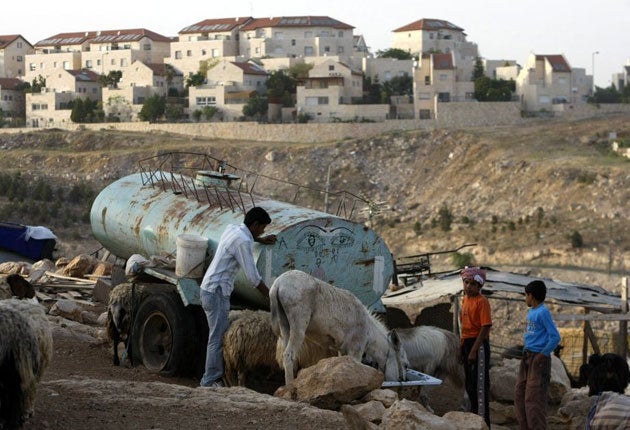
Israel is continuing to resist international pressure by moving ahead with a series of settler-driven demolitions of Palestinian houses in East Jerusalem and is continuing the previous government's policy of building in existing settlements. And Benny Begin, a minister in Mr Netanyahu's Likud party, will this week attend a prize giving for Noam Arnon, the leader of the notably hardline Hebron settlers for his achievements in "putting Zionism into action".
The issues: Obstacles to peace
Settlements Israel is under renewed pressure to end settlements in East Jerusalem and stop expanding existing ones in West Bank. Successive governments have promised to remove illegal outposts but felt able to ignore pressure from George Bush.
Palestinian State Netanyahu is resisting US pressure to declare he wants it but says he is ready for immediate economic, security, and political talks with the Palestinians, and will remove roadblocks to encourage "economic peace".
Hamas role The split between the Palestinians is a major stumbling block. Hillary Clinton seems willing to ease the path to a unity government. But it's not clear either Hamas or Fatah are seriously interested in putting an end to their differences.
Syria Netanyahu has said he will never give up the Golan Heights and he doubts Syrian President Bashar al-Assad's good faith in seeking talks. But a Syria-Israel-US agreement could be part of a regional deal that Barak Obama is thinking about.
Iran Israel is still sceptical that US efforts at dialogue with Tehran will bear fruit and has not ruled out military strike. Obama says any talks with Iran will not be open-ended and that no options are off the table, but stresses tougher economic sanctions.
Join our commenting forum
Join thought-provoking conversations, follow other Independent readers and see their replies
Comments