Israel goes to war over Hebron's 'House of Peace'
A nation has been polarised by the decision to forcibly remove some Jewish settlers from the West Bank city. And a ramshackle dwelling has found itself at the centre of the storm
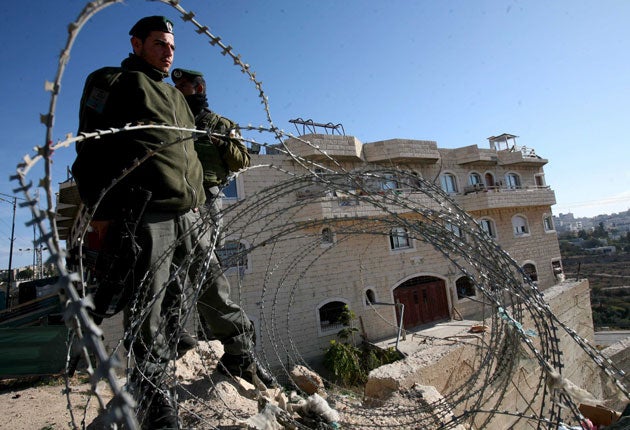
From the inside, it could at first sight be a squat anywhere in the developed world. The bare concrete floors, the nylon doors, the shafts of sunlight peeping between the roof's breeze-blocks indicating where the winter rain will come in and the electric generator show the occupants have had to improvise. The brightly coloured letters of the alphabet pinned to the unpainted wall of one family apartment testify to the presence of infants.
But even if the letters were not Hebrew and the nearest neighbours were not Arab, you would quickly realise that this was different. One wing is for the teenage boys, many with knitted kippas characteristic of the militant "hilltop" Jewish settler youth, the other for the girls, many of whom are out gathering rocks that could soon be needed to repel invaders, most likely Israeli police and military. A portrait hanging in the boys' corridor is of the late Rabbi Meir Kahane, the extreme right-winger with a criminal record assassinated in New York two years after he was banned from Israeli politics for inciting anti-Arab racism.
This is Beit Ha Shalom, or the "House of Peace" as the Hebron settlers have named it, apparently without irony. This ramshackle house is the focus of what could become the highest-profile power struggle yet between the Israeli state and settler militancy in the occupied West Bank.
In March 2007, settlers moved into the building, strategically sited between the 7,500-strong settlement of Kyriat Arba and the 20th-century Palestinian heart of Hebron, where 800 other Jewish settlers live near the Tomb of the Patriarchs, sacred to Jews and Muslims alike. Last week, Israel's Supreme Court cleared the way for the inhabitants of what is effectively a fifth, and wholly unauthorised, settlement in the overwhelmingly Arab city of Hebron, to be evacuated, if necessary by force.
For left and right, this has become a crucial test of the Israeli government's future willingness to enforce the removals of West Bank settlements – all illegal under international law – that would be needed if a Palestinian state is to be established. Some settlers reacted to the court decision by spray- painting "Mohamed is a Pig" on a mosque, defacing gravestones in the adjacent Muslim cemetery and slightly injuring a soldier. A prominent Hebron settler, David Wilder, says the miscreants were told to leave. But he adds: "It has to be understood, much as I object to going into a graveyard or painting slogans on mosques, extremism breeds extremism."
He is referring to the Supreme Court decision by Israel's Chief Justice, Dorit Beinisch, whom Mr Wilder describes as "almost as far left as you can get", Justice Ayala Procaccia, "a little further to the left" and the bench's only Israeli-Arab, Salim Joubran. "Here you have a judge putting together a panel of two of the most left-wing judges and an Arab and they're going to determine whether Jews should live in Hebron. Come on."
Daniella Weiss, guru for the "hilltop youth", now ensconced in Hebron, says last week's delinquency is "tiny in relation to the horrible anti-Semitic [court] decision to drive Jews out of their homes". Across the road, Palestinian construction worker Majdi Jaabari says his family lives "in panic" from the settlers who he says throw stones and eggs at passers-by "day and night", and "insult our Prophet".
Mr Wilder acknowledges it hasn't been a "rose garden" and that "once in a while there's a provocation" and rocks are thrown. But he insists that "for the most part things are quiet".
The military's attempts to negotiate with the official settler leadership on the Yesha council broke down on Tuesday. But, anyway, the Hebron settlers have little truck with the Yesha leaders, whom they blame for betraying the 8,500 settlers pulled out of Gaza by the Ariel Sharon government in 2005. "We will not work with the Yesha council because we have no intention of compromising," says Mr Wilder. "The only room for negotiation is if they say we can stay in the building and then we'll be very happy and say ok. That's what we call give and take. They give and we take. That's the way negotiations work with the Arabs. We give and they take. That's what Israel is expert in."
The settlers say they bought the 3,500sq metre building fair and square – for a sum not far short of $1m – from a Palestinian who now claims he did not sell it. The police say the sale documents were forged. The settlers have an expert witness who says the documents were "autoforgeries" deliberately faked by the vendor in case a genuine sale caused him trouble later. And they say they have a tape of the Palestinian admitting the sale.
But the settlements expert of the pressure group Peace Now, Hagit Ofran, believes the legal argument is irrelevant, if put beside the larger political question. "We believe they should not be in the building and not in all Hebron," she says.
The Supreme Court has ordered the settlers to leave while the forgeries issue is decided in court. The Defence Minister, Ehud Barak, said the settlers will have to go. The Prime Minister, Ehud Olmert, said the court did not "explicitly order" the state to evict them.
Daniella Weiss says she hopes the government makes the right "evaluation" because "they do not know what awaits people who try to evacuate. Nobody wants a civil war but because of the brutality of the left, and the pressure of the world, it might be tough".
Either way a decision not to evict would be a victory for the settlers and their ceaseless struggle for a greater Israel stretching across the West Bank to the Jordan river. Asked where the Palestinians fit into this vision, Ms Weiss says: "This is our homeland. Some people who come here as guests; if they behave nicely, OK. What do you do with a guest who doesn't behave nicely? Out."
Hebron: A city divided
The 1997 Hebron Protocol split the city 80:20 between Palestinian and Israeli rule. That 800 Jewish settlers live near the central Tomb of the Patriarchs – which is "shared" by Muslims and Jews – has caused tensions. In 1994, a Jewish extremist, Baruch Goldstein, massacred 29 Palestinian worshippers at the tomb.
Join our commenting forum
Join thought-provoking conversations, follow other Independent readers and see their replies
Comments