Israel: Land of the toxic kingmaker
The controversial right-wing politician Avigdor Lieberman holds the balance of power after Israel's election last week. Donald Macintyre visits his West Bank home of Nokdim
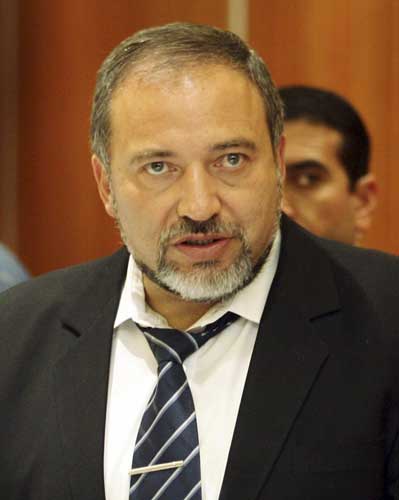
After some hesitation, Debbie Weinglass, a Jewish West Bank settler, finally decided not to vote for her neighbour, Avigdor Lieberman. She was worried he might tilt a little too far to the left.
To be fair, Mrs Weinglass doesn't put it quite like that. Instead, she says she was worried that Mr Lieberman, despite being routinely described as a neo-fascist by his more vociferous Arab and left-wing Israeli opponents, might deliver power to the centrist Kadima leader, Tzipi Livni, by joining her, rather than Benjamin Netanyahu's right-wing Likud, in a coalition. So she voted for the National Union, committed to a greater Israel stretching all the way from the Mediterranean to the Jordan river.
Mr Lieberman's 15 seats have cast him in the role of "kingmaker" after last Tuesday's Israeli election. With a question mark still hanging over which way he will jump this week, Mrs Weinglass says: "I hope he goes with Netanyahu and not Livni. I don't like either of them, and Netanyahu is not really trustworthy. But Kadima is for giving land for peace, and that's not realistic. If you give one inch to the Arabs they will want two."
Over cake and lemonade in the handsome new premises of the library she runs, with its picture window giving a stunning view of this stark landscape, south-east of Bethlehem, where the Judaean Hills meet the desert, the Detroit-born Mrs Weinglass, 51, explains that she likes the main policies of Mr Lieberman, who vigorously opposed the withdrawal of settlers and troops by Ariel Sharon from Gaza in 2005. She agrees with what she says is his view that if 10,000 Jewish settlers were to be removed from Gaza, then 10,000 Israeli Arabs should have been transferred to Gaza in return. In her opinion the rocket attacks from Hamas-controlled Gaza since disengagement are proof that any further territorial concessions to the Palestinians "will compromise Israel's security".
We are at the foot of Herodion, the cone-like artificial hill built for a fortress by King Herod two millennia ago. Mrs Weinglass, one of the settlement's founding members, says: "Nokdim is only seven minutes from Jerusalem, and if Herodion was in the land of the Arab, there would be rockets coming down from it on the holy city of Jerusalem."
In theory, if much less so in practice, this reflects a slight difference between Mrs Weinglass and Nokdim's most famous resident. Mr Lieberman has not ruled out – some time in an unspecified future – dividing the land. But as a precondition he would strip more than 100,000 Israeli Arabs in the northern Wadi Ara triangle of their citizenship by redrawing the borders to make them Palestinian instead of Israeli. Indeed, Mr Lieberman's ultra-hawkish stance towards Israeli Arabs is part of what has made him a pivotal political player. Israeli Arab protests against Israel's 22-day offensive in Gaza sharply increased the popularity of his flagship proposal for a "loyalty" test under which Arab citizens would have to pledge allegiance to the Jewish state. And that, in turn, helped him to take far-right support away from Mr Netanyahu.
The rise of the populist Moldovan-born former nightclub bouncer, alarming to some inside as well as outside Israel, may partly explain unconfirmed reports in the Israeli media yesterday that Washington would prefer a broad Likud-Kadima-Labour coalition – about the only one that could cut Mr Lieberman and his Yisrael Beitenu (Israel Is Our Home) party out of office altogether. As a man who has suggested that Arab Knesset members who have any contact with Hamas representatives should be "executed", and that Israel should treat Gaza as Russia did Chechnya, he has certainly courted controversy.
Yisrael Beitenu dismissed a recent Haaretz report that he had once been a member of Kach, the party outlawed in 1988 for being racist, as "orchestrated provocation". But the Haaretz columnist Akiva Eldar wrote earlier this year: "Even in his most fascist days, [the late Jörg Haider] never called on Austria to rid itself of citizens who'd been living in the country for generations. Also, Haider never suggested standing up legislators representing these citizens in front of a firing squad."
More substantively, Mr Lieberman resigned from Ehud Olmert's government last year in protest at a peace process he certainly does not believe in. This suggested he could still put the brakes on any Barack Obama-inspired attempt to persuade Israel to breathe new life into such a process.
Deep in occupied territory at Nokdim, this is a positive, of course, increasing the respect with which he is viewed by its residents. Mrs Weinglass, who likes and works closely with Mr Lieberman's wife, Ella, on educational services for the settlement, points out that it is a mixed religious and secular community. Indeed, some individual families – like that of Mr Lieberman, whose wife and daughter are both religious – are themselves mixed in this respect. That fact has helped him among some religious voters who would otherwise be put off by his fiercely secular espousal of civil marriage and the easier conversion of those immigrants with non-Jewish parents.
Both policies, like his Putin-style strongman image, are highly popular among Mr Lieberman's base of right-wing secular incomers from the former Soviet Union. Indeed, Rabbi Obadia Yosef, the spiritual leader of the ultra-orthodox Shas party, moved to stop the seepage of his own adherents by declaring that voting for Yisrael Beitenu "gives strength to Satan". This cuts little more ice with Nokdim residents than the corruption allegations which Mr Lieberman has been trying to shake off for a decade or more.
"With any politician if you look hard enough you will find something in the closet," says Mrs Weinglass, "but I think he is one of the cleanest." Her fellow resident, Latvian-born Yona Frankel, 58, a close friend of the Liebermans, says of the investigations of his financial affairs: "They have been looking at this for 10 years. If there was something in it, they would have found it by now."
The now-gated hillside settlement of 170 detached houses was originally called El David in memory of two residents of neighbouring Tekoa: Eli Pressman, who was killed in action in 1982 during the first Lebanon war, and David Rosenfeld, who was killed at Herodion by Palestinians a month later. Mrs Frankel is clear that Mr Lieberman's choice of the settlement was not accidental. She points out that his family joined in 1988, living in a caravan for five years.
Mr Lieberman's 18-year-old son was named Amos in recognition of the biblical connections with the prophet, a shepherd from neighbouring Tekoa, adds Mrs Frankel. She says the Yisrael Beitenu leader, like her and her family, "came here out of ideology, because he wanted a Jewish homeland for a Jewish people".
So how should Mr Lieberman use his "kingmaker" leverage when the coalition-making process starts in earnest? "All this coalition talk doesn't concern me," says Mrs Frankel. "I just want him to be Prime Minister."
What happens next?
After results are officially published on Wednesday, President Shimon Peres will invite one party to form a coalition. Typically, this will be the party with the most seats, but the task can be given to another party if it has more chance of commanding the necessary 61 seats for a majority – which Netanyahu may have. The chosen leader has 28 days, which may be extended for another 14. If he or she fails, the President can give someone else 28 days to form a government. If no coalition results, fresh elections are likely.
Players in the power game
Benjamin Netanyahu
Has complex relationship with Lieberman, who served as his first chief of staff when he was Prime Minister in 1996. They share right-wing positions – for example, believing the army should have toppled Hamas. But Lieberman wants to replace Netanyahu as leader of the Israeli right, and was the main reason for Likud losing the poll lead it held before the Gaza war.
Tzipi Livni
Has been wooing Lieberman strongly, because his support is her main chance of stopping Netanyahu forming the next government. A secular politician, she has been stressing their agreement on civil marriage and a willingness – in Lieberman's case, heavily qualified – to see two states, Israeli and Palestinian. But her courting of Lieberman has gone down badly with leftists.
Ehud Barak
Refused before the election to rule out a coalition with Lieberman, while acknowledging that he was "not my cup of tea". This infuriated Labour members of the Knesset, such as Shelly Yachimovich, who described Lieberman as "a dangerous phenomenon" who brings out "the darkest urges of part of the Israeli public". Barak now seems resigned to Labour trying to rebuild itself in opposition.
Join our commenting forum
Join thought-provoking conversations, follow other Independent readers and see their replies
Comments