Israel uses Hitler picture to sell its settlement expansion
Foreign minister orders diplomats to circulate photo ahead of discussions with President Obama's envoy
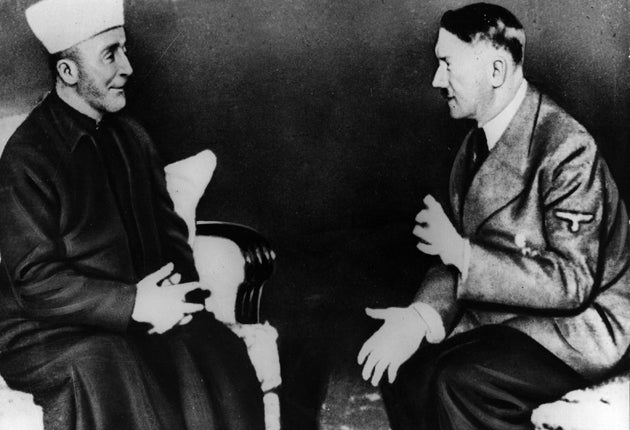
Avigdor Lieberman, Israel's foreign minister, has triggered fresh controversy by urging diplomats abroad to use a 1941 photograph of a Palestinian religious leader meeting Hitler to counter protests against a planned Jewish settlement in Arab East Jerusalem.
The hard right Mr Lieberman ordered the circulation to Israeli embassies of copies of the notorious wartime photograph of Hitler meeting the then Mufti of Jerusalem, an overt sympathiser with the Nazis who helped them raise an SS division in Bosnia. The move has alarmed some experienced Israeli diplomats who believe it will be counterproductive. It came after the US State Department expressed its disapproval to Michael Oren, the Israeli ambassador in Washington, over plans to build at least 20 apartments for Jewish settlers at the site of the old Shepherd's Hotel building in the inner East Jerusalem district of Sheikh Jarrah.
The building was once used as a headquarters of the Mufti, a member of the one of the most prominent Palestinian families in Jerusalem. The Palestinian nationalist Faisal al-Husseini, grand nephew of the Mufti, was a frequent interlocutor and strong advocate of peace moves with Israel in his later years until his death in 2001.
The plans for the Shepherd's Hotel site have highlighted a continuing rift between much of the international community and Israel over the latter's continued settlement building in East Jerusalem. The site was bought in the 1980s by a company controlled by Irving Moskowitz, a major benefactor of of right wing settler groups.
While the Israeli Prime Minister Benjamin Netanyahu is deep in negotiations with US officials over the settlement freeze in the West Bank being demanded by President Obama, he made it clear this week he will not be deterred from sanctioning continued building for Jews in East Jerusalem. Israel's sovereignty over the whole of the city "cannot be challenged", he said.
Israel unilaterally annexed East Jerusalem – unlike the West Bank which it did not seek to annex – after the 1967 Six-Day War and officially regards the city as the undivided capital of Israel. But most Western governments do not recognise the annexation and back the Palestinians' call for East Jerusalem to be the capital of a future Palestinian state.
One Israeli official in Jerusalem said of Mr Lieberman's move: "If the issue here is sovereignty over Jerusalem then passing on a historical photograph like this completely misses the point... It has nothing to do with it."
The Foreign Ministry confined itself to repeating Mr Lieberman's explanation that the photograph had been sent out so that "the facts are known".
George Mitchell, President Obama's Middle East Envoy is due to meet Mr Netanyahu to discuss the settlement freeze issue early next week. One Israeli official has predicted that the Prime Minister would go further than previous governments in ordering a moratorium on West Bank settlement building. The US has demanded a freeze to help kick-start peace negotiations with the moderate Palestinian leadership in Ramallah. The Palestinian President Mahmoud Abbas has said he will not accept Mr Netanyhau's invitation to talks without it.
But when it comes to East Jerusalem, Mr Netanyahu has made it clear he will follow previous governments – including that of his predecessor Ehud Olmert – by continuing to allow building there. Ahead of tomorrow's Cabinet meeting, he insisted that "residents of Jerusalem may purchase apartments in all parts of the city". He added: "In recent years hundreds of apartments in Jewish neighbourhoods and in the western part of the city have been purchased by – or rented to – Arab residents and we did not interfere... This is the policy of an open city, an undivided city that has no separation according to religion or national affiliation."
Amid protests from other governments, the French foreign ministry summoned Israel's ambassador Daniel Shek this week to re-state its opposition to settlement building, including in east Jerusalem. Some Palestinian Jerusalem residents have rented apartments in some Jewish settlements in outer East Jerusalem. A prominent anti-settlement Israeli lawyer Daniel Seidemann said this week that most land in West Jerusalem was state land which precludes those other than Israeli citizens – a category which includes Arab citizens of Israel – from purchasing property on it. Most Palestinian Jerusalemites are legal residents but not Israeli citizens. While Palestinian ID holders are not precluded from buying property on private land in West Jerusalem, Mr Seidemann did not know of any who had; this was for "social cultural and economic reasons".
The Mufti and the Fuhrer: A meeting of like minds
As the Grand Mufti of Jerusalem at the outbreak of the Second World War, Mohammad Amin al-Husayni was a powerful Nazi sympathiser – and an assassination target for the Allies. The moment that ensured his permanent notoriety came in 1941, when he was pictured with Adolf Hitler in Berlin. Al-Husayni was there to lobby Adolf Hitler for a declaration in favour of Arab nationalism and against a Jewish homeland. Hitler refused the request for tactical reasons, but the Mufti later recollected that he had sworn "the suppression of the Jewish national homeland is part of my battle". Few now dispute that he was an anti-Semite; whether he is still relevant is debatable. After he died, the hotel at the centre of the current dispute was bought by an American-Jewish millionaire.
Join our commenting forum
Join thought-provoking conversations, follow other Independent readers and see their replies
Comments