Kurdish voters rebel against corrupt elite
As the Iraqi region goes to the polls, many are blaming the growth in inequality on an entrenched political establishment. Patrick Cockburn reports
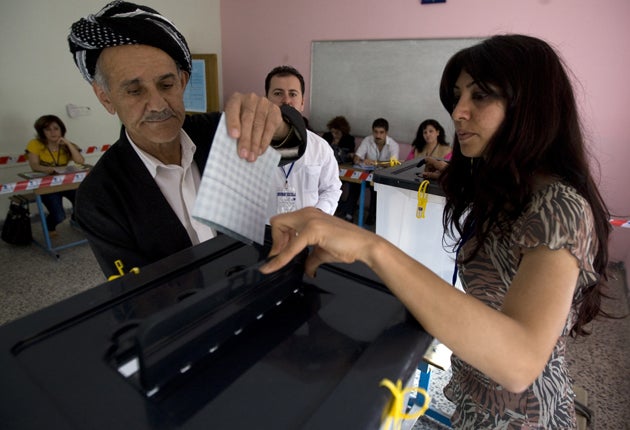
Every suitable flat surface in Iraqi Kurdistan is covered in election posters or banners, some so vast that they have been shredded by the desert wind. In this part of the country most of the flags are dark blue, the colour of Goran, or Change, party which in the general election yesterday was challenging the Kurdish political establishment for the first time.
It has been a surprising campaign. Goran leaders appear a little bemused by the surge in vociferous support for them and the extent of the openly expressed dissatisfaction with the powers that be. This hunger for reform is very evident in Sulaymaniyah, the most heavily populated province in Kurdistan. Driving in the high hills close to the Iranian border, I saw a young man riding a bicycle made unwieldy by two blue flags tied to the handlebars. At a nearby picnic spot in a grove of trees, a family had spread a blanket on the ground from which to eat as a Goran flag waved over their heads.
Such political engagement has never been seen in Kurdistan before. Through gritted teeth the two ruling parties, the Kurdistan Democratic Party (KDP) and the Patriotic Union of Kurdistan (PUK), say they welcome effective opposition as a sign of democratic progress. For its part, Goran hints at emulating Georgia or Ukraine by carrying out its own "orange revolution" against the establishment. This is made up of former insurgents entrenched in power ever since they successfully led the Kurdish national liberation struggle against Saddam Hussein. The poll yesterday could show that appeals to Kurdish nationalism no longer trump a deep-set and growing feeling of resentment against the new Kurdish ruling class.
Denunciations of the PUK and KDP, standing together as the Kurdistan List, and expressions of support for Goran, have grown in volume over the past few months. Driving along a road which leads to a mountain overlooking Sulaymaniyah last week, I suddenly saw a party just off the road where many people were dancing and celebrating in front of a large yellow excavator draped in blue flags. On a small stage a Kurdish band was playing and people were dancing to the music, holding hands as they formed concentric circles which contracted and expanded as they danced.
"Everything must change after 18 years," said Dara Jabar, who works in a factory in Nottingham but had come back to vote, and was attending the celebration. "They must give the money they stole for themselves and their political parties back to the people."
The PUK was founded and is led by the President of Iraq, Jalal Talabani; the KDP is led by the president of the quasi-independent Kurdistan Regional Government, Massoud Barzani. Both men are politicians of great skill and experience, but for many people their past achievements and current efforts to avert the threat to the Kurds from a resurgent Iraqi government are no longer enough to justify their autocratic, secretive and corrupt rule.
In many respects Mr Talabani and Mr Barzani are victims of their own success in bringing peace to Kurdistan in the decade since they fought a bloody civil war in the 1990s. Younger Kurds no longer feel the same sense of imminent danger as their fathers. A young woman at the street party in Sulaymaniyah called Asos Hama said brutally: "Barzani and Talabani keep all the oil wealth for themselves. People with university degrees drive taxis and people live three or four to a room. Of course we want change."
Goran has grown swiftly after a split in the PUK that has ruled eastern Kurdistan since Saddam withdrew his troops in 1991. Its leader is the former PUK deputy leader, Nowshirwan Mustafa, who earlier this year told me that he thought Kurdistan was run along the same dictatorial lines of an ex-Soviet republic and is, in effect, a one-party state in control of every aspect of life.
Events in Kurdistan are taking a similar path to that of many countries where the leaders of national liberation or revolutions become comfortably established in power and used to monopolising its perquisites. But this development is all the more serious in Kurdistan, indeed in Iraq as a whole, because their governments depend wholly on their oil revenues.
The Kurdish government receives this money, 17 per cent of Iraq's oil income, from Baghdad. There is no real Kurdish economy. The country produces almost nothing, with even bottled water in Sulaymaniyah coming from Iran or Turkey. All good jobs are with the government, which spends 65 per cent of its budget on salaries and operates a gigantic patronage machine through the KDP and PUK. Standing outside one polling booth in the poor Khabad areas of Sulaymaniyah yesterday were group of men who all said that they had voted for Goran. "What is your main demand?" I asked."We are asking for jobs in the government," they said.
Politics in the rest of Iraq, also wholly dependent on the oil wealth that pays for a bloated and dysfunctional state machine, work in much the same way as in Kurdistan.
There have been rumblings in recent years that all was not well in Kurdistan. In 2006, protesters in the eastern town of Halabja burned down the substantial and ornate monument on the outskirts which commemorated the death of 5,000 residents in 1988 in a notorious poison gas attack by Saddam Hussein's bombers. One demonstrator explained their actions, saying: "The Kurdish government exploited Halabja to draw attention to the plight of the Kurds and get donations that never reached us."
Three years later, the Halabjans are unrepentant. A local Goran representative, Peshko Hama Fares Mahmoud, told me: "It was only after we burned the monument that they started giving us new roads and a better electricity and water supply."
Even so, he pointed to the ruins of houses that had not been repaired since the devastating gas attack. He thought a good showing by Goran would have a similarly energising impact on the government.
The ruling parties in Kurdistan will probably hold on to power after today's poll, though many are predicting that Goran will get 15 to 20 seats out of 111 in the new parliament. In poorer areas of Sulaymaniyah yesterday, most of the voters said they had voted for change. Dilshad Jabbar Aziz, who left Kurdistan in 1999 to drive trucks and work on construction machinery in Liverpool, said: "There was no work here when I left and it was not much better when I returned six years later."
Kurdish leaders say this is unfair and that the majority do not remember how bad things were in 1991 when they took over. It is easy to see what they mean. I came to Sulaymaniyah in that year, just after it had been recaptured by the Iraqi army which was unearthing the bodies of its secret policemen who had been killed in the Kurdish uprising and buried in mass graves. The whole of Kurdistan was devastated by prolonged war, and some 3,500 out of 4,000 villages had been destroyed.
Improvements were slow to come. Four years later in 1995, I visited a village called Penjwin on the border with Iran, where people avoided starvation and were able to feed their families only by defusing a particularly dangerous type of jumping Italian-made mine called the Valmara, which had been laid everywhere by the Iraqi army. The mine looked like a small Dalek, and if you touched one of its prongs, a small charge threw it into the air where it exploded at waist height, spraying hundreds of metal balls in all directions. Villagers defused them at enormous risk to sell the explosives and the aluminium in which they were wrapped for a few dollars. Many villagers died, and Penjwin's main street was filled with people without feet or hands.
Kurdistan is far better than that now. But it is a deeply unequal society. In the capital, Arbil, there are newly built gated communities of luxury houses, while in much of the city people complain that they cannot afford rent or a new house. Speeding convoys of vehicles carrying the new elite are widely resented, and many people demand a larger share of the national cake. Kurdish politicians argue that the cake is smaller, and distribution of it less corrupt, than most Kurds imagine, but their explanations find few believers.
The ruling elite in Kurdistan is probably too well dug in to be dislodged. There is also a possibility that, if the reformers of Goran feel they have been robbed by a fixed poll, they will take to the streets in protest, as in Iran. What is happening here in Iraqi Kurdistan today may be a precedent for the rest of Iraq, where the government is far worse and where many Iraqis believe their oil money is being systematically looted to line the pockets of a semi-criminal ruling caste that replaced Saddam Hussein.
Join our commenting forum
Join thought-provoking conversations, follow other Independent readers and see their replies
Comments
Bookmark popover
Removed from bookmarks