Little relief for Palestinian refugees in Lebanon
Generations of Palestinian refugees are still marooned in Lebanon. In a small way, British Muslims are trying to help, finds Mary Dejevsky
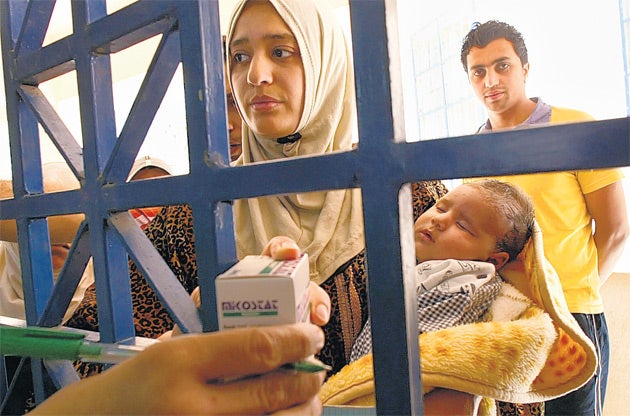
The scene could have been almost anywhere where the rich and poor worlds collide. A reasonably maintained building surrounded by depressingly visible disintegration; and inside, a bright room where small children, dressed in their best, are waiting to sing, dance and recite for the benefit of cooing foreign visitors.
The difference was that this was in Lebanon; in the Beddawi Palestinian refugee camp to be precise, outside the battered northern city of Tripoli. And afterwards each child received an envelope with the cash that would help maintain them and fund schooling for another month.
The orphans' centre at Beddawi is where the children and their carers come to find the various forms of help provided by the British-based charity Muslim Aid and local NGOs. Most of the 400 or so children they help are not, strictly speaking, orphans. They are children whose fathers have died, gone to prison or simply left, and whose mothers – shunned by society – risk destitution. With no access to benefits from the the state of Lebanon, and with neither citizenship nor any prospect of attaining it, these children are doubly deprived.
Yet meeting some of these children at Beddawi and those helping them was one of the brighter points in an otherwise bleak introduction to the plight of Palestinians in Lebanon. These are communities that remain confined to camps, more than 60 years after they were dispossessed.
I had been invited to accompany a film crew visiting aid projects in Lebanon. The twist, and the reason my curiosity was tweaked was that the projects were funded, all or in part, by this Muslim charity, and the film crew was made up of British Muslims.
Now there was clearly a promotional aspect to the trip, as the central purpose, for Muslim Aid, was to draw attention to its work – as will the film, which celebrates the organisation's 25th anniversary. Here was a relatively shy charity – as, for obvious reasons, many Muslim charities have become since 9/11 – seeking to present itself to a wider audience at a milestone in its existence.
I imagined that Muslim Aid, in inviting a non-Muslim such as myself to visit some of its projects, might also want to convey another message. Westerners often ask why rich Muslims, in countries such as Saudi Arabia, do not do more to alleviate the suffering of Palestinians. Here was proof that British Muslims, at least, do their bit.
Certainly, the four young men – and they were all men – working on the film saw their work as part of a social and religious contribution. When I met up with them in Beirut, they were exhausted. Their trip had covered Indonesia, Bangladesh and Bosnia. They had just flown in from Darfur – and been given a hard time at Beirut airport. The Lebanese found it difficult to reconcile a British passport with their ethnicity. Officials everywhere treated them as Pakistanis, and their British passports as though they were somehow "cover".
Travelling with the crew as presenter was Tre Azam, a previous participant in The Apprentice. Even his combination of charm and well-staged indignation failed to move the authorities. There were camps to which, despite prior notice, the camera-men were refused access.
Even so, we covered a lot of ground. Day One was spent mostly at a rain-sodden Beddawi, a concentration of decaying buildings with parlous sanitation and intermittent electricity transmitted through second-hand wires taped together at head height that periodically flamed and fizzed.
We visited multi-generation families living three to a small flat. Up many flights of uneven steps, we visited families with elderly, infirm grandparents and severely disabled children. We met families who had lit the decrepit stairway with candles to guide us, as the routine seven-hour power cut began.
Everyone we met was struggling with the multiple catastrophe of dire housing, high medical expenses, no benefits and no earner. The local aid workers knew the exact circumstances of everyone they visited, and how to find them, down endless labyrinths of alleys. Most families received blankets or new bedding, as well as cash contributions. An elderly man had received a wheelchair. From everyone there was gratitude, but also resignation; these were small episodes of good fortune in an overwhelmingly uninterested, mostly unkind, world.
I will admit that even the desperate conditions at Beddawi and the other camp we visited, Burj Shemali on the edge of Tyre in the south, were no more appalling than I have seen elsewhere – from China and Iran to apartheid-era South Africa. But we passed others where the conditions fleetingly visible through the razor wire, and rumoured violence, hinted at even worse.
Peculiar to Lebanon, though, is the dehumanising contrast between the energetic post-war reconstruction to shiny first-world standards, and the unrelenting squalor of the camps. The truly glorious natural scenery only heightens the disparity. A shanty-town outpost of Burj Shemali follows a shoreline that, anywhere else, would be a prime site for luxury hotels. It is clogged with detritus; sewage flows direct to the sea, and the water floods back into the tumbledown houses.
Even in such a run-down city as Tripoli, with an overt military presence and sporadic clashes between an uncertain array of forces, the contrast between town and camp is immediate.
Yasmine, a social worker in her thirties at Beddawi, said conditions had markedly deteriorated in the past five years. She had grown up in the camp, and managed to get an education in one of the few professions open to Palestinians. It was not just material conditions that had grown worse, she said, it was that employment had dwindled. The majority of men now had no paid work, nor the prospect of any, and despondency had set in. The fetid streets, collapsed buildings and dirty water everywhere told their own story.
As hope of better conditions has been lost, so too has the dream, for many we met, of reclaiming the land of their fathers (grandfathers or even great-grandfathers). The murals and tattered posters of Yasir Arafat are faded; replaced, if at all, by photos of Hassan Nasrallah, leader of the Islamist paramilitary Hezbollah. Despite pointed questions from Tre and his film-makers – who were disappointed we lacked the time to go and "look across the border at Palestine" – few of the refugees we met, of any age, held out much prospect of ever seeing their ancestral land. For the young British Muslims, who had adopted the Palestinian cause as their own, this was hard to understand. Still harder, for me, was to accept the Palestinians' passivity in the face of their non-existent civic rights – even if citizenship amounted to accepting they would never "return".
In so short a time, you gain only glimpses. But my two days with Muslim Aid in Lebanon let a little light into not one, but two, worlds of which I had known disgracefully little. One was the world of the aid recipients – mostly Palestinians, who remain refugees into the third and fourth generation. But the other was the world of the film-makers and aid workers: British Muslims from that very background – of Pakistani descent and around 30 – that tends to arouse such suspicion, following the London bombings of July 2005.
They were intensely proud to be British-born, and upset by being treated as Pakistanis in Lebanon.They were also were critical about the cooler welcome they said now tends to await them at UK passport control. When I asked where their social conscience had come from, they spoke of their families, but also of watching television coverage of the Bosnian war. They had been in their teens at the time and concluded that if, as it appeared, Europe was unable or unwilling to protect its own Muslims, what price the safety of Muslims anywhere? As European Muslims, they had assumed a personal obligation to help and protect. That is the sense of duty that charities, such as Muslim Aid, are tapping into.
Join our commenting forum
Join thought-provoking conversations, follow other Independent readers and see their replies
Comments