Livni and Netanyahu vow to oust Hamas after Gaza rocket strikes
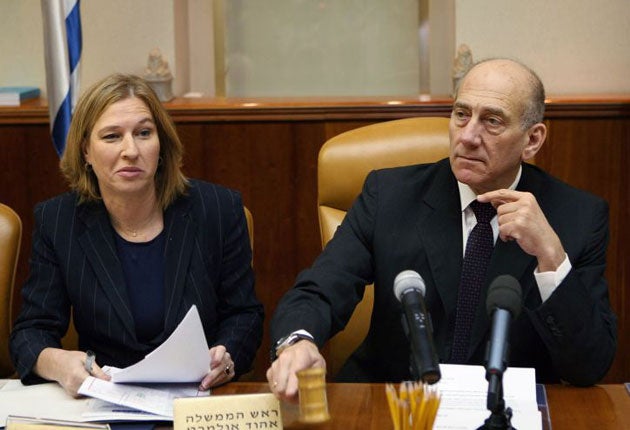
The Israeli government faced growing pressure to adopt a tough military posture against Hamas as renewed rocket attacks against southern Israel moved to the fore of the Israeli election campaign yesterday.
Two days after the end of a fragile six-month ceasefire with Hamas, at least 20 rockets and mortar bombs struck southern Israel, including a direct hit on a house in the border town of Sderot. Nobody was hurt. The rocket attacks coincided with a cabinet meeting that was meant to forge a strategy on how to deal with the militant Islamic movement that rules the Gaza Strip, but instead illustrated sharp divisions within the ruling Kadima party.
The Prime Minister, Ehud Olmert, who hastily led Israel into war with Hizbollah in Lebanon in 2006, suggested a wait and see approach to Gaza, saying that "a responsible government doesn't rush into battle, neither does it shy away". He called on his fellow ministers to avoid "bold statements" about the crisis. But the Foreign Minister, Tzipi Livni, who is vying with the hard-line Likud party leader, Benjamin Netanyahu, in the February election, vowed that her government's "strategic objective" would be to "topple the Hamas regime" using military, economic and diplomatic means.
Mr Netanyahu visited the Sderot house and called for tough military steps against Hamas, whose defeat he said was "inevitable". He added: "In the long-term, we will have to topple the Hamas regime. In the short-term ... there are a wide range of possibilities, from doing nothing to doing everything, meaning to conquer Gaza."
The cabinet meeting heard from Yuval Diskin, the head of the Shin Bet domestic intelligence agency, that Hamas has rockets that could strike the city of Beersheva, a major population centre about 40km from the Gaza Strip. But the Defence Minister, Ehud Barak, the Labour leader, warned that even an incursion involving two to three divisions, or more than 20,000 troops, may not be enough to stop rocket fire. Government ministers promising to topple Hamas "do not know what they are talking about," Mr Barak said.
Lieutenant General Moshe Yaalon, a former chief of staff who is now Likud's security expert, recommended the assassinations of Hamas leaders and "in and out" military incursions to stop the rockets. However, a leading analyst, Yossi Alpher, said it is time for Israel to admit that it does not have a "workable strategy" for dealing with Hamas.
Mr Alpher suggests considering informal, non-governmental contacts with the group to examine possible political options. "We want Hamas to disappear, but we can't make them disappear. We've tried economic warfare, ceasefire, and limited military responses with a price tag. A fully-fledged invasion hasn't been tried because the costs are too high, there is no exit strategy, there could be heavy casualties, there could be [negative] international focus, and there is no guarantee it will stamp out Hamas. I would counsel trying to encourage them [Hamas] politically in a limited way, perhaps through Israelis having informal contacts with them."
Hamas is seen in Gaza as being interested in a return to the ceasefire, provided it can present the public there with a loosening of Israel's blockade of the coastal enclave. Hamas says that Israel violated the ceasefire terms by not opening Gaza crossings to goods and supplies, while Israel says it upheld all of its commitments of the Egyptian- brokered arrangements. Ismail Haniyeh, the head of Hamas's government in Gaza, brushed aside the Israeli threat: "Nothing can finish off our people," he said last night.
Talal Awkal, an analyst in Gaza City for the al-Ayyam newspaper, which backs the moderate Palestinian President, Mahmoud Abbas, said that Islamic Jihad, a smaller militant group, and not Hamas is the main force behind the rocket fire. "I believe Hamas wants a return to the tahdiya because under the tahdiya it can strengthen its rule over Gaza," he said, using the Arabic word for a period of calm. He said Hamas is not pressing Islamic Jihad to stop the rocket fire because it does not accept the previous equation, a ceasefire without an opening of the border crossings.
In Mr Awkal's view, the Israeli calls to topple Hamas are campaign rhetoric. He believes Israel's interest is to perpetuate the division between a West Bank ruled by Mr Abbas's Fatah movement and a Gaza Strip ruled by Hamas. "I don't believe we are facing a complete invasion or reoccupation, but we will see operations by aircraft, especially helicopters, some incursions and assassinations," he explained.
Join our commenting forum
Join thought-provoking conversations, follow other Independent readers and see their replies
Comments