New party tries to give Kurds their 'Orange revolution'
After 18 years in power, ruling parties face wave of protest over corruption
"I must ask you to leave because you are criticising the authorities on state property," said a Kurdish official, interrupting our conversation with a critic of the Kurdish government.
We were speaking to Peshko Hama Fares Mohammed, a representative of Goran, or Change, the new political party which is seeking to dislodge the two parties which have ruled Kurdistan for the past 18 years. The result will be decided in a hard-fought general election taking place tomorrow.
We had met outside the town of Halabja in eastern Kurdistan at a monument whose blue and white tower commemorates the 5,000 Kurds killed in a poison gas attack by Saddam Hussein's air force in 1988.
In a café at the back of the monument, Mr Mohammed explained why so many Kurds are angry at the way in which the ruling Patriotic Union of Kurdistan (PUK) and the Kurdistan Democratic Party (KDP) between them monopolise power, money and jobs. At this moment the official in charge of the monument, who had been openly eavesdropping, broke in to say that he could not allow anything bad about the government to be said in a building for which he was responsible. "I might be sacked from my job if anybody found out what you were saying," he explained apologetically as he evicted us.
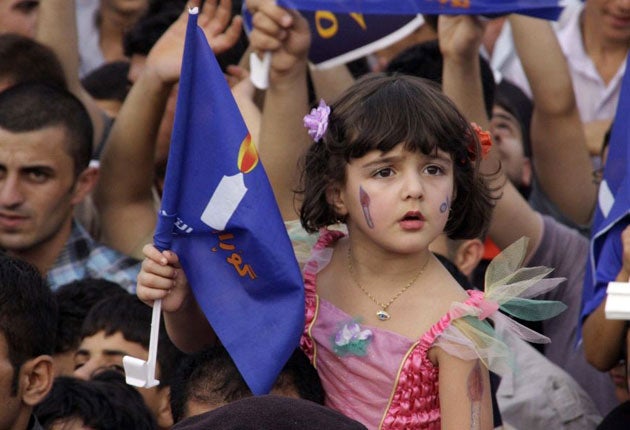
Eastern Kurdistan is ablaze with Goran's blue flags and posters, as the movement tries to emulate the "Orange revolutions" of Georgia and Ukraine, where reformers used elections to depose long-entrenched elites.
Nobody expects the long-established Kurdish leaders, Jalal Talabani, president of Iraq and head of the PUK, and Masoud Barzani, president of the highly autonomous Kurdistan Regional Government and head of the KDP, to lose power. They are the men who fought Saddam Hussein and brought quasi-independence to their people. But their rule, previously unchallenged, is being challenged in a way that some Kurds compare to the protests in Iran.
"Kurdistan is run like an ex-Soviet republic," claimed Nawshirwan Mustafa, the leader of Goran, in an interview with The Independent earlier this year. "There is no division between party and government, no independent judiciary, no fair distribution of national wealth, or real democracy."
Government leaders say this is a bit rich coming from Mr Mustafa, since he was, until recently, the deputy head of the PUK, and part of the very elite he now denounces for corruption and autocracy. Nevertheless, the PUK heartlands in Sulaimaniyah province are full of indications that many people agree with Goran's assault on the establishment.
At a rally in one district of Sulaimaniyah, its supporters danced and applauded a Kurdish rapper whose refrain was, "Nobody is happy now in Kurdistan." Dara Jabar, who works in a factory in the UK and had returned to vote, said: "The parties take all the oil money for themselves and nobody knows where it goes." Asos Hama, an enthusiastic Goran supporter, said: "People are very fed up because this is potentially a very rich country, but people who have been to university have to work as taxi drivers for 10 or 12 years."
Mohammed Tawfiq, a former senior official of PUK and now a spokesman for Goran, has a broader criticism. He says that people are angry about lack of services such as electricity and water, but adds that the Kurdish political leadership has got everything else wrong since the fall of Saddam Hussein in 2003, from their failure to establish the Kurdish claim to the city of Kirkuk to secretly awarding contracts to exploit Kurdish oil.
The Kurdish political establishment, leaders of one of the most successful national liberation movements in the world, appears taken aback by the seeming ingratitude of their own people. President Talabani and President Barzani have been fighting back hard, holding their own meetings and demonstrations. Walls are covered with their emblem of a prancing horse on a green and white background.
Elections in Iraq are about more than popularity. Patronage is crucial to success at the polls and the government controls most jobs in an economy dominated by the state. A main complaint of Goran is that the KDP and PUK members form a mafia that monopolise the distribution of jobs, contracts and subsidies.
Join our commenting forum
Join thought-provoking conversations, follow other Independent readers and see their replies
Comments