Reformist gains in Kurdish vote shake Iraq's quiet north
Calls for end to monopoly control of power generate strong results for Goran party
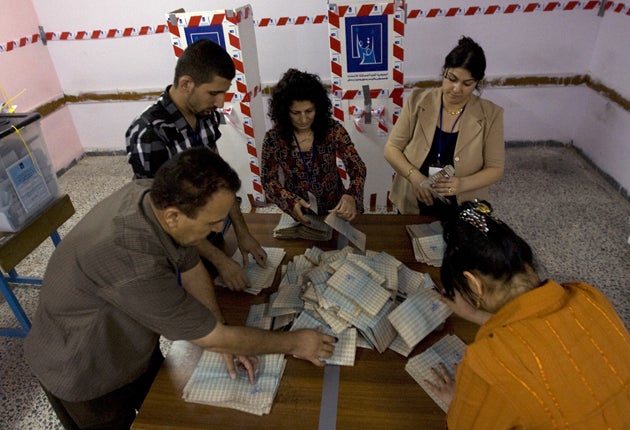
The surprisingly strong showing by a reformist party in Kurdistan elections is shaking the power structure in what has long been the most stable part of Iraq.
The "Goran" party – which translates as "change" – did particularly well in Sulaimaniyah, in eastern Kurdistan. This region has long been the stronghold of Iraqi president Jalal Talabani. The electoral setback to his party, the Patriotic Union of Kurdistan (PUK), is reported to be so severe he is considering resignation, according to al-Sharqiya, a television news channel.
The outcome of the election is being closely monitored by the Baghdad government for signs the normally well-organised and united Kurdish bloc is beginning to split.
This would be important given growing hostility between Baghdad and the Kurdistan Regional Government (KRG) which is threatening to lead to armed conflict between Arabs and Kurds over disputed territories, including Kirkuk and its oilfields.
Based on incomplete results yesterday evening, Goran appeared to have won some half of the vote in Sulaimaniyah. "It is too close to call," said Qubad Talabani, son of the president, speaking for the Kurdistan List – which unites the PUK and the Kurdistan Democratic Party (KDP).
But the defection of so many of its supporters to Goran, which was only formed recently, is a blow to the PUK in its stronghold. "Goran's success has changed the way politics is done in Iraqi Kurdistan," said Hiwa Osman, country director for the Institute for War and Peace Reporting, and former press secretary to President Talabani.
Goran leaders said yesterday they suspected their gains in the KDP-dominated Arbil and Dohuk provinces had been limited by electoral fraud, in the final hours of the poll.
Mohammed Tawfiq, a former PUK leader who joined Goran, said: "All was going well until about 3.30pm when there was a surprising surge in the number of voters in the space of a few hours. There was definitely something fishy going on."
If suspicion by Goran supporters that the vote was rigged hardens into a conviction they have been robbed of complete victory, then animosity will deepen between the parties. Last night however there were no signs of any move to organised street protests.
Goran was founded by Nawshirwan Mustafa, a former deputy leader of the PUK. He accused his former allies of ruling Kurdistan autocratically, as if it was a former Soviet republic like Turkmenistan. As well as his former party, he was critical of the KDP, led by Massoud Barzani, who is also president of the KRG.
Mr Mustafa said the ruling parties had total control of parliament, the judiciary, intelligence agencies, the media, peshmerga militia, and Kurdistan's 17 per share of Iraq's oil revenues.
Most people, he said, survive "on government salaries". He said there is "no economy, no industry and no agriculture". Mr Mustafa also alleged that the Kurdish leaders were exaggerating the threat of war with Baghdad to frighten Kurds into offering their support. "It is a fabrication to mobilise public opinion," he said.
Mr Mustafa described the KDP as the "family party" of Mr Barzani, who was re-elected president of the KRG.
But in Sulaimaniyah, he was outvoted by an obscure candidate, Kamal Mirawdeli, in what will be seen by the KDP as a serious rebuff, and a sign its PUK partner has been weakened. Speaking in the run-up to the election, Mr Barzani reiterated his determination to see Kurds make good their claims to disputed areas which stretch 300 miles across northern Iraq, from Syria to Iran.
He openly attacked Iraqi prime minister Nouri al-Maliki for monopolising power, such as controlling the oil industry, and unilaterally appointing 15 army divisional commanders.
Goran leaders have criticised Mr Barzani's confrontational approach in trying to make Kirkuk and other disputed areas part of the KRG.
"You can't integrate them by force," said Mr Tawfiq, adding that non-Kurdish minorities need to be encouraged to offer their support by better services, and greater respect for their rights.
Goran's platform of combating corruption and party control of power, money and jobs, resonated with many Kurds. The campaign came alive with mass rallies under the blue Goran flag, in a way which has never happened previously in Kurdistan. These prompted the Kurdistan Front to respond with its own mass rallies.
Such activism is uncommon in much of the rest of the Middle East, where elections are often a means for the state to demonstrate its own control.
The struggle for power in Kurdistan
What are the elections about?
The Iraqi Kurds are electing a president and a 111-member parliament for the highly autonomous Kurdistan Regional Government.
Why does the election matter?
The Kurds, about a fifth of Iraq's population have hitherto been the most united and best organised community in Iraq. This enabled them to play a disproportionately important role in Iraqi politics, with the president, foreign minister, army chief of staff and other senior figures all being Kurds. The political divisions exposed by the election may make it difficult for them to play this role future.
Who rules Kurdistan at present?
The Kurdistan Regional Government (KRG) is described as autonomous, but in practice it is more independent, politically and militarily, than many members of the UN. It is ruled by a coalition of the Patriotic Union of Kurdistan (PUK), led by Iraqi President Talabani, below left, and the Kurdistan Democratic Party (KDP) led by KRG president Massoud Barzani, right.
Who is behind the Goran, or Change, political party?
This is a new breakaway faction of the PUK led by Nawshirwan Mustafa, former deputy leader of the PUK. Mr Mustafa says the KRG, as it is currently run, is autocratic, corrupt and incompetent.
Will the election make a war between the Arabs and Kurds in Iraq more or less likely?
The Kurds will probably be more divided in future and that could mean Baghdad considers them an easier target. At the same time, though, Goran leaders have urged a more conciliatory approach in handling issues like Kirkuk and the disputed territories.
Join our commenting forum
Join thought-provoking conversations, follow other Independent readers and see their replies
Comments