Return to the scene of a lynching
The killing of Mohamed Msallem shocked a nation. Two months on, Robert Fisk visited Ketermaya to find out what his death says about Lebanon
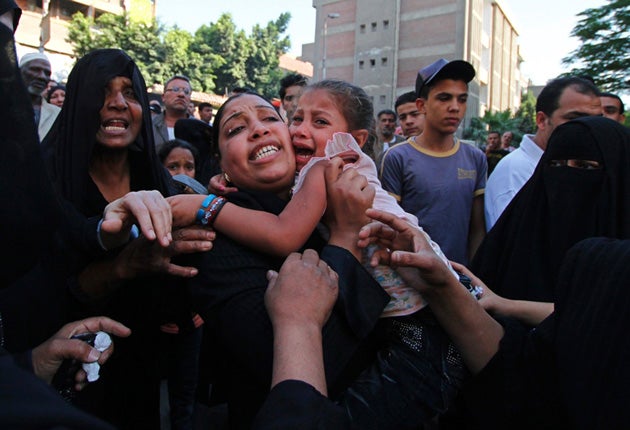
They didn't hang him from a tree," the police chief insisted to me. "They put a butcher's hook through his throat and hanged him from an electricity pole – that one, over there."
And sure enough, just opposite the clean little mosque of Ketermaya, stands the rusting pylon upon which Mohamed Msallem met his terrible end. His victims – two little girls and their grandparents – lie in their graves a few metres away, plastic flowers blessing the grey earth, not far from the tomb in which half their family were buried almost 30 years ago, among the 50 victims of an Israeli air attack.
Tragedy afflicts this little village. Conscience, too. Msallem was strung up by the people of Ketermaya, seized from the cops who had brought him back to the scene of the crime, stripped to his pants and then paraded through the streets to the taunts of the villagers, butchered by the peace-loving civilians who can still not believe what they did.
The lynching on 29 April shocked Lebanon. A country that has shrugged off its civil war – and is trying to ignore the next Hizbollah-Israeli conflict – is supposed to have reverted to tourism, Crusader castles and Roman ruins and fine restaurants. But Ketermaya is an awful reminder of the incendiary pain that exists beneath its soft landscape.
Msallem was an Egyptian – which didn't help – but he was believed to have been a rapist as well as a murderer and the police, for reasons still to be explained, brought him back to the village less than 24 hours after the murders.
"Why did they bring him back here so soon?" one of the coffee shop owners asked. "They hadn't even buried the bodies. The little girls and their grandparents were waiting to be buried when they showed up with this man and what did you expect of the people? They acted as if they were mad."
The police chief – and this, of course, is largely a story without names – says that the cops in Chihim, the nearest big town, took the decision to bring the Egyptian back. An old friend, a colonel in the Internal Security Forces, who regularly did this "scene of the crime" stuff, admitted to me later that "when I take murderers back to villages, I travel with 60 policemen in order to protect them".
So what exactly was the crime? Msallem was accused of killing Yussef and Kawsa abu Merhi – the grandparents – because Yussef was allegedly going to tell the husband of his niece, Badria, that Msallem was having an affair with her. In the grandparents' house, Msallem also found their grandchildren, Zeina, aged seven, and nine-year old Amina, whom he stabbed to death. One of the children's bodies – the family showed me pictures – had 22 knife wounds. Badria's husband, Daher Ali, was in prison – apparently for killing his brother, whom villagers say had tried to rape Ali's daughter – so the tragedy goes on and on. Msallem was also accused of raping a 13-year old child a few months before killing the four villagers.
Yet Ketermaya is a kind little hamlet. Instead of cursing the foreigner who turned up to ask about this bestiality, the villagers gave me tea and coffee and fruit and took me to the mosque and the graves, shaking their heads, asking why the police were so stupid, mourning the dead of long ago. The story in Ketermaya, a mixed Druze-Sunni village, is that way back in 1975, a Jewish couple who lived here – there was a tiny Jewish community in Lebanon at the time – were driven from their homes and that their son, an Israeli pilot, bombed the village in revenge during the Israeli invasion of 1982.
By extraordinary chance, I was sitting on the hillside above Ketermaya in 1982 and saw the lone plane attack, repeatedly bombing the village on the morning of 7th June.
There were no Palestinian fighters there – just civilians, of whom at least 50 were hiding in their homes – and they were all in their graves within 24 hours. There is a rectangle of concrete, covered in weeds and muck, to mark their passing, just 20 feet from Amina's and Zeina's graves.
More than half the dead of 1982 were from their family. As one of them said to me – and cousins must, I suppose, be awarded the gentleness of anonymity – "God seemed to have done something terrible to us".
Next to me, as we spoke, was the broken garden railing that was sheared away by the Israeli bombs almost three decades ago. I met several Abu Merhis. They all spoke lovingly of the little girls and showed me the fearful photographs from the mortuary. The grandfather appears to have been stabbed in the eye. Ministers and government officials had been to see them.
Everyone agreed that it was a strange, rare event that must never be repeated. Justice must be done. "What came over us?" one of the Abu Merhis asked me.
At least two suspects have been arrested for murdering Msallem. The police claimed that Msallem had confessed– but hadn't given a reason for the murders. Badria is now in the hands of the authorities who claim, with little conviction, that Msallem did not act alone.
Even stranger is the fact that Msallem, according to the villagers, lived in an apartment right next to the home of the Abu Merhi couple and that Badria had also moved into the third floor of the same building – which, all ironies being tragic here, stands on the other side of the cemetery where the four dead are now buried.
Human Rights Watch (HRW) and other humanitarian groups have, of course, condemned the Lebanese police forces. "The Lebanese authorities are facing a test," a spokesman for HRW said. "If they don't reassert the rule of law by prosecuting those who killed a suspect who was entitled to the presumption of innocence, the law of the jungle will have won the day."
Unfortunately, Lebanon's law is modelled on that of France, courtesy of the much-unregretted French mandate, where there is no presumption of innocence – which is what did for Msallem. Ibrahim Najjar, the justice minister, has already expressed his regrets for the lynching to one of Egypt's assistant foreign ministers, Mohamed Abdul Hakam.
"I would like to personally apologise to the government and people of Egypt," Mr Najjar said, "for the reaction in the village of Ketermaya, which would not have happened had it not been for the gruesome crime that preceded it." Lebanon's smart young interior minister – and they have not all been smart or intelligent men – also condemned Msallem's murder, as did the Lebanese president. And Fady Noun wrote a profoundly moving article in the French-language L'Orient-Le Jour newspaper in which he lamented the tragedy of Ketermaya.
"This crowd [that killed Msallem]," he wrote, "it is us – and it is each one of us. Anyone is capable of doing this. Our internal wars include all kinds of parallel cruelties and barbarism."
And he wrote of the impunity that followed the civil war in Lebanon – in which so many men with blood on their hands were permitted to go free – and of how that impunity still affects all who live here.
Only a few days before the Ketermaya killings, Ghazi Aad, who defends the civil rights of all who disappeared during the 1975-90 war – at least 18,000 have no known grave – was explaining why it was necessary to examine the Mar Mitr cemetery, because a woman living in the district had seen men taken there for execution. So graves may soon be opened. To soften grieving hearts? Or to pour more blood into them?
A divided society
*Lebanon has a population of just over four million but is one of the most complex nations in the MIddle East, with 18 officially-recognised religious groups. Four are Muslim, 12 are Christian, one is Druze and one Jewish. The constitution also provides for freedom of religion and freedom to practice all religious rites. The three largest groups in the country are Sunni Muslims, Shia Muslims and the Maronite Christians, who have a long history of association with the Roman Catholic Church.
*The large number of different groups stems from Lebanon's position as a refuge for persecuted minorities from across the region.
*The country has a long history of political division. Its tragic background includes a fifteen-year civil war, which began in 1975, and a major military offensive by Israel in 2006.
*The constitution stipulates a balance of power distributed among the main religious groups. Christians and Muslims are represented equally in parliament, the cabinet and in senior positions within the civil service. According to the International Crisis Group, sectarianism "has become Lebanon's political stock-in-trade".
*An alliance led by Saad Hariri, the son of the murdered former prime minister, Rafik Hariri, and comprising Sunni Muslim, Druze and Christian parties, won elections in 2009 with a solid majority. The grouping is known as the March 14th alliance after the date of a popular uprising in 2005 against interference by Syria, a one-time strong ally.
Join our commenting forum
Join thought-provoking conversations, follow other Independent readers and see their replies
Comments
Bookmark popover
Removed from bookmarks