Rocket attacks raise fear of second front for Israel
Two years after Lebanon war, Hizbollah blamed again after nursing home is hit, injuring six
Friday 09 January 2009
Latest in Middle East
On Facebook
From the blogs
CC kills more people than cervical cancer; why haven’t we heard about it?
There is a disease whose incidence is rising in the UK and most of the industrialised world. However...
We need to avoid another ‘lost generation’
A tiny green shoot one day, and then a chill wind the next. Anyone hoping for signs of economic spr...
More than half of Afghanistan’s families live in extreme poverty
Leila is watching her baby intently, as his mouth moves trying to swallow the small blob of yellow p...
Time for a new approach to alcohol
Ambulances were called and three drunk teenagers were brought to my care. One was so drunk we had to...
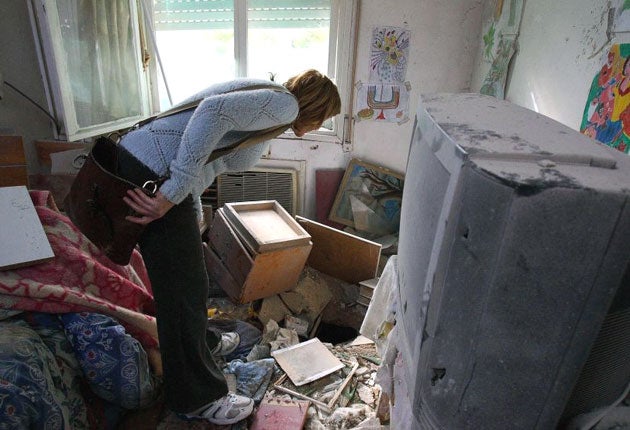
For the people of Nahariya, rockets fired from Lebanon into Israel yesterday brought back the grim prospect of being in the frontline of Israel's 2006 war against Hizbollah. Two years ago, they were on the receiving end of salvoes of rockets every day. Yesterday elderly residents at the Pensione Zilverman nursing home in the city were about to sit down for breakfast at 7.30am when a Katyusha rocket, fired from across the Lebanese border, smashed through three floors of the reinforced concrete building, shattering rooms in its path.
Haiya Bloom, a 91-year-old widow, broke her leg when she was thrown across the room. Five others were also taken to hospital suffering from cuts, bruises and shock. Shrapnel from the blast sprayed nearby buildings and cars. Locals acknowledged that the scale of casualties at the home could an hour later hit the Kibbutz Mitsava just outside the city without causing any injuries.
Hizbollah disclaimed responsibility for yesterday's attack which is being widely attributed to the Popular Front for the Liberation of Palestine, a faction showing solidarity with Gaza. But this was the first time that Israel had been hit from across the Lebanese border since the offensive on Gaza began on 27 December and most people in the area are convinced that more will follow.
There were repeated reminders that the Hizbollah leader, Sheikh Hassan Nasrullah, had threatened that his movement was prepared to take action, if necessary, which would make the 2006 Lebanon war look like "a walk in the park".
Henry Carmeli, the manager of the nursing home, believed that much worse is to come. "I have no doubt that we will get more Katyushas," he said. "What worries me is that if people start getting killed here then the Israeli government will retaliate and we will have another war in the north. This was very lucky, we could have had a massacre here."
The dining room where the residents had gathered for breakfast, he pointed out, has a wooden roof and the rocket would have probably killed or injured many of those there if it had landed just 15 feet in the other direction. Yoshe Bar Lev, a 39-year-old engineer, whose flat was one of those hit by spraying metal from the rocket, was convinced that Hizbollah had a hand in the attack despite their denials.
"They did this before, using Palestinians to do the firing on their behalf," he said. "Listen, we were here during the last war. They were firing Katyushas at us day and night. Of course the Lebanese government is saying that Hizbollah was not involved. They are scared of them. Hizbollah has a big stockpile of weapons and they could use them to open a second front to put the Israeli government under pressure. We must be prepared for that and the Israeli government must do something."
Most residents of Nahariya were, however, grateful that the morning's attack was not followed by others. Atana Katz rushed her two children, Naftali, seven, and Ariela, four, to a basement room used as shelter as their house, 100 yards from the nursing home, shook in the blast. "My immediate thought was 'Oh no here we go again', it was all going to start off again like the last time," she said. "That really was a terrible time, we had rockets landing all the time and the town simply became deserted. People just left if they could."
Mrs Katz, 30 and her husband Michael, 39, originally from Ilford, in Essex, had moved to Nahariya partly due to security reasons before the Lebanese war. "I was in Jerusalem during the second Intifada and we had a lot of suicide bombings. This is a very nice place and I think people have regained their confidence after what happened two years ago. It was good to see people still walking around after the explosion."
The family accept that living on the frontline is traumatic. "We went back to England on holiday just afterwards and there were some fireworks. Naftali thought they were Katyushas," said Mr Katz. "But we have no intentions of going back, we like our lifestyle here, and in a way everyday life feels safer than England in many ways. We haven't got any knife crime, you don't fear being mugged, the children can go out and play without the fear they may be kidnapped.
"There is no point in moving within Israel. In 2006 a lot of people went to the south to escape the fighting. Now I have family down there who are under rocket attack. Of course we all want peace, but it is very difficult to predict when that will happen."
The Israeli viewpoint: Voices from the blogs
Nicky israelity.com
"When I went to buy milk this morning and saw the TV in our tiny village shop tuned to the news and a picture of the the Lebanon and Israeli border, I felt a deep sense of foreboding. It's what we've all been frightened of, that the battle in the south will lead to a new front in the north... I felt it acutely – a kind of moral and emotional exhaustion."
Chana www.blogsofzion.com
"Defeating Hamas now will certainly result in a tragic loss of life. Many innocent people, most of them Palestinians, will die. However, it is time bleeding hearts on the left in North America and Europe realise that dislodging Hamas now will prevent repeats of this war and bloodshed and might revive some slim hope for peace in the future. In the long run, letting Israel finish what it has started will save lives. My biggest fear is that world leaders will let images from Gaza and public sentiment sway them into pressuring Israel to end the conflict prematurely."
Batya shilohmusings.blogspot.com
"Israelis are in danger and a ceasefire will show weakness... Talk of a truce is one of the most dangerous things we can do now. Sarkozy should have been told to stay home and to let our wonderful IDF defeat the Arab terrorist enemy. If we don't, Jews won't be safe."
- 1 Ninety gaffes in ninety years
- 2 Cameron's 'drunk tanks' are dangerous, say police
- 3 Can you master a language in a weekend?
- 4 Rothschild loses libel case, and reveals secret world of money and politics
- 5 No secularism please, we're British
- 6 Apple admits it has a human rights problem
- 7 You couldn't make it up: Sun staff hope Strasbourg can save them from Murdoch
- 1 Ninety gaffes in ninety years
- 2 Spotify: 1 million plays, £108 return
- 3 Apple admits it has a human rights problem
- 4 Rangers future could be bright says administrator
- 5 Rothschild loses libel case, and reveals secret world of money and politics
- 6 MP faces charges over Nazi stag night
- 7 Six Grammys, five years off: Adele puts love before career
- 8 No secularism please, we're British
- 9 Mark Steel: If religion is 'marginal', I'm the Pope
- 10 Lightning kills an entire football team
Free trial of new Independent iPad app
Get your daily dose of the best of British journalism, sponsored by American Airlines
Amazing restaurant offers
Three glasses of free champagne and a special menu at 46 top London restaurants.
Latest Independent competitions
Win anything from gadgets to five-star holidays on our competitions and offers page.
Commercial thought leaders
Watch the best in the business world give their insights into the world of business.
Career Services
Day In a Page
How an abortion divided America
Did they all live happily ever after? That's up to you...


Comments