Sadr's militia may live to fight again
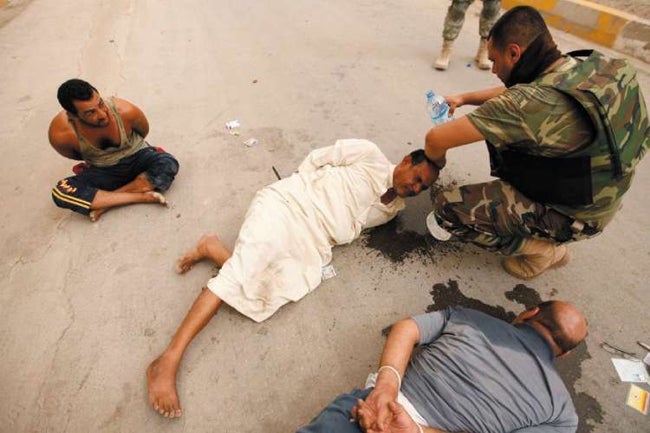
All over Baghdad and southern Iraq, supporters of Muqtada al-Sadr, the anti-American Shia cleric, are harassed, on the run or in jail. The black-shirted gunmen of his Mehdi Army militia no longer rule in Shia parts of Baghdad, Basra and Amara where once their control was total.
A great survivor of Iraqi politics, Mr Sadr is living in the Iranian holy city of Qom, where he is studying to elevate his position within the Shia religious hierarchy. It was from there, to the dismay of many followers, that he ordered his Mehdi Army fighters to go home and allow the Iraqi army to penetrate their strongholds.
"Muqtada has acute political instincts but he is a terrible organiser," said an Iraqi secular politician who knows him well. "He is a complete anarchist," he added, with a laugh. "But the government is not going to succeed in destroying his movement, though his prestige has been damaged."
Mr Sadr owes his authority to the reverence with which his family of Shia clerics is regarded by millions of poor Iraqis. This is because his father and two brothers were murdered by Saddam Hussein's gunmen in 1999 and his father-in-law was executed in 1980. Before his father died, he built a movement based on Islamic revivalism, Iraqi nationalism and social populism, which Mr Sadr has inherited.
The Iraqi government is doing its best to liquidate orcripple this Sadrist movement before the provincial elections in October. An American military intelligence assessment this year suggested that Mr Sadr's followers would win 60 per cent of the vote in Baghdad and southern Iraq.
They are unlikely to do so now. Though the government of Prime Minister Nouri al-Maliki pledged to Mr Sadr, when he ordered his gunmen off the streets, that it would not persecute his movement, anybody who belonged to the Mehdi Army in Sadr City is liable to arrest. In Basra, shops that used to sell CDs with songs in praise of Mr Sadr now sell gypsy music and have been told by soldiers to throw their old stock away.
Many Mehdi Army members blame Mr Sadr for letting them down when his men were holding their own. They also wonder why he did not set up monitoring committees to ensure the government implemented the terms of the ceasefires.
Iraqi politicians speculate about whether withdrawal is permanent. "Remember, Muqtada's men were not militarily defeated," warned one Iraqi leader.
A Shia politician said: "The main Mehdi Army bastions in Baghdad were Sadr City, with a population of 2.4 million people, and in al-Hurriyah and al- Shu'ala districts, with a further 1.1 million. That is more than half the people in Baghdad, and I suspect the Mehdi Army could take back these areas in 48 hours' fighting."
Leaders from Sadr City are more sceptical. Bashir Ali and Ahmed Mohammed, both sheikhs, say the Mehdi Army has become too unpopular to return, owing to its violence and corruption.
But Bashir Ali added: "We cannot express our views publicly because we would be killed. They would shoot us down when we go to the mosque." He thought the Mehdi Army and the Sadrists were "too deep- rooted in Sadr City after five years in control to be uprooted". He added: "Maybe if the government had acted two years ago it could have been done, but not now."
He did not think the Sadrists were able to stage an uprising because of their unpopularity and because, although "they still have their Kalashnikovs and pistols, they have lost their heavy machine guns and rocket-propelled grenade launchers".
Ahmed Mohammed said the only good thing the Mehdi Army had ever done was as a local defence force during the sectarian civil war in Baghdad in 2006-07. "When one Shia was kidnapped, they would go and kidnap two Sunni," he said. With the ebbing of sectarian strife, the Shia in the capital feel less need for militiamen to rule their streets. Mr Sadr's decision not to fight to the finish against the Iraqi army offensives in the first half of the year was motivated by two reasons. Ever since his militiamen suffered heavy losses fighting US marines in Najaf in 2004, he has tried to avoid fighting the US Army directly, or his Shia rivals when backed by the Americans.
And Mr Sadr learnt during the fighting that Iran was supporting Mr Maliki. The Iranian ambassador to Baghdad, Hassan Kazemi Qumi, said: "The idea in the government was to fight outlaws. This was the right of the government and the responsibility of the government." Without Iranian support, Mr Sadr's militiamen were bound to lose; even with it they would have had no answer to US firepower.
The Iraqi army by itself was getting nowhere in Basra and Sadr City before it was backed by the US military. Even in Amara today, there is a US battalion waiting to support Iraqi military forces. Nobody knows how the mainly Shia, 500,000-strong Iraqi security forces would respond if ordered to fight a resurgent Mehdi Army without US support.
Join our commenting forum
Join thought-provoking conversations, follow other Independent readers and see their replies
Comments