Saudi Arabia bans all marches as mass protest is planned for Friday
Extra troops are sent to north-east to quash any Shia protest as King Abdullah's regime gets jittery and oil prices soar in response to the region's continued unrest
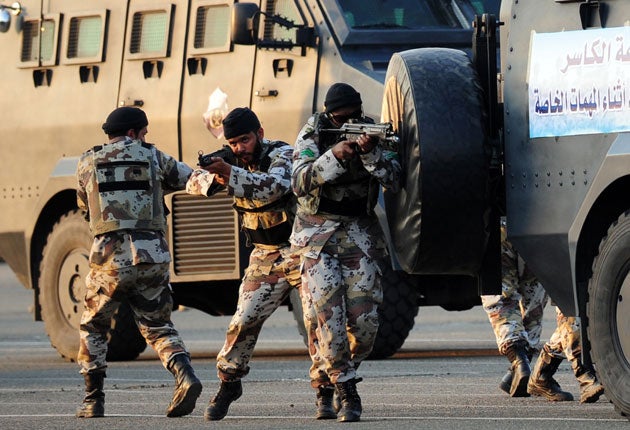
Saudi Arabia, the world's largest oil producer and the regional domino whose fall the West fears most, yesterday announced that it would ban all protests and marches. The move – the stick to match the carrot of benefits worth $37bn (£23bn) recently offered citizens in an effort to stave off the unrest that has overtaken nearby states – comes before a "day of rage" threatened for this Friday by opponents of the regime.
The Saudi Interior Ministry said the kingdom has banned all demonstrations because they contradict Islamic laws and social values. The ministry said some people have tried to get around the law to "achieve illegitimate aims" and it warned that security forces were authorised to act against violators. By way of emphasis, a statement broadcast on Saudi television said the authorities would "use all measures" to prevent any attempt to disrupt public order.
Already, as The Independent reported yesterday, the ruling House of Saud had drafted security forces, possibly numbering up to 10,000, into the north-eastern provinces. These areas, home to most of the country's Shia Muslim minority, have been the scenes of small demonstrations in recent weeks by protesters calling for the release of prisoners who they say are being held without trial. Saudi Shias also complain that they find it much harder to get senior government jobs and benefits than other citizens.
Not only are the Shia areas close to Bahrain, scene of some potent unrest in recent weeks, but they are also where most of the Saudi oil fields lie. More than two million Shias are thought to live there, and in recent years they have increasingly practised their own religious rites thanks to the Saudi king's reforms.
But the day of protest called for this Friday was – perhaps still is – likely to attract more than restive Shias in the east. There have been growing murmurs of discontent in recent weeks; protesters have not only been much emboldened by the success of popular uprisings in Tunisia and Egypt, but online channels of communication by those contemplating rebellion have been established. Some estimates indicate that as many as 20,000 were planning to protest in Riyadh, as well as in the east, on Friday.
The jitters of the Saudi regime will be at least equalled in many parts of the world where sympathy for democracy movements is tempered by a reliance on petrol, which most people – for all the special pleading of the haulage industry – can just about afford. Saudi Arabia sits on a fifth of the world's oil reserves.
The past week, with conflict disrupting all but a trickle of Libya's oil production, has seen the Brent barrel price climb to $103, with UK pump prices swiftly going up to £1.30 a litre. The rise in the price per barrel was caused not just by the Libyan strife – the country produces only 2 per cent of the planet's oil needs – but also by the prospect of further unrest in the region, although not the threat of full-scale breakdown in Saudi Arabia.
Yesterday, alarmist voices were not slow to exploit fears. Alan Duncan, an international aid minister and a former oil trader, raised the prospect in an interview with The Times of the price of crude rising well beyond 2008's record of $140 a barrel, to $200 or more.
"Do you want to be paying £4 a litre for petrol?" he asked. "I've been saying in government for two months that if this does go wrong, £1.30 at the pump could look like luxury." He outlined a "worst-case scenario" in which serious regional upheaval could propel the price to $250 a barrel, and thence to British drivers paying £2.03 a litre. London is now considering not imposing the planned 1p rise in fuel duty.
Join our commenting forum
Join thought-provoking conversations, follow other Independent readers and see their replies
Comments
Bookmark popover
Removed from bookmarks