Smugglers back at work in tunnels beneath Gaza
Fuel and food still being brought in despite damage from Israeli bombing raids
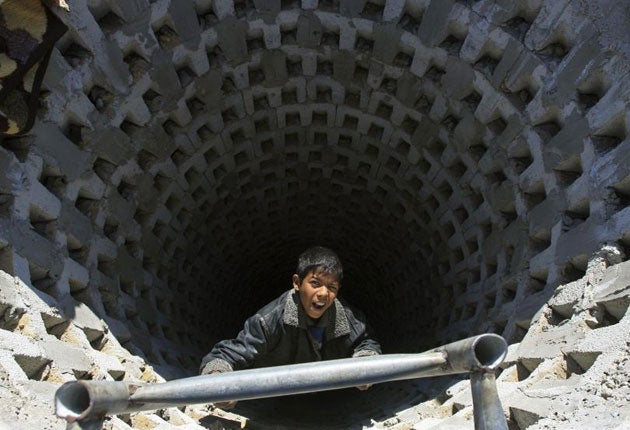
Some Gazans are working to restart – or are continuing with – the smuggling of contraband under the Gaza-Egypt border, despite the hundreds of Israeli bombing raids which they admit have destroyed most of the tunnels that operated here until Operation Cast Lead began.
They say that highly prized diesel and petrol for fuel-starved Gaza is still flowing through improvised piping under the border as other operators begin to assess the damage and work on reconstructing tunnels filled in by precision F16 bombing.
As well as destroying or damaging hundreds of tunnels, the bombing has dramatised Israel's central war aim of persuading Egypt – with international help – to call a halt to arms smuggling under the Rafah border. While arms are presumed to have been brought through the network, many of the openly dug tunnels have supplied fuel, domestic goods and livestock, in what a UN report last year described as a "vital economic lifeline" to a Gaza under blockade.
The tunnel numbers grew rapidly after Israel imposed its closure of Gaza when Hamas seized control by force in the wake of a short but bloody civil war between it and its Fatah rivals culminated in the June 2007 collapse of their short-lived coalition. Hamas insists the tunnelling would stop if the crossing were reopened for commercial goods.
At one tunnel entrance yesterday a Daf tanker emblazoned with "Fares Petrol" was filling up with 19,000 litres of fuel from one of three storage tanks with a total capacity of 50,000 litres. The corrugated roof of the breeze-block "office" within the enclosed compound – containing a desk and satellite TV – was holed by shrapnel from a bomb which landed at the next door tunnel entrance during the Israeli offensive.
The main operator of the tunnel, "Abu Abdullah", who like several others along the border would not give his full name, said that his own tunnel had been hit by a bomb, which landed some 250 metres away, half way to the border. "Thank God it did not affect the tubes and we can still get the fuel through," he added.
A bearded Hamas activist, Abu Abdullah, 35, said his tunnel was used also to convey "cheese, motors, generators. Whatever you can think of to break the siege, we brought it in". He strongly denied importing weapons through the tunnel and said he intended to complete reconstruction of it within three weeks or a month to bring in other goods. "Even when the rockets were falling, we went on bringing the fuel in," he said.
One Rafah resident who refused to be named said he believed that Hamas had other, secret tunnels, for supplying the Islamic faction's military wing with weapons but did not know their location.
Like many operators of an estimated 400 tunnels before the Israeli offensive, Abu Abdullah had paid a 10,000 shekel (£1,825) fee to the Hamas-run Rafah municipality – ostensibly to finance a regulation regime. He also supplied the municipality with fuel for its own vehicles. He said that a consortium of Egyptian and Palestinian investors had stumped up $90,000 (£63,700) to build the 25-metre deep tunnel and that profit margins were low, given the initial stake and that he employed 16 workers on the Palestinian side alone. Currently, he said, he pays 2.20 shekels a litre for petrol – which is initially smuggled into Egypt from Libya in huge 50,000-litre trucks – sells it for 3 shekels and that it sells at the pump for around 3.30 shekels a litre.
Like other operators along the border, he was sceptical that Egypt would halt the smuggling of civilian goods if it restarts because of its importance to the economy of northern Sinai. "The Egyptians are very interested in money. For us money comes second to breaking the siege. I am proud of doing this, to help the people of Gaza," he said. The door to another breeze-block building housing the tunnel entrance was padlocked and Abu Abdullah apologised that he could not show us inside because he was not carrying the key. But he said that he estimated that "40-50" tunnels along the border were still at least partly working despite heavy bombing which has clearly devastated streets of homes in the Rafah refugee camp, close to the border from which residents were first ordered to flee.
Elsewhere, two operating partners, "Abu Amjad" and "Mohammed", both 30, were using a small generator to haul sand and mud from the main shaft before assessing the full damage to the tunnel, mainly used for importing food products. "It cost us $90,000 to build so another $5,000 to repair it will not be so much," said Abu Amjad. Asked if he was not worried that it could be bombed again, he added: "It was dangerous before the war." Collapses were already costing about three workers' lives a week last year.
Some operators have given up. Abdul Majid Shaer, 20 said he and his three partners had sunk $20,000 each into a tunnel they were still building when the war started. He had financed his own stake from the $100 a day he had been earning as a tunnel worker. Now it was too badly damaged to continue. "We have no alternative," he added.
Join our commenting forum
Join thought-provoking conversations, follow other Independent readers and see their replies
Comments
Bookmark popover
Removed from bookmarks