Syria and Saudi leaders in mission to avert war
An unprecedented show of Arab cooperation reflects worries of fresh conflict in Lebanon. Robert Fisk reports from Beirut
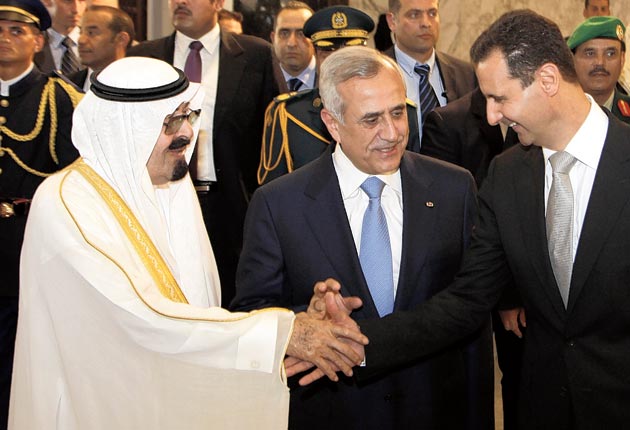
Syria is back. President Bashar al-Assad dropped off in Beirut yesterday – along with old King Abdullah of Saudi Arabia – to chat to the Lebanese president, ministers and members of parliament over a massive lunch.
It lasted only a few hours, but no one doubted the significance. Lebanon's chaos needs once more the guiding hand of Sister Syria. Not Syria's army – not yet – but even Assad's father Hafez only made a presidential trip to the Lebanese border. This is the first time in more than 40 years that the Caliph of Damascus – as head of state – has entered the holy of holies in Beirut.
In theory, the two rulers came to Lebanon to "smooth tensions" between Hizbollah and the Lebanese government – a crisis that was largely generated by Hizbollah, which is also an ally of Syria and Iran. But in reality – and here the Lebanese may be suspicious of the origins of their latest crisis - it means the re-emergence of Syria in Lebanon. Waiting at Beirut airport was prime minister Saad Hariri, who shook the hand of President Assad, the man whose country he once believed had ordered the murder of his father Rafiq in 2005. It was therefore a grimly historic moment which both men will remember for very different reasons. Pax Syriana returned to Lebanon – and the Lebanese showed their dutiful gratitude.
How did all this come about? Well, four spies, a claim by Hizbollah's leader that the UN tribunal into the death of ex-prime minister Hariri is part of an Israeli plot and a threat by Israel to attack civilian targets across Lebanon.
The four spies are the easy part of the story. Lebanese army intelligence arrested them over a period of six months this year, claimed they worked for Israel and – much more seriously – that they were senior employees of Alpha, the Lebanese mobile phone network. All four are in prison and Hizbollah's secretary-general, Sayed Hassan Nasrallah, has called for their execution, even though the four have not yet been tried. They were, Nasrallah claimed, giving target information to the Israelis during the Hizbollah-Israel war of 2006, a conflict in which more than 1,300 Lebanese, mostly civilians, were killed and more than a hundred Israelis, most of them soldiers, died.
At around the same time, the German news magazine Der Spiegel hinted that Hizbollah had been responsible for killing Hariri, a charge that Nasrallah has always denied and which Hizbollah says was planted by Israel. Most Lebanese blamed the Syrian Baath security services and a few pro-Syrian stooges in Lebanese intelligence. Hizbollah, although Syria's ally would not, it was thought, get its hands dirty with such a domestic killing. The inquiry of the UN tribunal investigating Hariri's assassination had revolved around a witness who turned out to be lying, and a mass of mobile phone calls made on the day that Hariri was murdered.
And then Lebanon's top army phone communication expert, Wissam al-Haj, was blown up in his car, thus depriving the UN's men of one of their best sources of information. But two weeks ago, Nasrallah went one further. The phone system was being run by Israel, he said, and he fully expected members of Hizbollah to be accused of Hariri's assassination when the UN issues indictments. In other words, Israel had "bent" the phone evidence.
For this reason Hizbollah no longer accepted the legitimacy of the international inquiries and would not cooperate with the UN which, by awful chance, has more than 12,000 soldiers serving in the peace-keeping force in southern Lebanon – the setting for Hizbollah's next war against Israel. And the implications of Nasrallah's speech were dire indeed. For the ruling coalition government, run by Hariri's prime minister son, Saad, supports the Tribunal and, if Nasrallah means what he says – that the tribunal is an "Israeli project" – then he is also implying that most of the cabinet work for Israel. With unfathomable Lebanese irony, of course, Hizbollah's political party are junior members of the same coalition.
Many Lebanese, however, now fear that the accord which allowed Hizbollah to join the Cabinet is dead and that Nasrallah's speech was the announcement of its funeral. Will Hizbollah therefore stage another take-over of West Beirut as they did two years ago, defeating the puny militia of Saad Hariri? Or will they concentrate on their enemies across the Israeli border? These were two of the questions that Assad and Abdullah came to answer yesterday.
A complicating factor – for Nasrallah, at least – is that Saad Hariri has just visited Damascus for the fourth time since becoming prime minister. And so out of the heavens yesterday, with messages of eternal friendship, emerged Assad and Abdullah.
Politically, Hariri didn't have much option. With Washington smiling warmly at Syria, the old American support for Lebanon has dissipated down to the tired "we support the sovereignty of Lebanon" mantra which Washington used when Syria maintained an army in the country. And America's support for the Hariri Tribunal has turned into near indifference.
But Nasrallah is not the only person indulging in fantasy. The Israelis have been churning out their usual roars. Lebanon will be regarded as responsible for any attack on Israel because Hizbollah is in the government, the Israeli government has warned; and this time – as opposed to 2006 – Israel will attack villages, towns and infrastructure.
This is quite mystifying to the Lebanese since the Israelis razed whole villages and attacked the country's infrastructure in 2006. But since the Israelis are re-writing a false history of 2006, they have even convinced themselves that this was the "second Lebanon war" – having forgotten the 1978 invasion, the 1993 and 1996 wars – and forecast the possibility of Israel's "third Lebanon war". Another conflict would actually be Israel's sixth Lebanon war, the last five of which it lost. This doesn't mean that the Lebanese (or Hizbollah) ever won, although Israel's ignominious 2000 retreat over the border under the premiership of Ehud Barak – currently among the top roarers – was almost certainly a long-term victory for Hizbollah. Now, both sides seem to want a repeat performance.
There was Barak again this week, announcing that "if Hizbollah fires a rocket into Tel Aviv, we will not run after each Hizbollah terrorist or launcher. We will see it as legitimate to hit any target that belongs to the Lebanese state". Then Israeli chief of staff, Lieutenant General Gabi Ashkenazi, said that his forces would not hesitate to strike Lebanese towns and villages. "We will move in these areas if need be," he said. One very senior Lebanese army officer responded with due diplomacy. "The Israelis always attack our towns and villages and commit war crimes like the Qana massacre. But this must be the first time that a country has announced its war crimes before committing them."
Not that Hizbollah escaped a few war crimes of its own in 2006, just as Judge Richard Goldstone – trashed by the Israelis after an exhausting report on the 2008-9 Gaza war – this year accused Hamas of war crimes, along with the Israelis. Firing missiles at civilians is a crime even if the Israelis have infinitely more sophisticated American weapons to use on civilians – and very occasionally guerrillas – when they go to war.
The "there will there be a third Lebanon war" myth is now being peddled by former US ambassador to Tel Aviv, Daniel Kurtzer. Kurtzer's latest wisdom would be outrageously funny if it wasn't taken seriously in Washington. It includes the recommendation that there should be an "upgrade" in US and Israeli "intelligence exchanges" and that the United States "should study ... the possibility of exploiting hostilities in Lebanon to launch a diplomatic initiative in the broader peace process." The idea that peace prospects of the Middle East would improve if more Lebanese were slaughtered is close to obscene.
Not that the Hizbollah have any reason to laugh. They used to be Tehran's toy, since their weapons came from Iran. But now that President Bashar, through whose country the arms flow into Lebanon, has made up with Hariri and turned up in Beirut, Syria is also going to be involved in Hizbollah's big military decisions.
And one more complicating factor. It looks like the Israelis have oil off their coast. The Lebanese too. So now Lebanon is accusing the Israelis of planning to take their oil as well. All in all, a pretty pickle. So complicated, in fact, that both sides may postpone a war till next year – just so they can understand what they will be fighting about.
President Assad smiled broadly and gave a thumbs up as he left the Lebanese presidential palace at Baabda yesterday, saying the talks had been "excellent". America, Hizbollah and Iran – and Lebanon – take note. Problems in Lebanon? Well, just call in at Damascus on the way. Syria is back.
Join our commenting forum
Join thought-provoking conversations, follow other Independent readers and see their replies
Comments