The Aleppo life-saver calling for weapons to save lives
‘You can only patch up people for so long. Most of the seriously injured we can’t save. The only way to end this is to defeat Assad’
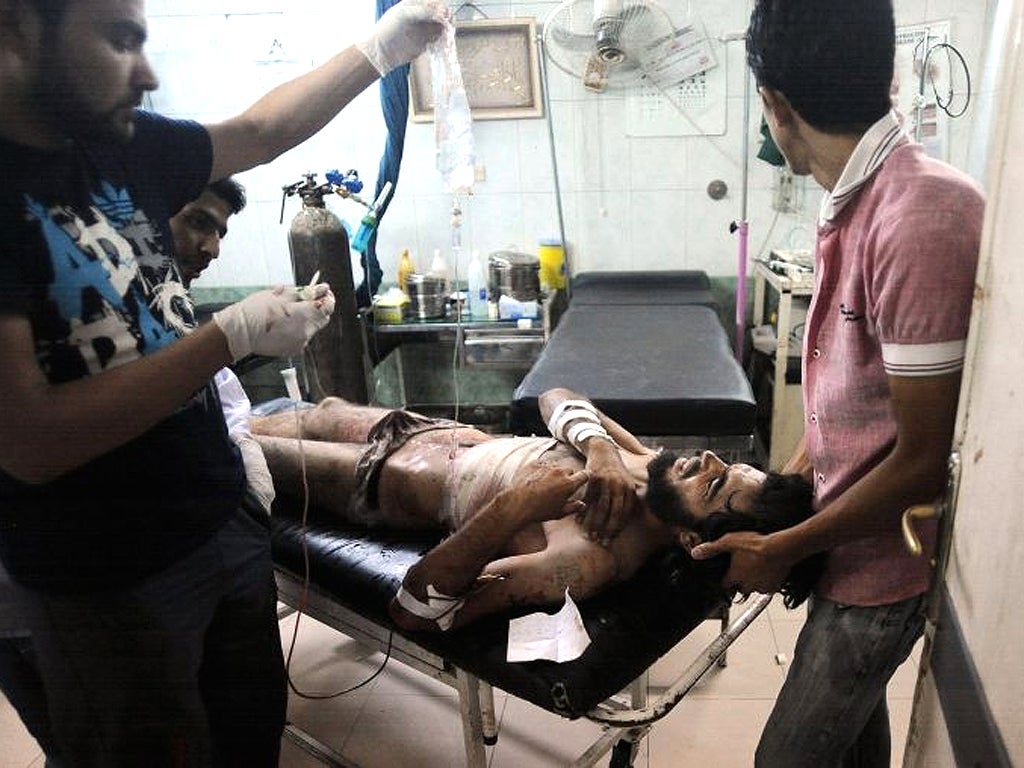
“We need supplies from the West, we are desperate” said the doctor as yet another of the injured, covered in blood, was carried in by three men to be taken to a makeshift surgery, one of a rising stream of casualties from the regime’s attacks. “We need weapons, anti-tank, anti-aircraft, anything we can get hold of.”
Later, as he scrubbed his hands in a basin stained with blood and ointment, Dr Mahmoud al-Shami continued quietly: “This will sound strange, a medical man saying something like this. But you know only patch up people for so long. Most of the seriously injured we can’t save anyway. You realize that only way to end this would be to defeat Basher al-Assad. Civilians are being killed by the regime.”
Among those killed were doctors. The burned bodies of three of them - Basel Aslam, Moussab Barad and Hazim Batikh - were found a few days after their arrest by the Mukhbarat, the secret police, at the end of June. They were all young and had been working in the poorer sections of the city. Later a pharmacist, Abdel Baset Arja, died while in detention. All had been accused of helping terrorists; their real crime, say the opposition, was to treat victims of the regime; the executions a warning to colleagues not to make the same mistake.
Many medics have taken heed. The director of a hospital very near the fiercest frontline of the city described to The Independent the frustration of not being able to get his staff to work at such a desperate time. Dr Mohammed Ahmed - not his full name – said: “I am not blaming them, people are very scared, for themselves, for their families. Some are too scared even to talk to me on the phone. I called 19 people and only two even answered. They do not want things like that on their record if Assad, Allah protect us, returns. Arja, the fourth man they killed, did not even come to the hospital, he was just selling us medicine.”
The conditions, even for a conflict zone, were grim at the hospital. There is never enough of a stock of medicine and the power supply, with a shortage of fuel for generators, fluctuate. In addition to coping with the medical problems the hospital faces the very real danger posed by this brutal conflict, it has been targeted from missile and mortar attacks half a dozen times in the last two weeks. The background noise of explosions, helicopters and ambulances careering around on streets of rubble were reminders of just how critical the situation was on the outside.
The hospital is treating around 50 patients a day, almost all of them injured due to the fighting. At present it has five doctors and two nurses working a rota. Dr Ahmed, an orthopaedic surgeon, the only specialist, says: “We really need around 12 doctors, some with specialisation, and two nurses per doctors. So you see how difficult it is to deal with complicated cases.”
One such case is brought in, a man shot in his lower stomach. The bullet is a hollow point ‘Dum Dum’ which has torn up his internal organs. Dr Shami - not his full name - pointing at the operating table with a buckled leg with a pool of dark red blood underneath said: “We shall try to send him across the border into Turkey, but I don’t think he’ll survive the journey. We have to concentrate on lives that we can actually save.” The patient, in his early 20s, stretched out his right hand, eyes wide open and imploring. He died the next day in the hospital.
The use of Dum-Dum bullets is illegal under international laws on combat. “So you think Assad’s people are abiding by the law in other matters? Is the shelling of residential areas with tanks legal? The use of aircraft to bomb civilians? Do you think this regime will stop and say ‘Oh no, we must not do that, it’s illegal’”, Dr Shami snorted.
Hazem al-Halali - another adopted name - graduated from the hospital and decided to stay and help in Aleppo rather than return to his home in Damascus. He is a member of a group of doctors called Noor Al-Hayat (Light of Life) working in areas which had seen the worst violence during the revolution.
The three doctors who were killed were fellow members of Noor and Dr Halali is now believed to be on a Mukhabarat death list. “I am a single man and if Aleppo falls to the regime, I’ll just go somewhere else in Syria, not outside the country, but in Syria. There is no question of leaving Aleppo for the time being, there are few enough doctors as it is. The Government would like us to die, or if that does not happen, just go away”, he said.
“They have told us not to treat people here, to send them to the government hospital. But a lot of people don’t want to go, they think they might be arrested or killed. We are talking about ordinary people here, not revolutionary fighters.”
The opposition boasts that unlike the regime it does not mistreat its prisoners. There have been, in fact, instances of summary executions of captured officials, especially of those belonging to the loyalist paramilitary, the Shabiha, and the Mukhabarat.
A field hospital had been set up by the revolutionaries further to the east of the city. Three soldiers, prisoners, arrived, all of them wounded, one quite seriously with a lot of blood around his neck and upper torso.
The two soldiers able to speak had the familiar refrain to the one heard from others in the same situation; they were conscripts and had no choice but to serve Basher al-Assad, they had tried to defect in the past but never had the opportunity and, at the same time, the plea they did not know just how bad things were.
A few rebel fighters heckled, calling the two prisoners liars, but not in a way which was particularly threatening. The soldiers continued to look scared. One repeated that the situation was calm where he came from in Damascus; he could not have known about the dreadful things happening elsewhere. A doctor cleaned out deep cuts on his forearm and shoulder and told him he would be alright.
As the soldier was led away, the doctor said quietly. “Kofar Batna, he comes from Kofar Batna. He said nothing was going on in there. That is not true, just I myself know of three people who were killed there; one of them was my wife’s cousin. Who knows, this man may have been among the killers.”
UN passes watered-down resolution
After failing to agree on firmer action, the UN General Assembly passed a watered-down resolution condemning the use of heavy weaponry by Syrian regime forces by 133 votes to 12, with 31 abstentions.
The vote in New York was overshadowed by another bloody day on the ground. Regime troops bombarded rebel hideouts in Aleppo, and in Damascus activists were counting the cost of an earlier strike on the Yarmouk Palestinian refugee camp south of the capital. Meanwhile, Russian news agencies reported that three of its ships, each with up to 120 marines on board, were due at the Syrian port of Tartous.
Loveday Morris
Join our commenting forum
Join thought-provoking conversations, follow other Independent readers and see their replies
Comments