The Big Question: What are Israeli settlements, and why are they coming under pressure?
Why are we asking this now?
Because the US administration appears to be serious about getting Israel to freeze Jewish settlement construction in the West Bank. Previous US administrations said they wanted a freeze but in practice allowed Israel to continue with at least some building.
How did the settlements come about?
In the aftermath of Israel's victory in the 1967 Six Day War, which left it in control of Gaza and the West Bank (as well as the Golan Heights) successive governments gradually allowed, and eventually effectively managed, the creation of more and more civilian Israeli communities in occupied territory.
Several forces converged to encourage this growth: religious Zionists and others on the ideological right who believed in a greater Israel stretching from the Jordan to the Mediterranean and that the West Bank – or Judaea and Samaria, as they invariably call it – had been "liberated" by the Six Day War; elements in the military establishment who believed it would enhance Israeli security; and politicians who believed that it made sense to grab as much territory as possible for Jewish residents, to improve Israel's bargaining position in any future peace talks.
What exactly constitutes a settlement?
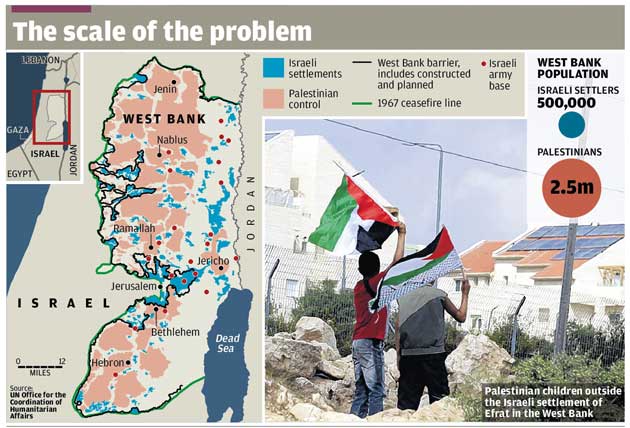
Typically settlements are thriving communities – anything between several hundred to several thousand in population size. The biggest, Maale Adumim, east of Jerusalem, is a town of 30,000 with its own large shopping mall, schools, recreation centre and mayor. Most are rural, though exceptionally around 800 heavily protected settlers actually live in the heart of the Palestinian city of Hebron. Around 280,000 Israeli citizens now live in 121 West Bank settlements – excluding Arab East Jerusalem, home to another estimated 190,000 Israelis, many in large neighbourhoods and apartment blocks built up since the 1967 war.
Was this process legal?
The most straightforward answer is: in international law no and in Israeli law yes. Oddly, one of the first people to say that it would be illegal in international law was Theodor Meron, the legal adviser to the Israeli foreign ministry immediately after the Six Day War. In secret advice which went to the then Prime Minister Levi Eshkol he argued that it contravened various conventions prohibiting the settling of civilians on occupied territory.
Meron, who went on to become one of the world's most eminent international jurists, has never wavered from that view. The US has been somewhat equivocal over the years about the legal position. But the large majority of Western countries (including Britain), the UN, and the International Court of Justice, which restated its view in a 2004 advisory opinion on the military's separation barrier, say that settlements are illegal, whether in the West Bank or East Jerusalem. And the 2003 Road Map, with the backing of the US, called for a total freeze on settlement construction. Israel's government and judiciary, however have never accepted that view.
Does this apply to the settlement 'outposts' that people are talking about?
No. Most of these are blatantly illegal even under Israeli law (even though various government departments often covertly help them, for example by providing electricity and water). Which is why Benjamin Netanyahu and his defence minister Ehud Barak say they will actually do something about (some of) them. A typical outpost is a collection of mobile homes on a ridge some way from an existing settlement, and can be the way a future settlement starts, or an existing one expanded.
A 2005 government report by Talia Sasson – commissioned by then Prime Minister Ariel Sharon – excoriated ministers for not dismantling 22 outposts in particular. But neither his government nor that of Ehud Olmert did anything about it, with the exception of nine houses in the single outpost of Amona. Anti-settlement activists have long called for the outposts to be dismantled but they will worry that Netanyahu intends to try and mollify the Americans by dismantling the outposts while continuing growth in the settlements themselves.
Why do the Palestinians and now the US see that as a problem?
Settlements have already made it considerably more difficult to envisage a Palestinian state, not least because the huge apparatus of roads, military infrastructure and protected land that services them – an estimated 40 per cent of the West Bank in all – which helps to cut the occupied territory into separate cantons and often swallows up Palestinian farmland. Second, opponents of settlements argue that they have had a profoundly negative effect on the peace process, put at its most extreme by Amos Elon, the Israeli writer who died this week and in 2002 wrote: "Imagine the effect on the peace process in Northern Ireland if the British government continued moving thousands of Protestants from Scotland into Ulster and settling them, at government expense, on land confiscated from Irish Catholics..."
Inevitably that effect is magnified the more they are allowed to grow. Which is why Palestinian President Abbas, who saw President Obama yesterday, has been arguing he won't negotiate with Israel until there is a freeze.
What's Israel's answer to all this?
First, they say that the long-term fate of settlements is a matter for negotiations with the Palestinians. The Olmert government said that it would not build new settlements and would only expand existing ones, especially in those blocs which they hope will fall to Israel in any future final-status deal with the Palestinians. Netanyahu, who has also said he will build no new settlements, would ideally like a similar understanding with President Obama to that Olmert apparently had with George W Bush. He has also pointed out that the Israeli government did remove the settlements in Gaza in 2005 (against his own opposition, as it happens) and argues they are not getting enough credit for this. The Netanyahu government says it is seeking to ensure "natural growth" or – in the latest parlance "normal life" in the settlements by ensuring that the children of settlers can find somewhere to live in their home communities when they marry.
Will the US agree?
That's not yet clear, but the indications – not least from Hillary Clinton, in some fairly blunt remarks she made in Washington on Wednesday – are that they will not. They seem more serious than the Bush administration at pressing the longstanding view that settlement expansion in the West Bank and East Jerusalem prejudices the prospect for peace negotiations. What they may try to do is to persuade some reluctant Arab states to "reward" a settlement freeze and other steps by conceding some gradual "normalisation" with Israel – for example, visas for Israelis and overflying rights for El Al planes, in return.
In the meantime, Netanyahu is under pressure from his own right-wing coalition to continue with the settlements, but that argument might not cut too much ice with Washington. After all, if he were to fall, Tzipi Livni is waiting in the wings.
Are the settlements a key obstacle to peace?
Yes...
* Creating 'facts on the ground' will make a Palestinian state impossible to realise.
* Mahmoud Abbas refuses to negotiate unless there is a freeze – which Netanyahu is not prepared to grant.
* Settlers are too entrenched a constituency ever to allow an Israeli government to make peace anyway.
No...
* Obama will persuade Netanyahu to call a halt to settlement construction which will allow peace talks to start.
* Gaza disengagement showed that settlements can be removed.
* Settlers would leave if Israel withdrew military protection, and non-ideological ones could even become Palestinian citizens.
Join our commenting forum
Join thought-provoking conversations, follow other Independent readers and see their replies
Comments