The Good (but endangered) Samaritans
Famous for helping others, the Israelite sect has so few members that they are embracing internet dating and marrying out to survive
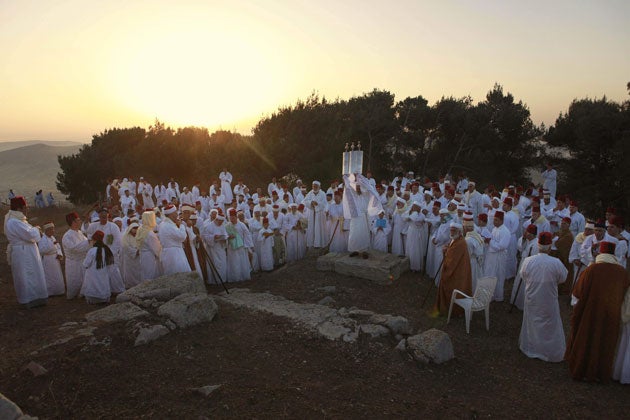
Whatever happened to the original Samaritans? At the time of the late Roman Empire, there were more than a million of them, but, by the last century, they were down to just 146 members. And so now, these guardians of an ancient faith with a famous cameo role in the Bible are using surprisingly modern methods to keep their tiny community alive.
Internet acquaintances, mail-order brides and pre-nuptial genetic tests have all become familiar to Samaritans trying to plan future generations despite a shortage of young women within their tight-knit community. Such openness to the outside world seems baffling in a group that considers itself the original Israelites and upholds rigid traditions about diet, sex and the Sabbath.
Half the community lives in the tidy modern village of Kiryat Luza on Mount Gerizim, the faith's holy mountain in the Israeli-occupied West Bank. The other half is in the Israeli town of Holon near Tel Aviv.
Husney Kohen, 65, one of the faith's 12 hereditary priests, saw no contradiction in the lifestyle of a community that is, as he puts it, "the smallest sect in the world", with 750 followers.
The Samaritans trace their ancestry to the northern Israelite kingdom that was destroyed by the Assyrians in around 720BC. Their faith shares many similarities with Judaism. "Samaritans are very religious, but we are also modern," Mr Kohen, 65, explained in the community's small museum here, lined with scriptures written in the ancient Samaritan language and lists of high priests going back to Aaron, the brother of Moses. The alternative to adapting was grim. A century ago, the community was down to fewer than 150 members. Some left to work in the Mediterranean port of Jaffa, launching a new community there.
Inter-marriage was so common that by the mid-20th century about 7 per cent of Samaritans suffered from some genetic defect. Genetic testing before marriage has helped cut that rate in half. With rising living standards, the community has slowly restocked its ranks in recent decades. But a surplus of males meant some men had to seek wives outside the Samaritan world. "We don't have enough girls, but we can't tell the boys they can't get married," Mr Kohen said. "We've taken in about 25 Jews, five Christians and three Muslims. The boys get to know them through the internet."
What may sound easy is quite difficult. The Samaritans insist the women convert before marriage and commit to a religious discipline hardly imaginable elsewhere. The Samaritans believe Mount Gerizim near the West Bank city of Nablus was the holy place chosen by God, not Jerusalem. They have their own version of the Torah and holy days similar to Jewish ones. They say that Judaism in the south, especially after the 6th-century BC Babylonian exile, diverted from the original faith. Their differences figure in John's Gospel, where Jesus surprises a Samaritan woman at a well by asking her for water even though Jews and Samaritans did not associate.
Samaritans observe the dietary, Sabbath and circumcision laws in their Torah to the letter. "The word Samaritan means keeper of the law, that's why we are so strict," Mr Kohen said.
In addition, women must live separately from their husbands and children during menstruation and isolate themselves after giving birth – 40 days after having a boy, 80 after a girl. "Everybody observes this," said High Priest Abdel Moin Sadaqa, 83. "This creates a sense of responsibility in our society. When a woman goes into this period, a daughter or sister comes to take care of her house in her place."
When a woman considers marrying into the community, she comes to live with the Samaritans for up to six months. "We examine them and they examine us," Mr Sadaqa said. To show this can work, he introduced his Ukrainian daughter-in-law, Shura. "She is more observant than many Samaritans," he boasted. "There is an office in Tel Aviv that encourages youths to have wives from other nationalities. I sent my son to that office."
Shura, 25, a casually dressed convert from Christianity, moved here five years ago from Kherson, Ukraine. Most Samaritan women sport Western-style clothes and uncovered hair, donning traditional dress on the Sabbath. "I was surprised to meet a Samaritan. I didn't know anything about them," she said nervously in Arabic.
Khader Adel Kohen, another Samaritan priest, is already thinking about wives for his three young sons when they mature. "With all respect to the high priest, I'm against marrying women outside our community," said Mr Kohen, an inspector in nearby Nablus for the Palestinian Authority's interior ministry. "If they don't find a wife, my sister has three daughters and my cousin has three daughters," he said. "Of course, we'd have them tested genetically first.
"They can marry anyone in the Samaritan community. Outside, no," he declared. "If they wanted to marry a non-Samaritan, I would try to dissuade them. After that, all I can do is deny them their inheritance."
Join our commenting forum
Join thought-provoking conversations, follow other Independent readers and see their replies
Comments
Bookmark popover
Removed from bookmarks