The quiet crackdown in a tourist playground
While putting up a progressive front, the Emirates of the Gulf have tackled any sign of unrest
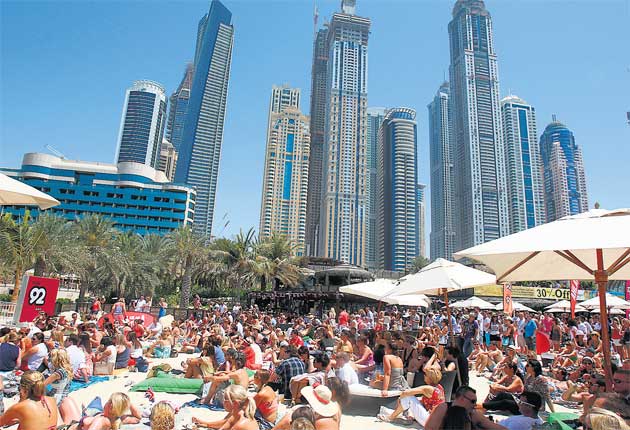
With its glistening skyscraper-lined highways so far untouched by the angry protesters who have filled the streets of other Arab cities, the United Arab Emirates appears on the surface to have escaped the dissent sweeping the Middle East. But the Emirates have not been immune to the ripples of the Arab Spring: a vociferous minority is demanding change, only to be met with a clandestine crackdown on dissent.
While other countries in the Gulf have expedited reforms to appease citizens demanding more freedom, the UAE – despite having long-attempted to present itself as a model of progress – has taken a different tack, silencing any individuals or organisations questioning the status quo.
The surreptitious crackdown has affected all spheres – professional associations, non-governmental organisations, think-tanks, the blogosphere and even art exhibitions.
Five Emirati bloggers and academics who were rounded up in April are currently on trial for "opposing the government", threatening state security and insulting the country's leaders. The arrests have shocked the desert nation. Dr Nasser bin Ghaith, one of the accused, is an academic at the Abu Dhabi branch of the Sorbonne University.
Since the arrests, authorities have cast their net wider, dissolving the boards of several non-governmental organisations such as the Jurists' Association, a group active in the defence of human rights, and replacing them with government appointees. The Teachers' Association has received similar treatment. Rights groups have described the move as a "hostile takeover of civil society".
"What we are seeing is a collapse in democratic rights," said one activist, who, like many, now declines to have his name published for fear of reprisals. "We have gone back 30 years. They are afraid the revolutions will come to the UAE so they are scaring people into keeping silent."
The targeting of respected academic institutions has raised eyebrows as they are hardly revolutionary hotbeds. Last month the Gulf Research Centre, one of the UAE's few political think-tanks, said it was being forced to leave the country after "objections by the Dubai government to various aspects of GRC's work." The head of the Dubai School of Government has also resigned.
Amid an ever-growing state of paranoia, the chief of the Arab world's biggest art show, the Sharjah Biennale, has also been sacked for not sufficiently censoring the exhibition.
The government's attack on the country's pro-reform voices began after 133 prominent Emiratis signed a petition in March requesting the right of all citizens to vote for members of the country's Federal National Council. Currently a government-appointed electorate votes for half the members of the council, which wields virtually no legislative authority, leaving power in the hands of the al-Nayhan royal family, headed by President Sheikh Khalifa bin Zayed.
Signatories say they have since been threatened by security officials. "They come to us and say we will be the next in jail. They say we are trying to destroy our country," said one.
Before his arrest, Ahmed Mansoor, one of the five activists on trial and a prominent Dubai-based blogger who helped organise the petition, wrote a final dramatic blog post.
Entitled "They came to take me in at 3.50am", it described the moment his building's security guard knocked on his door to tell him three policemen outside wanted to speak to him about a problem with his car. "They make such tricks to and take you," Mr Mansoor wrote.
Mr Mansoor had long suspected that his blog would lead him into trouble with the authorities. "My family have mixed feelings; they think this might bring trouble not only for me, but for them too," he said in an interview with The Independent before his arrest. "On several occasions they've asked me not to talk about more sensitive topics."
There is concern that the trial, which resumes on 18 July, will result in heavy sentences. Professor Abdulkhaleq Abdulla, a politics lecturer at UAE University who knows several of the detainees, described the charges as "heavy and loaded."
"We can only hope the trial will be free and fair. This doesn't fit the image of the UAE: it has promoted itself as a country without political prisoners," he said.
The oil-rich nation has played a careful balancing act since citizens across the Arab world took to the streets demanding the end of dictatorships. While outwardly trying to maintain the façade of a progressive haven for Western business and expatriate workers, in reality it has been increasing its grip on power.
The country's divided interests are evident in its diplomacy. Abu Dhabi's F-16s and Mirage jets are supporting the Libyan rebels fighting against Gaddafi's brutal regime. But the UAE remains one of the most visible supporters of the region's other embattled leaders, with the President sending messages of solidarity with his Syrian counterpart Bashar al-Assad, and the Foreign Minister, Sheikh Abdullah bin Zayed, visiting in a gesture of fraternity. He paid a similar visit to Egyptian dictator Hosni Mubarak shortly before he was ousted.
It remains to be seen whether the recent crackdown will silence the dissent, or help to galvanise the reform movement. For one of the petition's signatories the latter seemed more likely. "Emiratis can't accept this treatment: the people are angry," he said.
Then there are the reported lay-offs of hundreds of expatriates in the public sector as the UAE leaders scramble to bring down 14 per cent unemployment. With those expatriates who have been asked to leave said to have been given just weeks to go, the leadership's urgency in pacifying the country's disaffected youth is evident.
Profile: UAE
Formed one day after gaining independence from Britain in 1971, the United Arab Emirates is a confederation of seven states (Abu Dhabi, Dubai, Ajman, Fujairah, Sharjah, Umm al Qaiwain and Ras al Khaimah) and is now one of the Middle East's key economic centres. Drawn by the nation's thriving oil and financial industries, 75 per cent of residents are expatriates. However those living in the highly developed southern cities of Abu Dhabi and Dubai enjoy a much higher standard of living than those in the poorer northern emirates.
Join our commenting forum
Join thought-provoking conversations, follow other Independent readers and see their replies
Comments