Toxic munitions 'may be cause' of baby deaths and deformities in Fallujah
News in pictures
News in pictures
On Facebook
From the blogs

Roy Hodgson for England: A club of one

To argue against Harry Redknapp for England is akin to arguing in favour of bankers bonuses. While s...

Time for a reality check on the Sri Lankan civil war

Sri Lanka, much like Britain, has side-lined accountability long enough.

Children Of Alcoholics week: One million children may just be the tip of the iceberg

Children Of Alcoholics week starts today. So, what are the aims for Nacoa during this important week...

Review of Being Human: ‘Being Human 1955’

Following on from an episode tinged with tragedy, this week lifted the mood with something lighter.

Suggested Topics

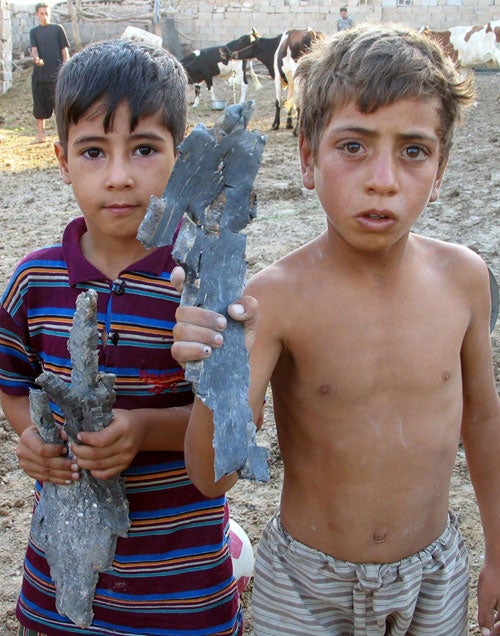
Evidence was growing this weekend that babies born in the Iraqi city of Fallujah – scene in 2004 of one of the few set-piece battles of the invasion – are exhibiting high rates of mortality and birth defects.

In September this year, say campaigners, 170 children were born at Fallujah General Hospital, 24 per cent of whom died within seven days. Three-quarters of these exhibited deformities, including "children born with two heads, no heads, a single eye in their foreheads, or missing limbs". The comparable data for August 2002 – before the invasion – records 530 births, of whom six died and only one of whom was deformed.

The data – contained in a letter sent by a group of British and Iraqi doctors and campaigners to the United Nations last month – presaged claims made in a report in The Guardian yesterday that there has been a sharp rise in birth defects in the city. The paper quoted Fallujah General's director and senior specialist, Dr Ayman Qais, as saying: "We are seeing a very significant increase in central nervous system anomalies... There is also a very marked increase in the number of cases of brain tumours." Earlier this year Sky News reported a Fallujah grave-digger saying that, of the four or five new-born babies he buries every day, most have deformities.

The campaigners' letter to the UN calls for an independent investigation to be set up, "the cleaning up of toxic materials used by the occupying forces, including depleted uranium and white phosphorus", and an inquiry launched to discover if any war crimes have been committed.

The campaigners believe that either white phosphorus or depleted uranium is a major, if not only, cause of the birth defects. White phosphorus, which US military has admitted firing on insurgents in heavily populated Fallujah, has a long history of military use, dating back to the First World War.

And although no scientific study has ever proved a causal link between depleted uranium and serious medical problems – and several studies seem to have proved the opposite – it is by no means in the clear. Ever since the first Gulf War, its use has been linked to cancers among returning troops.

Day In a Page

Picture preview: Lucian Freud drawings

Lucian Freud drawings

Picture preview
Silent revolution at the Baftas as the French take top awards

Silent revolution at the Baftas

The Artist wins in seven categories, with Meryl Streep the other big success story
Whitney Houston: The diva who had – and lost – it all

The diva who had – and lost – it all

Nick Hasted charts the highs and lows of Whitney Houston's life
How Picasso won over (some of) the British

How Picasso won over (some of) the British

Winston Churchill and Evelyn Waugh hated his work, but Picasso provided inspiration for a whole generation of UK artists
Topshop: A Decade Of Design

Topshop: A Decade Of Design

When London Fashion Week starts on Friday, Topshop will celebrate 10 years backing its brightest young stars
John Prescott: 'My wife thought I'd just retire, but I'm not a slippers man'

'My wife thought I'd just retire, but I'm not a slippers man'

At 73, John Prescott isn't mellowing. In fact he's taking a shot at becoming a police commissioner
Jim Gamble: We are losing the race to protect our young

Jim Gamble: We are losing the race to protect our young

Technology and the children who use it won't wait for slow-moving child-protection services and police to catch up
Sarah Sands: A friend is not the one you turn to, but the person who turns to you

Sarah Sands on friendship

A friend is not the one you turn to, but the person who turns to you
Andy Burnham: 'It's a genie out of the bottle moment'

Andy Burnham interview

'It's a genie out of the bottle moment'
Leveson: What we've learnt so far

Leveson: What we've learnt so far

Ingenious hacks, shifty editors and attacks of Sudden Memory Loss Syndrome – Matthew Bell assesses the state of play at the Royal Courts of Justice
Modern lovers: The 'sexual body warriors' and pioneers transforming 21st-century relationships

Modern lovers: The 'sexual body warriors'

Sarah Morrison meets the people redefining love in the 21st century.
'I was angry, so angry': How heartbreak, betrayal and Su Pollard helped Estelle find pop success

Estelle: 'I was angry, so angry'

The singer talks about heartache, betrayal and bouncing back.
Choc tactics: Bill Granger's Valentine's recipes for chocoholics

Bill Granger's Valentine's recipes for chocoholics

Should it be white, milk or plain? Can you make a melt-in-the-mouth pudding without using any?
Male, pale & stale: Could more women on the board help Mothercare – and other ailing firms?

Male, pale & stale

Could more women on the board help Mothercare – and other ailing firms?
Upstairs, downstairs, 2012-style

Upstairs, downstairs, 2012-style

There are now more domestic workers in Britain than in Edwardian times