Yemen braced for power battle as President vows to return
Protesters remain jubilant – but lack of leadership prompts fears of civil war
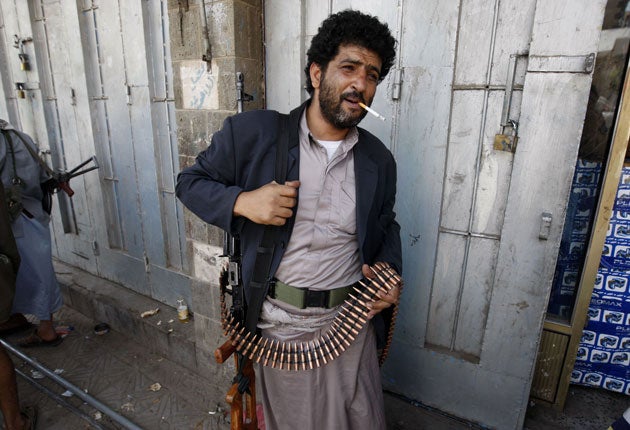
Pressure is building on Saudi Arabia to quickly conclude a power transfer deal for Yemen amid reports that the convalescing Yemeni president, who fled the country after an attack at the weekend, could try to come back.
President Ali Abdullah Saleh, who has ruled the impoverished Arab state for nearly 33 years, is recovering in Saudi Arabia after an attack on his presidential compound in the capital, Sana'a, wounded him in the neck and killed 11 of his bodyguards.
Yemenis have celebrated the President's abrupt departure, interpreting it as a sign that he will not return. But his exit has left a deep power vacuum that some analysts fear could ignite a broader conflict that could lead to civil war.
The violence has not halted since Mr Saleh's departure. Yesterday evening, armed men killed seven soldiers and wounded 12 others in clashes in the southern Yemeni city of Zinjibar, a local official and witnesses said. An army force had tried to storm the town of 20,000, capital of the flashpoint Abyan province.
Opposition leaders have moved swiftly to prevent Mr Saleh's return, throwing their support behind Abdel Rabbo Mansour Hadi, the vice-president in his absence. They are hoping to manoeuvre Yemen into a quick political transition that they could present as a fait accompli.
But Mr Hadi was yesterday quoted as saying that the injured President, who is being treated for shrapnel wounds, "was making an excellent recovery" and would return "in the coming days". That contradicted other reports claiming the President would remain in Saudi for two weeks – a week to recover and a second for meetings.
Such a homecoming would almost certainly set off more violence, as rival tribal leaders try to get rid of him. But many analysts are doubtful that Mr Saleh will be able to engineer a comeback, predicting that Saudi Arabia will succeed in preventing it.
During his stay in Riyadh, the Yemeni President will be pressed by the Saudi government to agree to a deal to concede power, on the proviso that he will have immunity from any prosecution and keep his assets.
But he has already reneged three times on promises to sign the deal, which would bring about presidential elections within two months.
Western leaders are believed to have backed the immunity deal, eager for Yemen to resolve its crisis and get back to rooting out a small but ambitious offshoot of al-Qa'ida, which has entrenched itself in Yemen's lawless provinces.
"This is a tremendous opportunity [for Saudi Arabia] to move forward fairly quickly," said April Alley, a Yemen expert at the International Crisis Group.
Washington was also apparently keen for Yemen to move ahead with a democratic transition in Mr Saleh's absence.
"We think an immediate transition is in the best interests of the Yemeni people," said Hillary Clinton, the US Secretary of State, when asked if Mr Saleh should remain abroad.
Mr Saleh has faced much opposition to his rule since a peaceful uprising in January. Initially, opposition leaders joined the movement, with influential tribes opposed to Mr Saleh later backing them. But in the past two weeks, the Hashid tribal federation, one of Yemen's most influential tribes, became the most immediate threat to Mr Saleh's rule, battling with regime loyalists in Sana'a.
As part of the talks that brought Mr Saleh to Saudi Arabia at the weekend, Riyadh brokered a ceasefire between the Hashid, which is led by Sadiq al-Ahmar, and the government. But yesterday this appeared to be unravelling after violence left six dead. In the northern Sana'a neighbourhood of Hassaba, pro-Saleh forces attacked tribesmen, killing three of them.
Loyalists also opened fire on a checkpoint manned by a military unit that had defected, losing two of their own men and killing one of the defected soldiers.
Mr Saleh's son and several nephews, who command elite military and intelligence units, have remained in Yemen, prompting fears that they will escalate the situation in the President's absence. Lined up against the Saleh family are a powerful group of armed enemies, which include Ali Muhsin, a popular general who defected from the regime two months ago along with his personal brigade.
Although Western states are investing a lot of expectations in the vice-president, Mr Hadi, to bring about reconciliation, within Yemen he is regarded by many as being weak and lacking the power base to consolidate meaningful change.
Join our commenting forum
Join thought-provoking conversations, follow other Independent readers and see their replies
Comments
Bookmark popover
Removed from bookmarks