America's real special relationship
President Obama has caused a stir by saying that the US has 'no stronger ally' than France. John Lichfield asks: why all the fuss?
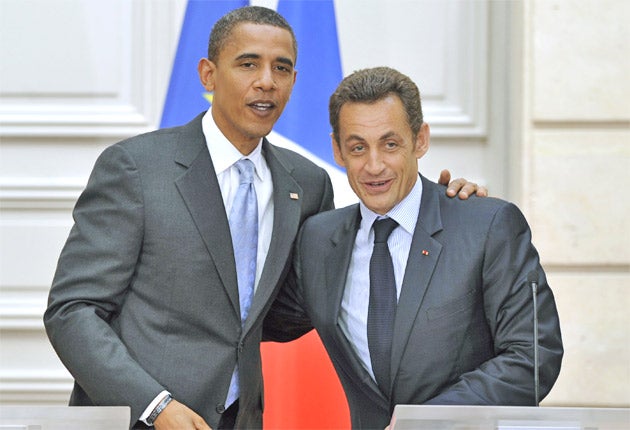
Marie-Joseph Paul Yves Roch Gilbert du Motier will be spinning contentedly in his grave. President Barack Obama, according to a wilfully dyslexic section of the British press, has declared that "France is America's greatest ally". Cue a great outpouring of French-bashing, Obama-bashing, wounded British pride and irate quotes from Conservative politicians you have never heard of.
"To suggest that Paris and not London is Washington's strongest partner is simply ludicrous," said Dr Nile Gardiner, director of the US-based Margaret Thatcher Center for Freedom. "Such a remark is not only factually wrong but insulting to Britain."
Actually, President Obama said no such thing. In welcoming the French President to a building that was once burned by the British, Mr Obama said: "We don't have a stronger friend and stronger ally than Nicolas Sarkozy, and the French people."
Please read that again carefully. Mr Obama said of France: "We don't have a stronger friend." He did not say: "France is our strongest friend."
In other words, President Obama merely put France into the Premier League – or rather the National Basketball Association – of America's friends. You the French, he said, are part of an "A-list" of America's pals, alongside – but not necessarily ahead of – Canada, Japan, Germany, Belgium, Luxembourg and Britain. In truth this is just the kind of boilerplate language that US presidents deploy for all visitors to the White House (a building which still shows the scars of the British military arsonists of 199 years ago).
Significantly, the French press did not gleefully quote, or misquote, the offending phrase yesterday. They did report that Mr Obama had called France an "exceptional partner". Over-sensitive British souls please note. He said: "An exceptional partner." He did not say: "France is our only exceptional partner, so screw you, you lachrymose limeys."
Why, then, such excitement? Why is Marie-Joseph Paul Yves Roch Gilbert du Motier spinning contentedly in his grave?
The excitement is based, partly, on an obsessive view in the British media that there is, or should be, an exclusive "special relationship" between the US and the UK.
The US does have a special relationship with Britain, based on sharing language, sharing spying, sharing nuclear-weapon technology, and sharing Simon Cowell. But the US also has special relationships with lots of countries.
The excitement in the British press is also based on ignorance of history, including wilful ignorance of the history of the past couple of years. Of all America's many special relationships, its oldest, and frequently its most troubled, has been with France.
This is where Marie-Joseph Paul Yves Roch Gilbert du Motier comes in. As the Marquis de Lafayette, commanding French troops, and supplying large amounts of Louis d'Or (French gold coins) which Paris could not afford, he helped in the 1770s to turn the American War of Independence from a brief revolt into a colonial victory. George Washington was the father of America: Lafayette was its midwife.
The relationship between the French and American revolutions is as tangled as two pairs of Christmas tree lights. The rationalising French philosophers of the 17th and 18th centuries laid the intellectual ground for the Declaration of Independence and the American Constitution. The American revolution, by bankrupting the French royalty and giving big ideas to the French middle classes, led directly to the French Revolution.
Two hundred years on, the two countries are very different but also very similar. Both are large, emptyish countries founded on abstract propositions. One has 265 kinds of cheese, all different. The other has 265 different kinds of peanut butter, all the same but with different labels.
France and the US have never fought one another. The history of their relationship is a sisterly one: a story of tiffs, betrayals, jealousies, misunderstandings and over-generous gifts. The biggest gift of all was the Statue of Liberty, presented by France to the US in 1886. Many famous Americans can trace French ancestry, including Walt Disney, Davy Crockett and John Kerry.
In 1812, when Britain fought the Americans once again, France came to Washington's aid. This time there were no real winners but there was one big loser: the American Indians.
In 1914, when France was invaded by Germany, the US did nothing much for a couple of years. Eventually, American troops did arrive to fight and die in large numbers in the final battles of 1918.
In 1940, when France was invaded by Germany, the US did nothing much for a couple of years. The US was attacked by Japan in the Pacific; Germany declared war on the US; and the US, with British and Canadian help, invaded France. The French were very grateful, all except their leader General Charles de Gaulle.
He feared, partly accurately, that the US wanted to treat France as a foolish, fallen country. The Americans also distrusted de Gaulle and tried to remove him as leader of the Free French (and even, according to one account, to assassinate him).
After the war, France joined the American-led North Atlantic Alliance. However, when de Gaulle returned to power in 1958, he still did not like the idea of being pushed around by the Americans. He took France out of the military wing of Nato, and booted the Nato headquarters out of Paris, in 1966.
Things then became messy and complicated for a while. President Jacques Chirac, despite serving time as a Howard Johnson soda jerk in Boston as a young man, became the most hated man in America in 2003.
He refused to join the Iraq war on America's side. He even tried to organise other countries in the world to oppose the idea at the United Nations. For this, the French were labelled (by Homer Simpson originally) a nation of "cheese-eating surrender monkeys".
French fries were renamed "Freedom fries". The Iraq war went ahead regardless. Many Americans now know that Jacques Chirac was right but they still have not forgiven him.
In 2007, he was replaced by a little man who had never been a soda jerk in Boston, who had hardly visited America, but who insisted (to annoy Jacques Chirac) that the US had been right all along.
President Nicolas Sarkozy then did several things to please the Americans. He took France back into the military wing of Nato; he married a beautiful pop singer. He also got on very well with George W Bush. But until this week, he got on very badly with President Barack Obama.
With the world economy still teetering, the two men are obliged, nonetheless, to get on. Mr Sarkozy is currently president of the G20 group of the world's largest economies. By saying that he was one of America's strongest allies, Mr Obama was flattering Mr Sarkozy but also stating the truth. Kind of.
Mr Sarkozy wants the US to help Europe to sort out the global economic mess by imposing some discipline on currencies and markets. Mr Obama would probably like to help but doesn't want to be called a Communist by a right-wing Congress. He flattered Mr Sarkozy this week but agreed to nothing very much.
As both French and Americans like to say: "Plus ça change, plus c'est la même chose."
Join our commenting forum
Join thought-provoking conversations, follow other Independent readers and see their replies
Comments
Bookmark popover
Removed from bookmarks