Bin Laden's terror files
What secrets will America find on terror chief's hard drive?
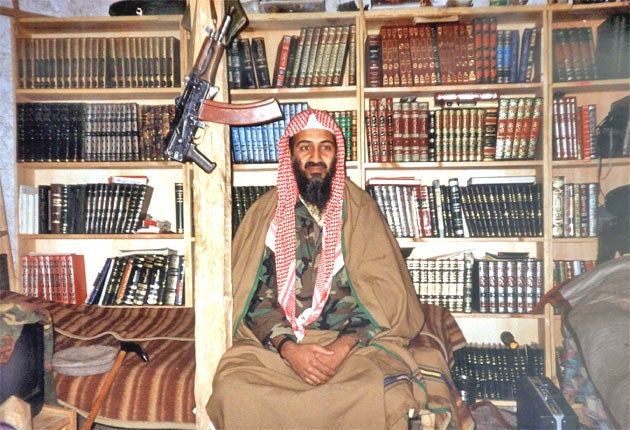
Hundreds of US analysts at a secret location in Afghanistan were last night poring over vast quantities of data gleaned from the operation to kill Osama bin Laden, searching for information that would lead them to other high-value al-Qa'ida targets. But as officials in Washington gleefully described a "motherlode" of intelligence to act upon, the prospect of further such operations looked set to destabilise relations with Pakistan, which warned that it would not tolerate any repeat of Monday morning's stunning raid.
Breaking a lengthy silence, the Pakistani government denounced the US raid on Bin Laden's hiding place, which culminated in the terrorist leader being shot in the chest and above his left eye, as a "unilateral" act that "violated" the country's sovereignty. It welcomed Bin Laden's death as "an important milestone in [the] fight against terrorism", but added that it has "deep concerns and reservations" about the manner in which the raid was carried out.
The statement, which was drafted after consultations with the ISI, added that "such actions undermine co-operation and may also sometimes constitute [a] threat to international peace and security". It came as CIA director Leon Panetta added further fuel to the fire by explaining that Islamabad had not been informed because "it was decided that any effort to work with the Pakistanis could jeopardise the mission" because "they might alert the targets".
Officials in Washington said that the intelligence gathered at Bin Laden's compound consisted of 10 hard drives, five computers and more than 100 portable storage devices. "They cleaned it out," one official told the US news website Politico, adding that analysts judged they had hit "the motherlode of intelligence" when it comes to al-Qa'ida. "Can you imagine what's on Osama bin Laden's hard drive?" The official said that the information would "be great even if only 10 per cent of it is actionable."
The US was facing pressure to release photographs of Bin Laden's body to help quell conspiracy theories about his death. Last night, the director of the CIA, Leon Panetta, said in an interview with NBC News that he did not believe there was "any question that ultimately a photograph would be presented to the public". The White House, however, reiterated that no decision had yet been made.
White House press secretary Jay Carney was also questioned last night over the manner in which Bin Laden was killed. Despite claims that he had been armed, Mr Carney and others have now admitted that he was not carrying a weapon when he was shot.
More pressing concerns behind the scenes concern the intelligence haul, which is emboldening the US to plan what is likely to be an unprecedented assault on the organisation that Bin Laden founded and led for so many years. John Brennan, the top anti-terror adviser to President Barack Obama, said that the US was determined "to pummel the rest of al-Qa'ida", suggesting that the network had now suffered a series of "severe body blows". Mr Brennan said that the US would "get to the bottom" of whether the Pakistani government helped Bin Laden stay hidden.
Leah Farrell, Barack Obama's counter-terrorism adviser, told the BBC that "there's a very real possibility that in the coming days and weeks quite a number of senior figures may well be taken out by drone strikes and/or captured".
On Capitol Hill, the shock of learning that Bin Laden had been hiding in a town so close to Islamabad was turning to barely disguised disgust with Pakistan. Some congressional leaders openly suggested that the almost $1.3bn in US aid given to Pakistan annually should be withdrawn if it is proven that anyone in its leadership knew where Bin Laden was.
The Pakistani statement had been seen as an attempt to distance itself from the widespread impression that the terrorist leader was hiding in the country with the knowledge of its powerful military establishment. It was motivated by a fear that the raid could set a dangerous precedent. The US has long expressed frustrations at its inability to deploy ground troops.
By mounting the raid unilaterally, the US was not just saying that it did not trust Pakistan, but was also sending a message, a senior Pakistani official told The Independent. "[It was] meant to teach a lesson," the official said. If Pakistan does not revise its willingness to help Washington with its aims in the region, there could be further such attempts.
Pakistan strenuously denies having knowledge of Bin Laden's presence in Abbottabad. Military and intelligence officials say that they had raided that same compound back in 2003, when pursuing another high-profile al-Qa'ida member, Faraj Al-Libi.
Mr Brennan said the US suspected Bin Laden had been based there for six years – although US forces themselves apparently missed his presence when stationed within a few hundred yards of the compound in 2008, a leaked diplomatic cable obtained by WikiLeaks revealed yesterday.
In Abbottabad yesterday, The Independent visited a house belonging to a major in the Pakistani army's medical corps, within 100 yards of the Bin Laden compound.
Join our commenting forum
Join thought-provoking conversations, follow other Independent readers and see their replies
Comments
Bookmark popover
Removed from bookmarks