Britain and France may share nuclear deterrent
Joint submarine patrols were rejected by Brown before the election, but they are now seen as an answer to defence cuts
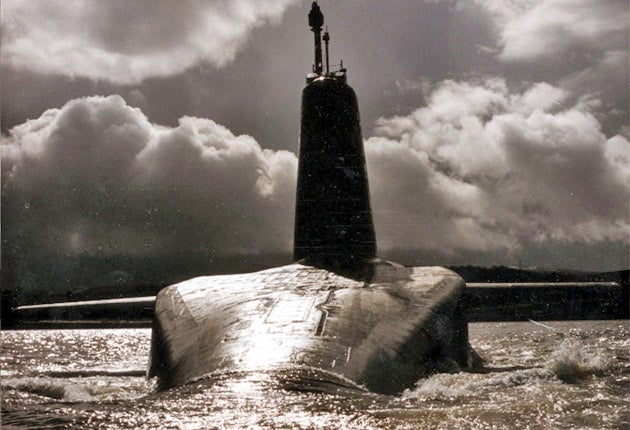
The possibility of a "shared" UK-French nuclear deterrent is set to be on the agenda of a summit between David Cameron and Nicolas Sarkozy in London this autumn.
A politically explosive proposal for joint Franco-British nuclear-submarine patrols – an idea sunk without trace in the recent past – has been brought back to the surface by the draconian defence cuts in both countries.
Although talks are still at a preliminary stage, officials in Paris say that the idea is one possibility for cost-saving military co-operation which is likely to be discussed by the Prime Minister and the President at the annual Franco-British summit in London in early November.
A senior British defence official acknowledged last night that the possibility of sharing nuclear deterrence capability with the French remains on the table, adding that a "number of options are being studied".
The official, who has advised the Government on nuclear policy, pointed out that although the Defence Secretary, Liam Fox, has vowed the UK will keep its independent nuclear deterrent, the £20bn cost of replacing Trident meant that "one had to adjust one's sights".
The insistence of Chancellor George Osborne that the money would have to come from the defence budget rather than the Treasury has made looking at cheaper options even more imperative.
The idea of joint submarine patrols has been discussed before – most recently in March – when it was floated by President Sarkozy but rejected by Gordon Brown. The change of government in the UK, and the sheer scale of the threatened defence cuts, have revived the discussions but French and British officials warn that technical and political obstacles have not yet been overcome.
The proposition is simple – if politically fraught. France and Britain each have four nuclear-armed submarines. Each has at least one submarine permanently on patrol, ready to respond to a nuclear attack on its home country. If the two countries pooled their fleets, there could be occasions when only one submarine – either British or French – would be stationed at the bottom of the ocean ready to retaliate against an attack on either country.
This would reduce the number of submarines that each country has to maintain in order to preserve a "credible" nuclear deterrent. It would also help to solve a huge political problem for the Coalition Government by reducing the cost of replacing the existing Trident submarines some time after 2015.
Sharing with the French is still "just a discussion point" but could help to address that problem, the defence official said.
The idea is believed to have been discussed by Mr Brown and Mr Sarkozy in March this year and ultimately sunk by Mr Brown as politically unfeasible in an election year. Similar discussions on Anglo-French nuclear co-operation are believed to have occurred in the past, going back to the Edward Heath government in the early 1970s.
Officials in Paris say that new impetus has been given to the idea by the huge budget deficits, and swingeing defence spending cuts, faced by both nations. Other ideas for military "pooling" said to be under discussion before the Franco-British summit include a revised version of a recently rejected proposal for a "shared" use of aircraft carriers and a joint programme for building a new generation of frigates.
Discussions in the past have been hampered by mutual suspicion and fear of negative domestic political and media reactions. The French did not like America's control over the supposedly independent UK nuclear deterrent. Britain suspected France of wanting to create a European defence policy to undermine Nato. These doubts have now been eased, on both sides of the Channel (and the Atlantic), by President Sarkozy's decision to return France to the joint military command of the Atlantic alliance. Politically, however, it is accepted that the idea might still be difficult to swallow in both countries.
Could France be relied upon to retaliate against an attack on the UK, if that might then mean nuclear retaliation against France? And vice versa.
Officials draw attention, however, to an interesting but little-reported comment by President Sarkozy in a speech in Cherbourg in March 2008, just after talks with Mr Brown. "Together with the United Kingdom," he said, "we have taken a major decision: it is our assessment that there can be no situation in which the vital interests of either of our two nations could be threatened without the vital interests of the other also being threatened."
The possibility of Franco-British nuclear co-operation has been a buzz subject for several weeks in defence think-tanks in both countries. Experts accept that (even though it is more than 200 years since France and Britain fought each other) the old suspicions and rivalries remain.
But they also point out that, in practical terms, a nuclear attack on Britain by a foreign aggressor would also be an attack on France (and vice versa). If British cities were devastated by a nuclear attack, most of northern France would be rendered uninhabitable.
Like Britain's four-string Trident submarine fleet based in western Scotland, France's nuclear deterrent or Force de Frappe consists of four submarines, each armed with 16 missiles. The fleet, currently reduced to three with a new submarine under construction, is based at L'Ile Longue, opposite the port of Brest in Brittany.
* Labour is set to fight the next general election on a pledge to halt the proposed £20bn Trident upgrade. Ed Miliband said yesterday that he wanted Britain to retain an independent nuclear deterrent but questioned the need for the like-for-like replacement supported by the Conservative Party.
Join our commenting forum
Join thought-provoking conversations, follow other Independent readers and see their replies
Comments