Financial crisis 'caused by white men with blue eyes'
With Brown at his side, Brazilian leader apportions blame for global recession
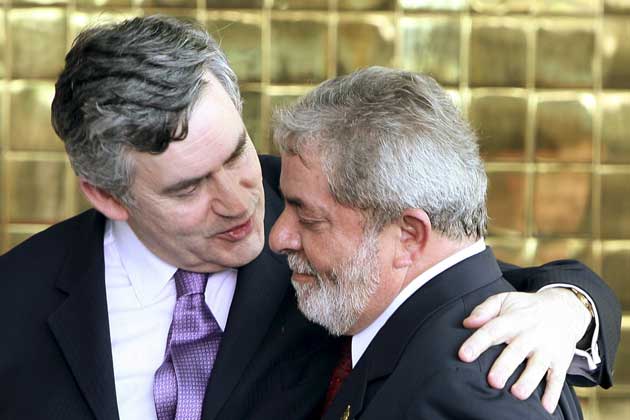
A British minister warned leaders of the world's biggest economies yesterday that they must produce more than empty rhetoric at the crucial G20 summit in London next week.
Lord Malloch-Brown, the plain-speaking Foreign Office minister who is playing a key role in the negotiations ahead of the meeting, said: "We can't again engage in meaningless, empty commitments which don't survive the flight home." Leaders risked fuelling public dissent if they did not agree on action to tackle the recession, with dire consequences for the poorest nations.
But he said Thursday's summit may not have an immediate impact. "The global economy is going to go on descending on 3 April, the massive destruction of wealth that is going on is not going to be stopped by any leaders' communique. Stock markets may be arrested and turned around but we are in for a very tough 2009 under any circumstances – including a successful G20 summit."
In Brazil, Gordon Brown continued his pre-summit tour but there was embarrassment when his host, President Luiz Inacio Lula Da Silva, said the financial crisis was caused by "white people with blue eyes". He told a joint press conference with Mr Brown that he had never met a black banker.
"This is a crisis that was caused by people, white with blue eyes. And before the crisis they looked as if they knew everything about economics," he said. "Once again the great part of the poor in the world that were still not yet [getting] their share of development that was caused by globalisation, they were the first ones to suffer.
"Since I am not acquainted with any black bankers, I can only say that this part of humanity that is the major victim of the world crisis, these people should pay for the crisis? I cannot accept that. If the G20 becomes a meeting just to set another meeting, we'll be discredited and the crisis can deepen."
Downing Street sources suggested the controversial remarks were meant for "domestic consumption".
Mr Brown called on G20 leaders to set up a $100bn (£69bn) fund to revive trade and said that levels of trade credit, which exporters and importers use to settle accounts, must be increased. He said worldwide trade was set to fall for the first time in 30 years: "Literally thousands of businesses who want to trade around the world are being prevented from doing so by the absence of trade credit available to them."
Today Mr Brown will attend a conference of centre-left parties in Chile on the last leg of his tour. James Purnell, the Work and Pensions Secretary, will tell the meeting: "Over the last decade the British government has done more redistribution than any other developed nation. It [the crisis] means... we can't create equality in the old way.
"While we will always have a moral duty to tackle poverty as we find it we can't simply take money from one set of people and give it to another, and call that equality. That is a palliative.
"Instead, the left needs to remember that it started off as a movement about power. We need to recognise that income inequality is just part of a wider struggle against the inequality of power. The greatest injustice is when people cannot achieve their goals because someone else with power stops them."
Spot the banker: Workers told to ditch suits
City workers have been told by their employers to wear casual clothes instead of suits next week in anticipation of violent protests across London during the G20 summit.
Financial institutions including Barclays, Credit Suisse, JPMorgan, Citi and Deloitte have emailed employees instructing them to wear plain clothes to work to avoid being targeted by demonstrators, sources told The Independent yesterday. Workers have also been told not to carry sensitive data and electronic equipment, and to consider postponing important meetings until the following week.
Demonstrators plan to stage a carnival in the Square Mile on Wednesday, featuring live music, street theatre and the hanging of banker effigies outside the Bank of England. On Thursday they will march through London's other financial centre, Canary Wharf, heading for the ExCeL Centre where the G20 summit is being held.
Police are said to be more worried about the protests in the City since Canary Wharf is covered by an extensive network of CCTV cameras.
One investment banker said yesterday: "When you tell a bunch of bankers to dress down, they wear a shirt, jumper, chinos and deck shoes. It makes us stick out more than if we we're wearing suits."
Join our commenting forum
Join thought-provoking conversations, follow other Independent readers and see their replies
Comments