IoS Investigation: The shocking truth about landmines
As casualties from landmines rise for the first time in years, campaigners say another Diana figure is needed to revive international will to tackle a terrible legacy of war
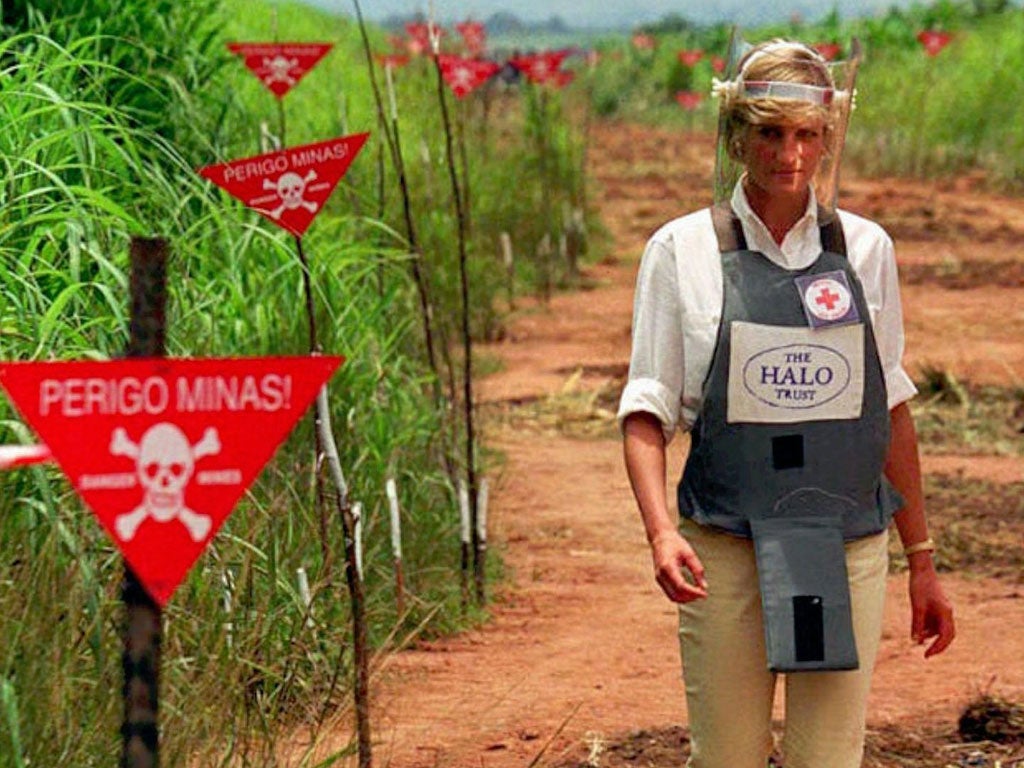
The landmine belongs to another era – or so many of us like to believe. We think of it as an evil all but consigned to history by the entreaties of Diana, Princess of Wales, and a Nobel prize-winning campaign for a ban. But after years of steady decline in the number of casualties, the numbers harmed by landmines is on the rise again.
In 2010-11 at least 4,191 people were maimed or killed by landmines, the first increase in the annual toll for seven years. Of these, at least 1,155 died of their injuries. This year is expected to be even worse.
The events of the Arab Spring have contributed to this, with Syria, Libya and Yemen all laying new mines. Last year the confirmed use of mines by state forces reached its highest level since 2004. In Libya alone, there were 184 casualties from mines or explosive remnants of war (ERW), up from just one in 2010. This year Syrian forces have been placing landmines near the borders with Lebanon and Turkey, and civilian casualties have already been reported to Human Rights Watch. There is evidence that fresh mines have also been laid in Yemen.
Even in places such as Angola, where landmines have been in the ground for decades – and whose minefields looked destined to be cleared after Diana visited in 1997 – casualties has risen, with 89 people harmed or killed by mines last year, double the number in 2010.
Two years ago the British government abandoned the funding of de-mining projects in Angola, Colombia and Somalia. Guy Willoughby, the chief executive of Halo, the charity supported by Princess Diana, said: "There is donor fatigue. Princess Diana would be dismayed to think that almost 16 years after her visit I would be standing up and saying Angola needs another 10 to 15 years' clearance, and possibly longer if there's any further donor fatigue. The clearance time is dependent on the number of de-miners you can hire."
Dignitaries from around the world will gather in New York on Friday to celebrate 20 years since campaigners formed the International Campaign to Ban Landmines (ICBL). Eighty per cent of the world – 160 countries – has now joined the Mine Ban Treaty, which won the ICBL the Nobel Peace Prize in 1997.
When the group first met in 1992, 20,000 people were being hurt or killed by landmines every year. Now the number is less than a quarter of that, but experts are concerned that governments have got complacent.
Nick Roseveare, the chief executive of the Mines Advisory Group (MAG), said: "Sadly, last year was the first year where more landmines were being laid on a dramatic scale. In the Syria conflict there's more evidence of landmines used, and in Gaddafi's Libya. More countries have been putting landmines into the ground, and that is inevitably going to lead to more casualties."
Despite the stigma created by a worldwide treaty, landmines are still mass-produced – primarily in Russia, China, Pakistan and Iran. There are still about 110 million landmines in the ground today, according to estimates – hidden killers that would cost some £18bn to remove. Mr Roseeare fears that political support to tackle the problem may be waning.
"There has to be a continued, dramatic increase in support by rich countries to solve this problem and fulfil the commitments of the treaty," he said. "But we're seeing donors disengaging from places like Angola. We regret that enormously. It's 15 years since Princess Diana walked in the minefields of Angola and there's still a huge problem."
In December campaigners and politicians will meet in Geneva for the annual meeting of parties to the Mine Ban Treaty. The news for many nations is likely to be grave, as enormous progress begins to be unpicked mine by mine.
Rosa Monckton, a friend of Princess Diana and a disabilities campaigner, said: "Diana would have been furious to see things slip back. It's a sad indictment on our society that we require a 'celebrity' to take notice of these issues."
Firoz Ali Alizada lost his legs after he triggered a landmine when taking a short cut to school in northern Afghanistan in 1996. Now a campaign manager at ICBL, he is concerned that the Arab Spring has prompted more mine use. "There are nearly 70 countries that are still threatened by landmines," he said. "Unfortunately there are a couple of cases of new users of landmines, such as the Syrian government, which is pretty bad, since the treaty has created a global norm. That's been one of the negative impacts of the Arab Spring."
David Livingstone, an associate fellow at Chatham House, believes that the nature of the uprisings of the Arab Spring rendered the political consensus against landmines irrelevant. "When you have uprisings where you don't have that proper control of your forces and well-defined battle processes, the political consensus doesn't apply in the same way. They won't think about what a properly trained battle process would be," he said.
He believes that another figurehead like Diana might help to keep up support. "I'm not trying to make [Diana] a saint, but we need to continue the awareness-raising of the impact of mines on civilian populations. That must not become yesterday's story while it is still a current issue."
Case studies...
'They took me to hospital. My leg was amputated'
Joao Dias Manuel from Moxico Province, Angola, lives with a vivid reminder that the country's landmine problem is not confined to the past
"The accident happened in 2010 when I lived in Luculo village, 18km from Luena. Someone came and stole my goats. The following day, I decided to go and cut some posts so that I could make a fence for my animals. There was an explosion. Then I saw a police vehicle. It took me to hospital where my leg was amputated."
'I heard an explosion. I ran outside, and there was blood everywhere'
Naema Masaud, 43, from Takut, Libya, lost her youngest son Zakaria, 11, to a landmine last year after it was left outside the family home by Gaddafi's troops
"We had only just come back home after sheltering in Tunisia during the war. I was inside when I heard an enormous explosion. I ran outside and Zakaria was just frozen and there was blood everywhere. His hand was blown off, and his left eye and groin were all hit. We had never seen any weapons, but there must have been a landmine we didn't see. Our eldest son fought with the rebels, and we were afraid for him, but we never expected this: the unexpected son died. We took him to Nalut hospital but there was nothing they could do, so we went with him in an ambulance to Tunisia. By the time he arrived, he had been bleeding for hours. He died the next day."
'There are still massive stockpiles of active weapons that must be destroyed'
Stuart Hughes is a diplomatic producer for BBC News
"I was working in northern Iraq in 2003, covering the war for the BBC, when I stepped out of a Jeep and immediately triggered a landmine that blew part of my right foot off. The cameraman I was working with, Kaveh Golestan, ran deeper into the minefield and was killed instantly. The landmine I stepped on may have been lying there for 20 years, or it may have been laid two weeks earlier. I'll never know. That's what's so pernicious about them. Wars come and go, and armies come and go, but communities have to live with landmines for years, or even decades afterwards.
"It's a sign of how far we've come in the last 20 years that these weapons are now stigmatised to the extent that even countries that haven't signed up to the Mine Ban Treaty often comply with it. But last year in Libya, we saw rebels planting landmines, which was a great cause for concern. Now Syria has come to the fore in the last few months. There are still massive stockpiles and, until they're destroyed, those weapons are active and can do harm.
"The biggest issue, as I see it now, is that there's limited infrastructure and resources in many mine-affected countries to help those who are still getting injured. If you step on a landmine in Cambodia or Somalia, your future can be pretty bleak. I was incredibly lucky – I was flown back to the UK and given first-class medical treatment. I was able to pick up my life again. But if I was Cambodian, I might well be begging on the streets now."
Landmine timeline
Sep 1991 Human Rights Watch calls for ban on landmines.
Oct 1992 International Campaign to Ban Landmines (ICBL) formed. It is awarded the Nobel Peace Prize in 1997.
Mar 1995 Belgium becomes first country to pass law banning manufacture, purchase and sale of landmines.
1996 Canada, Germany, Denmark, Austria and Sweden adopt ban on anti-personnel mines.
Jan 1997 Princess Diana calls for international ban on landmines.
Dec 1997 122 nations sign Mine Ban Treaty in Ottawa, Canada.
Aug 1998 Britain bans manufacture, sale and use of landmines by the military.
Dec 2001 One million mines placed along India-Pakistan border.
2010 660 sq km of land cleared, destroying over a million mines.
Mar 2012 Human Rights Watch reports Syria laying mines along borders with Lebanon and Turkey.
Oct 2012 Campaigners mark 20th anniversary of the ICBL.
Sam Creighton
Join our commenting forum
Join thought-provoking conversations, follow other Independent readers and see their replies
Comments