Iran ducks out of nuclear confrontation with West
Groundbreaking talks lead to inspection of plants and deal on processing of uranium
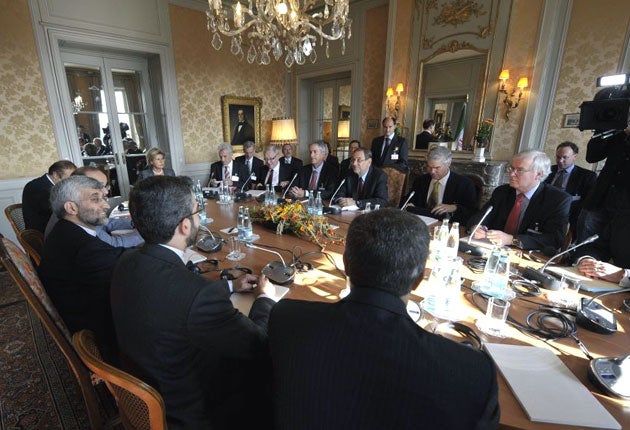
Iran appeared to pull back from confrontation with the West over its nuclear programme last night, agreeing to admit inspectors to a newly revealed nuclear plant and to surrender some of its enriched uranium to be processed abroad, a concession which could delay or at least complicate any efforts to acquire a nuclear bomb.
The Islamic Republic made no immediate commitment halt its uranium enrichment programme but, in a step that buys Tehran a reprieve from harsh UN sanctions, signalled a readiness to engage in an intensive process of discussion with the West.
The moves came during crucial talks in Switzerland between envoys from Iran and six world powers, during which the official high-level silence between America and Iran – which has lasted almost intact for 30 years – was broken decisively and substantively.
On a mandate from President Barack Obama, the US diplomat William Burns held a one-to-one meeting with Iran's chief nuclear negotiator, Sayeed Jalili, in an effort to defuse the crisis over suspicions that Iran is actively seeking to acquire nuclear weapons.
In Washington last night Mr Obama welcomed the Geneva talks as " a good start" but stressed that Iran must take "concrete steps" to meet its obligations under international law. "We've made it clear that we will do our part to engage the Iranian government on the basis of mutual interest and mutual respect but our patience is not unlimited," the President said.
Described as "a significant conversation", the encounter between the Iranian and American envoys was engineered by the Obama administration in the hope of using dialogue to draw the Iranians into negotiations aimed at persuading them to suspend uranium enrichment in exchange for incentives.
Last night, there were hopeful signs that the President's direct overture had yielded tentative results. Javier Solana, the EU foreign affairs chief, announced that Iran would admit inspectors "within weeks" to the newly revealed nuclear site near the holy city of Qom.
Crucially it was also revealed that Iran has agreed "in principle" to hand over roughly three-quarters of its stockpiles of low-enriched uranium for further enriching into fuel rods in Russia and France. The material will then be exported back to a research reactor in Tehran to meet an urgent Iranian need for isotopes for hospitals and medical applications.
If implemented, the deal will allow Iran to save face by claiming it now has access to stocks of a material it vitally needs. But having to trade in its own low-enriched uranium would be a big setback if it harboured hopes of turning this material into bomb grade uranium. Iran currently has about 1,500kg of low enriched uranium and experts believe it would require about 2,400kg to make a weapon.
The concession does not amount to a substantive change of heart by the clerical regime, but Western diplomats said the Geneva talks had opened the way to "an intensive process". They also stressed that last week's revelations of a previously undeclared nuclear site at Qom had altered the dynamics of the standoff, with Tehran now on the back foot. "The Iranians now know we mean business" said one official. Mr Solana said that Iran and the six world powers would now move into a phase of intensive dialogue with another meeting of the seven-nation grouping to take place before the end of the month.
But the opportunity to talk was presented as a last-chance option with a December deadline. If by then there is no progress towards Iran agreeing to freeze enrichment then the big powers have made it clear they will move to hit the Islamic Republic with harsh economic sanctions. The first step, officials said, will be to intensify talks, accompanied by the practical "confidence building" measures including inspections and the uranium for medicine deal.
The face-to-face talks between Messrs Burns and Jalili credited with generating an improved atmosphere, took place on the margins of a meeting between Iran and representatives of world powers (the five Security Council members, America, China, Russia, France and Britain; plus Germany and the EU). It was the first resumption of seven-nation talks in 15 months, but it was the first time the US was participating fully and all eyes were on the "bilateral" between the American and Iranian envoys.
European diplomats said the symbolic importance of the US/Iran encounter was crucial. "This was really very important" said one official. "We have to be cautious, there is a long way to go yet, but this was key in changing the atmosphere".
Technically the first encounter between Iran and the US since diplomatic relations ended in 1980 – after the Islamic revolution and the ensuing American hostage crisis – took place two years ago in Baghdad. But that was a three-way meeting to discuss Iraq organised by the Iraqis. Mr Burns was also present at a big powers meeting last year which the Iranians also attended. But under the Bush administration he was denied a mandate to engage directly with his Iranian counterpart and it was made clear the American presence was a one-off event.
This time, significantly, the US delegate had been instructed to draw the Iranians into a continuing process on a range of bilateral concerns, including the Middle East peace process and Afghanistan. The new dialogue between Tehran and Washington could ultimately lead to the restoration of diplomatic relations.
Yesterday's meetings came amid mounting alarm over Iran's nuclear ambitions. Last week the leaders of the US, France and Britain dramatically revealed the existence of a new, previously undisclosed uranium enrichment plant, hidden partly underground on a Revolutionary Guard military base in mountains near the holy city of Qom. The Western powers suspect the facility is part of a network of secret nuclear bomb-making factories. Iran claims it is merely intended to feed enriched uranium to nuclear power plants and denies any attempt at a cover-up which would be illegal under UN rules.
Mr Obama, with strong backing from the French and British, used the alarm generated by the Pittsburgh announcement to ratchet up pressure on Iran at the talks to come clean on the Qom plant, and to allow much closer scrutiny by inspectors from the UN watchdog, the International Atomic Energy Agency, of its entire nuclear programme. In exchange they offered to introduce no new sanctions and provide a range of economic incentives but only if Iran moved to suspend enrichment permanently.
But in an effort to avoid further escalation, Iran was not immediately threatened with the toughened sanctions for which Mr Obama has been trying to assemble international support.
Instead, Tehran was first pressed to enter into negotiations with a view to a year-end deal to freeze its enrichment activities.
Hillary Clinton, the US Secretary of State, last night said the Geneva talks had "opened the door" to progress. She called the talks between Iran and the big powers "productive" but said Iran still had to take concrete actions.
Half a century of mutual suspicion
1953 CIA helps orchestrate overthrow of popular Iranian PM, Mohammed Mossadegh. Shah Mohammed Reza Pahlavi is restored to power.
1972 US President Richard Nixon visits, but opposition to Shah and perceived Western imperialism mounts.
1979 After bloody clashes, the Shah flees into exile in January. The next month, exiled cleric Ayatollah Ruhollah Khomeini returns to seal victory for a revolution whose mantra was "Death to America". In November, Iranian students seize US embassy in Tehran and take 90 hostages – 52 were held captive for 444 days.
1980 Washington breaks relations with Tehran.
1986 US President Ronald Reagan admits to secret arms deals in Iran Contra scandal.
1997 Reform-minded President Mohammad Khatami sweeps to power, pledging "dialogue among civilisations".
2002 US President George W Bush brands Iran part of an "axis of evil" and accuses it of seeking nuclear weapons.
2005 Tensions worsen after the election of hardline President Mahmoud Ahmadinejad.
2008 US leads efforts to toughen UN sanctions over Iran's nuclear programme.
2009 President Barack Obama says he is prepared to extend hand of peace if Iran "unclenched its fist". Last week he revealed existence of a secret nuclear facility at Qom.
Join our commenting forum
Join thought-provoking conversations, follow other Independent readers and see their replies
Comments
Bookmark popover
Removed from bookmarks